
Lodovico in Othello
Minor character
A Venetian noble and kinsman of Brabantio who brings official news from Venice and serves as a sober, public witness.
Who is Lodovico?
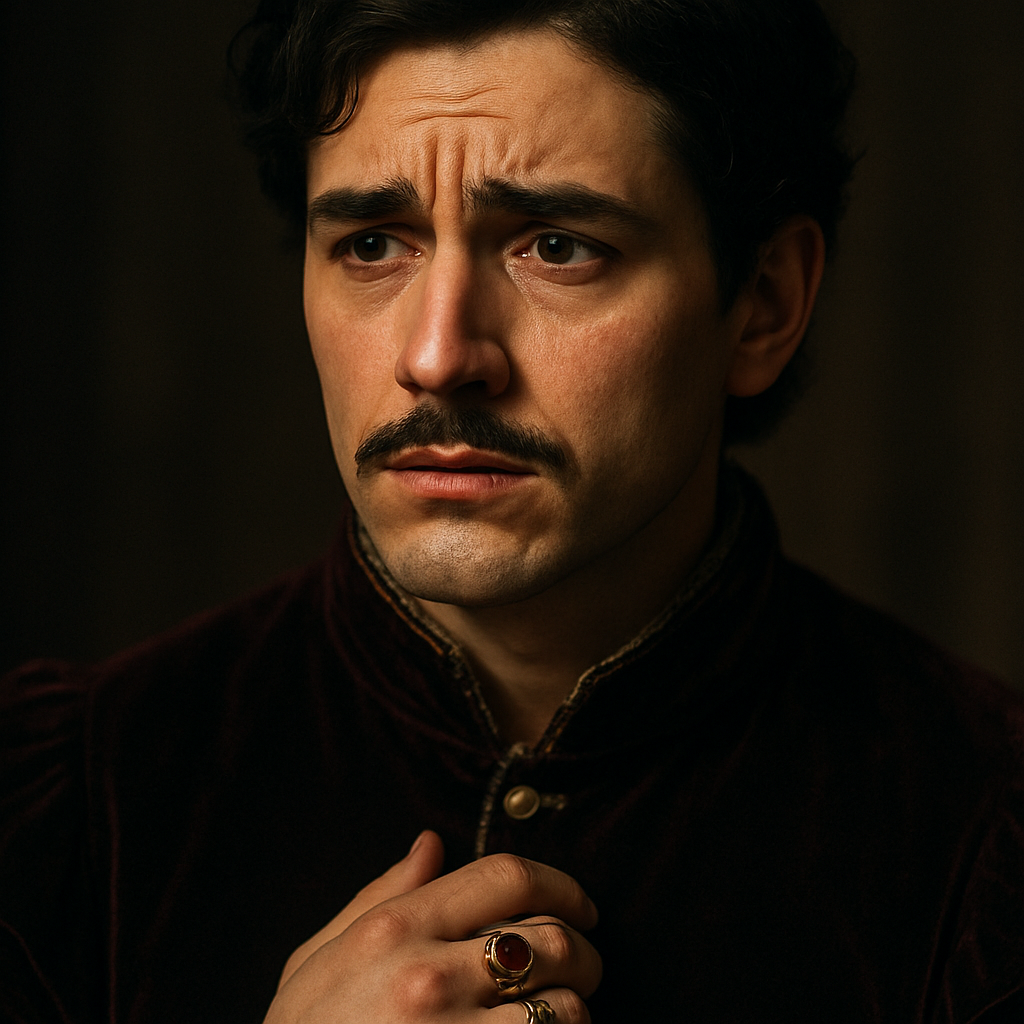
Lodovico arrives from Venice as a noble kinsman of Brabantio bearing official letters and the authority of the Duke and Senate. Because his word carries weight, his presence arrests attention in the charged military and domestic scenes at Cyprus. He reads a dispatch that summons Othello home and names Cassio as Othello’s replacement, an announcement that precipitates Othello’s violent outburst. Lodovico reacts with astonishment and disillusionment when Othello strikes Desdemona in front of him; he expresses doubt that this is the same man he once respected. He also participates politely in social moments—excusing himself from private scenes—and stands with other notable men at the crisis’s end, left to witness and record the tragic consequences. Lodovico functions as a channel for official Venice into the remote garrison and as a public measure of how far Othello’s honor and self-control have fallen.
In the book: We first meet Lodovico as a noble kinsman of Brabantio who arrives from Venice with official letters, speaking for the Duke and Senate. He matters because his word has weight—people stop to listen—and he brings the sober voice of Venice into the charged atmosphere of the garrison.
Personality
- authoritative
- He arrives bearing a letter from the Duke and Senate and reads the dispatch aloud, and everyone listens.
- dispassionate
- He reads the official news and responds with sober astonishment rather than immediate judgment when Othello behaves erratically.
- observant
- He notes and later laments the change in Othello after seeing him strike Desdemona in public.
- formal
- He politely excuses himself from Desdemona and Emilia’s private chamber, maintaining decorum.
Character arc
Lodovico enters as an official mouthpiece of Venice: calm, respected, and able to alter events by delivering orders. His reading of the senate’s dispatch—summoning Othello and promoting Cassio—should reassert Venetian order, but instead it triggers visible evidence of Othello’s collapse when Othello strikes Desdemona in front of him. That moment marks Lodovico’s shift from confident envoy to disillusioned observer; he registers disbelief and moral unease, lamenting that the Othello he knew has changed. Lodovico otherwise keeps a formal distance, excusing himself from intimate scenes, but he does not retreat; by the final act he is among the men left to judge and report what has occurred. He therefore moves from authoritative agent of the state to a witness who must reconcile official commands with the tragic failure of private virtue and command.
Relationships
- Brabantio Kinsman of Brabantio who arrives from Venice representing the same social world.
- Duke of Venice His letter carries the authority of the Duke and Senate, making Lodovico their local representative.
- Othello An admired military leader whom Lodovico summons home by reading official orders and then watches behave violently.
- Desdemona A woman whose public humiliation (being struck by Othello) Lodovico witnesses and laments.
- Iago He exchanges astonished remarks with Iago after Othello’s outburst, watching Iago’s feigned perplexity.
- Gratiano Present with Lodovico at the end, left to judge and report the tragic events.
Quotes by Lodovico
“I do beseech you, sir, trouble yourself no further.”
Act 4, Scene 3Lodovico politely excuses himself from Othello and Desdemona, signaling the formal withdrawal of the court and setting the stage for the intimate scene between Desdemona and Emilia.
Why Lodovico matters
Lodovico embodies the sober, legal voice of Venice and functions as a public gauge of what counts as honorable conduct. By bringing the senate’s orders and witnessing Othello’s public collapse, he exposes the play’s tensions between private passion and public duty. His disillusionment makes the breach between civic expectation and personal tragedy visible: if an official envoy can be shocked by a governor’s violence, the social order itself is shown to be fragile. Lodovico’s role also emphasizes the play’s concern with reputation, authority, and the consequences when the standards of the state fail to contain private cruelty.
Chapters with Lodovico
More Othello characters
 Othello
 Cassio
 Desdemona
 Iago
Iago Emilia
 Roderigo
 Bianca
 Gratiano
All chapter summaries ›Characters ›
Read Othello illustrated
Every scene in these notes comes from the Book2Life reader, where the full public-domain text is illustrated as you read, with character portraits and narration. Free in your browser and on iPhone.
