
Othello in Othello
Protagonist
A celebrated Moorish general in Venetian service, recently married to Desdemona and respected for his leadership.
Who is Othello?
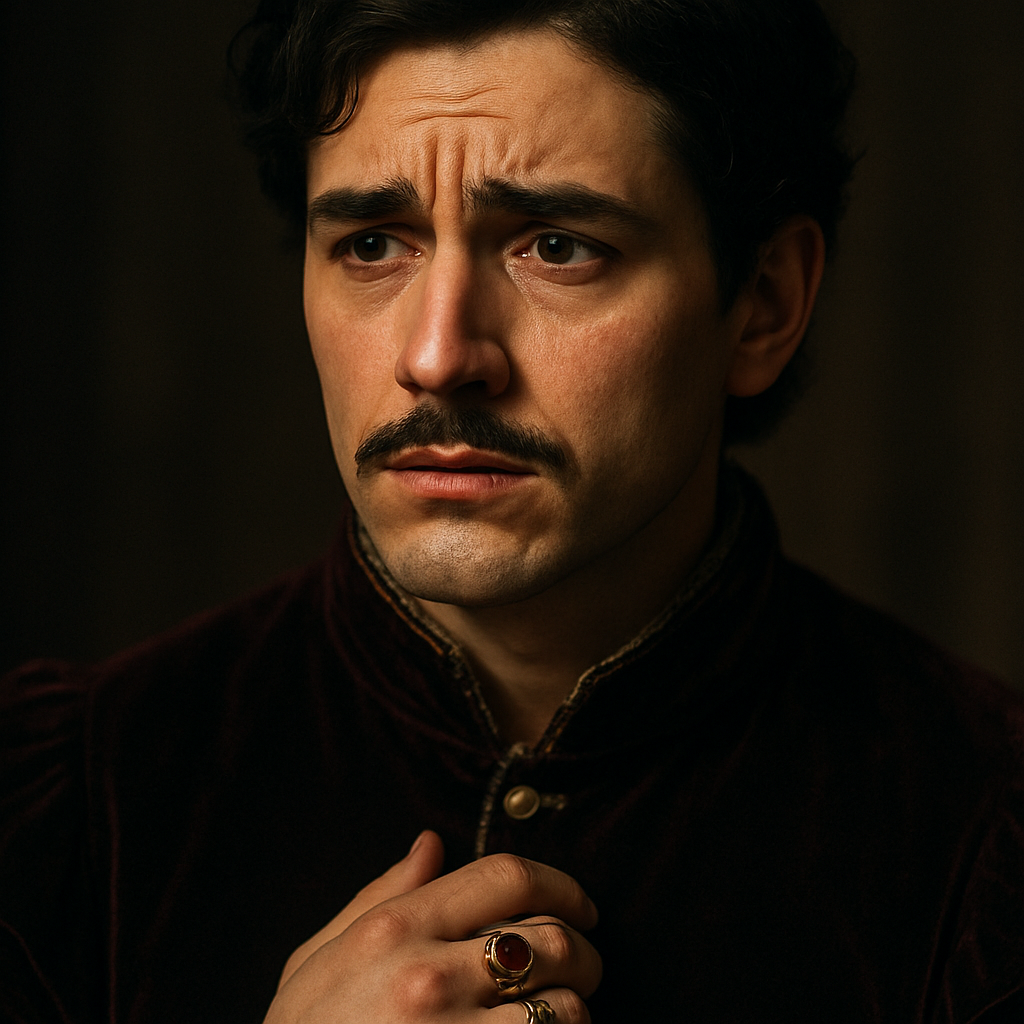
Othello is a distinguished Moor and the military commander charged with defending Cyprus. He has recently married Desdemona, whom he loves and whose testimony he stakes his honor on when accused by her father. Calm, composed, and confident in public, he commands respect in the Venetian council and on the battlefield. Once in Cyprus he displays tender affection toward Desdemona, but he also relies on the counsel of those around him. Manipulated by Iago’s insinuations and staged “evidence” — especially the lost handkerchief and staged scenes with Cassio — Othello’s trust corrodes into consuming jealousy. He strips Cassio of rank after a drunken brawl, is driven to brutal public confrontations with Desdemona, and ultimately murders her in a misguided attempt to avenge perceived dishonor. After Emilia exposes Iago’s treachery and the truth of the handkerchief is revealed, Othello realizes his irreversible mistake, wounds Iago, confesses, and takes his own life beside Desdemona.
In the book: We first meet Othello as a celebrated Moorish general in Venice, calm under pressure and confident in his hard-won reputation. He has just secretly married Desdemona and is quickly called before the Duke to answer her father’s outrage and to discuss urgent military business, which he handles with composed dignity.
Personality
- Composed
- When Brabantio accuses him in the council, Othello answers calmly and tells his story of how Desdemona came to love him.
- Honorable
- He stakes his life on Desdemona’s testimony before the Duke and accepts the Duke’s command to lead the defense of Cyprus.
- Trusting
- He repeatedly relies on Iago’s counsel and apparent honesty, making Iago his lieutenant in the plot against Cassio and Desdemona.
- Passionate
- His love for Desdemona is intense — he speaks of being lost without her — and later that passion turns into violent jealousy.
- Proud
- He reacts violently when his honor is threatened: he strikes Desdemona publicly and resolves to kill her to avenge perceived shame.
Character arc
Othello opens as a respected, composed military leader who confidently defends both his marriage and his public duty before the Duke. His early scenes emphasize dignity, mutual love with Desdemona, and an earned reputation. Once in Cyprus, small manipulations and insinuations by Iago begin to unsettle him. The removal of Cassio from command after the brawl and Iago’s engineered incidents (the missing handkerchief, Cassio’s casual talk and laughter) steadily transform suspicion into conviction. Othello’s temperament shifts from controlled sorrow to convulsive fits of jealousy; he publicly humiliates and then privately strangles Desdemona, convinced of her infidelity. Only after Emilia reveals Iago’s plot — and the handkerchief’s true path is exposed — does Othello fully grasp his error. The final stage of his arc is recognition and remorse: he wounds Iago, confesses that he was “wrought,” and kills himself beside the woman he has just murdered, completing a tragic fall from honored commander to penitent suicide.
Relationships
- Desdemona His wife; he loves her deeply but is driven by jealousy to accuse and ultimately kill her.
- Iago His ensign and trusted advisor whose apparent honesty Othello relies on; Iago manipulates him into murderous jealousy.
- Cassio His lieutenant whose drunken brawl costs him his post and whom Othello comes to suspect of an affair with Desdemona.
- Emilia Iago’s wife and Desdemona’s attendant who defends Desdemona and later exposes Iago’s treachery to Othello.
- Brabantio Desdemona’s father who accuses Othello of bewitching his daughter and confronts him in Venice.
- Lodovico A Venetian noble who brings the senate’s dispatches and witnesses Othello’s alarming change in behavior.
Quotes by Othello
“’Tis better as it is.”
Act 1, Scene 2Othello accepts Iago’s report that he restrained violence, showing calmness and reluctance to escalate the conflict.
“My services, which I have done the signiory, Shall out-tongue his complaints.”
Act 1, Scene 2Othello asserts that his public service and reputation will outweigh Brabantio’s personal accusations.
“Most potent, grave, and reverend signiors, My very noble and approv’d good masters:”
Act 1, Scene 3Othello begins his public defense, addressing the council with dignity as he admits marrying Desdemona and prepares to tell how he won her.
“If after every tempest come such calms, May the winds blow till they have waken’d death!”
Act 2, Scene 1Othello celebrates his reunion with Desdemona, expressing bliss and relief after the storm at sea.
“He that stirs next to carve for his own rage Holds his soul light; he dies upon his motion.”
Act 2, Scene 3Othello rebukes the brawlers and warns that acting on private rage carries deadly consequences, asserting his need for order.
“Give me the ocular proof, Or, by the worth of man's eternal soul, Thou hadst been better have been born a dog Than answer my wak'd wrath.”
Act 3, Scene 3Othello demands visible evidence of Desdemona's infidelity, already primed by Iago's insinuations to equate suspicion with guilt.
Why Othello matters
Othello embodies the play’s exploration of honor, trust, and the destructive power of jealousy. As a respected outsider whose private life becomes public drama, he shows how reputation and love can be weaponized by manipulation. His fall traces the human vulnerability to insinuation and the ease with which honor can be converted into vindictive violence. Through Othello’s downfall and final remorse the play interrogates racial and cultural difference, the fragility of self-knowledge, and the tragic costs when confidence in others is misplaced.
Chapters with Othello
More Othello characters
 Cassio
 Desdemona
 Iago
Iago Emilia
 Roderigo
 Lodovico
 Bianca
 Gratiano
All chapter summaries ›Characters ›
Read Othello illustrated
Every scene in these notes comes from the Book2Life reader, where the full public-domain text is illustrated as you read, with character portraits and narration. Free in your browser and on iPhone.
