Pride and Prejudice Chapter 8 Summary
Covering a screen
At dinner and afterwards at Netherfield, conversation reveals manners, social snobbery, and Elizabeth’s spirited distance as Jane’s illness keeps her in bed.
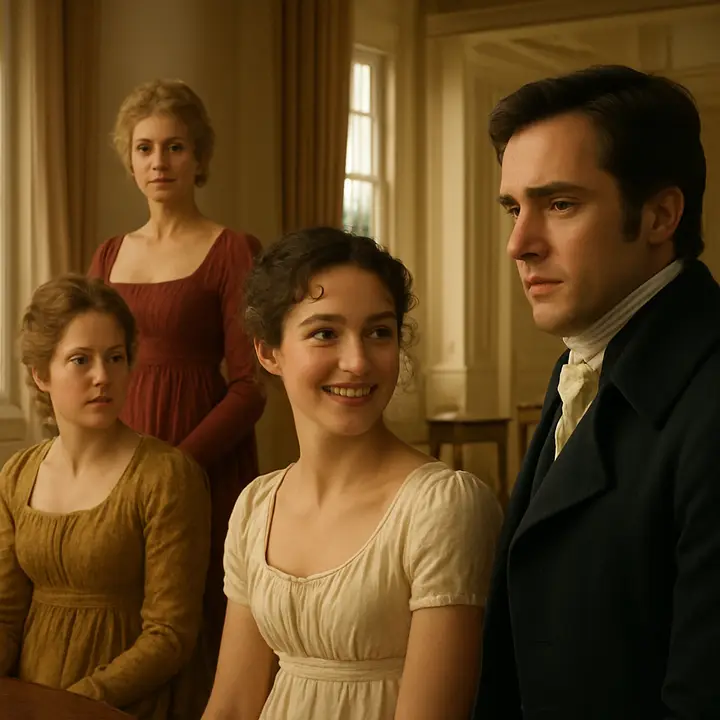
Summary
At about half-past six Elizabeth is summoned to dinner at Netherfield while Jane remains unwell in her room. Elizabeth answers the guests’ civil inquiries but cannot say Jane is any better; the Bennet sisters’ polite concern is brief and self-focused, restoring Elizabeth’s pleasure in disliking them. Mr. Bingley alone shows obvious solicitude for Jane and is attentive to Elizabeth, which comforts her amid the coolness of the others. Miss Bingley and Mrs. Hurst are absorbed with Mr. Darcy and their own judgments; Mr. Hurst is idle and uninterested. After dinner Miss Bingley immediately criticizes Elizabeth’s appearance and manners, mocking her muddy petticoat and country behavior, while Bingley defends Elizabeth’s looks and motives. The sisters then ridicule the Bennets’ social standing and connections, prompting Darcy to remark that such things diminish the chance of marrying “men of any consideration.”
Elizabeth spends the evening caring for Jane until she falls asleep and then joins the drawing-room where the others play cards. She declines to join, preferring a book; Miss Bingley ridicules her as a great reader who despises cards, and Darcy and Miss Bingley debate what an “accomplished” woman is, with Elizabeth and Bingley exchanging dryly observed remarks. The conversation moves to family libraries and Pemberley, with light teasing about purchase and taste. Elizabeth’s attention shifts from the book to the card table as she watches them; Miss Bingley and Mrs. Hurst condemn Elizabeth’s manner as a device to attract men, which Darcy calls meanness when it approaches cunning. Concern for Jane’s health returns: Bingley pushes to fetch Mr. Jones in the morning if necessary, while his sisters suggest a town physician; in the meantime they attempt to soothe themselves with music and duets, and Bingley instructs his housekeeper to take every care of Jane and Elizabeth.
Key events
- Elizabeth summoned to dinner while Jane remains ill in bed at Netherfield.
- Miss Bingley and Mrs. Hurst ridicule Elizabeth’s muddy appearance and country manners.
- Bingley defends Elizabeth and shows clear concern for Jane.
- Conversation shifts to accomplishments, books, and Pemberley; Darcy critiques the usual meaning of "accomplished."
- Elizabeth prefers reading and observing to playing cards; Miss Bingley attacks her motives.
- Plans are made to send for Mr. Jones in the morning if Jane does not improve; the Bingley sisters sing after supper.
Analysis
This chapter develops social contrast and character through conversation and small domestic incidents rather than plot action. It sharpens Elizabeth’s position as an outsider within the Netherfield drawing-room: she is observant, witty, and independent in taste (preferring books and genuine concern for her sister), while Miss Bingley and Mrs. Hurst represent polished snobbery, valuing decorum, accomplishment, and social rank. Darcy’s remarks—especially his correction of the inflated meaning of “accomplished”—both align him with discerning judgment and distance him from common praise, reinforcing his aloofness and critical nature. Bingley’s behavior establishes him as warm and sincere: his attentions to Jane and Elizabeth contrast with his sisters’ affected manners and create a moral center of kindness.
The chapter uses dialogue as the main vehicle of characterization and theme: social class and the performative nature of accomplishment are exposed through the sisters’ chatter, while Elizabeth’s responses and silence reveal her evaluation of them. Small details—Elizabeth’s muddy petticoat, the discussion of family libraries and Pemberley—serve as micro-symbols of genuine character versus social pretension. Austen’s free indirect discourse lets readers see Elizabeth’s inner reactions without overt authorial commentary, keeping narrative irony sharp and inviting readers to judge alongside her. The episode foreshadows social tensions about class, marriageability, and personal worth that will recur, and it consolidates relationships: Bingley’s sympathy, Miss Bingley’s rivalry, and Darcy’s principled reserve.
Important quotes
“She has nothing, in short, to recommend her, but being an excellent walker. I shall never forget her appearance this morning. She really looked almost wild.”
Mrs. HurstMrs. Hurst criticizes Elizabeth’s country appearance to mark Miss Bingley’s circle as superior and to mock Elizabeth’s manners.
“They all paint tables, cover screens, and net purses.”
Mr. BingleyBingley lists the commonplace accomplishments of young ladies, which sparks Darcy and Miss Bingley’s debate about what being "accomplished" truly means.
“I cannot boast of knowing more than half-a-dozen in the whole range of my acquaintance that are really accomplished.”
Mr. DarcyDarcy narrows the definition of accomplishment to deeper cultural and intellectual refinement, distancing himself from fashionable flattery.
Characters in Chapter 8
All chapter summaries ›Characters ›
Read Pride and Prejudice illustrated
Every scene in these notes comes from the Book2Life reader, where the full public-domain text is illustrated as you read, with character portraits and narration. Free in your browser and on iPhone.
