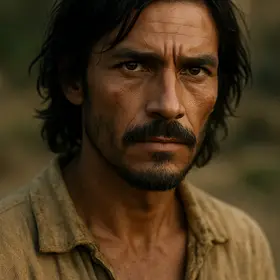
The Spaniard in Robinson Crusoe
Major character
A battered Spanish castaway rescued from cannibals who becomes a courteous, practical ally to Crusoe and a link to other Europeans.
Who is The Spaniard?
The Spaniard is a weakened European prisoner rescued by Crusoe and Friday from a cannibal party. Courteous and steady even in misery, he proves immediately useful: he shares news about other stranded Europeans, explains the desperate condition of the Spaniards and Portuguese on the nearby coast, and helps Crusoe plan practical steps for survival and rescue. He volunteers for risky tasks—traveling in a canoe to negotiate or recruit the stranded men and helping carry and tend rescued captives—and provides local knowledge that widens Crusoe’s options for escape and alliance. In gatherings about strategy he counsels restraint and prudence, supporting Crusoe’s decision to secure more provisions before attempting a mass rescue. The Spaniard thus functions as both a reliable worker in Crusoe’s fortified settlement and an informant whose testimony spurs Crusoe to plan voyages and negotiations with other Europeans.
In the book: We first meet him as a battered Spanish castaway rescued alongside Friday’s father from a raiding party on the shore. Courteous and steady even in misery, he quickly proves useful, sharing news of other European survivors and offering practical help that widens Crusoe’s lonely world.
Personality
- Courteous
- When Crusoe first finds him weakened and rescued from the cannibals, the Spaniard remains courteous and steady despite his misery.
- Practical
- He offers practical help and local knowledge about stranded Spaniards and Portuguese, which informs Crusoe’s plan to increase provisions before a rescue.
- Trusted
- Crusoe entrusts him (along with Friday’s father) to travel in a canoe to recruit or negotiate with other stranded Europeans.
- Informative
- He supplies news of seventeen white men once seen and explains the desperate lack of tools, provisions, and powder among the stranded men.
Character arc
The Spaniard appears first as one of the rescued Europeans: weak, grateful, and composed in captivity. After his rescue he moves from passive survivor to active collaborator. He consistently offers useful intelligence about other white men on the coast and counsels prudent courses of action, joining Crusoe’s community of three and then taking part in outward missions—he and Friday’s father go in a canoe to seek contact or recruit the stranded Spaniards and Portuguese. He helps tend the wounded prisoners, assists with discussions about whether to attempt a mass rescue, and accepts Crusoe’s leadership and rules. He does not undergo a dramatic personal transformation in these chapters; rather, his arc is one of recovery and functional integration: from a battered castaway needing care to a reliable agent whose information and labor expand Crusoe’s strategic options and bolster the small island society.
Relationships
- Robinson Crusoe An ally and subordinate who follows Crusoe’s authority, supplies news, and helps execute plans for rescue and provisioning.
- Friday Comrade-in-arms who fights alongside Crusoe and Friday during the rescue of prisoners and collaborates in the settlement.
- Friday's Father A fellow rescuer and canoe companion who accompanies him to negotiate with stranded Europeans.
- The Mutineers He helps contend with the threat posed by the arriving boat of mutineers by supporting Crusoe’s defensive and salvage actions.
- The Portuguese Captain Mentioned indirectly through news he provides about other Europeans (Spaniards and Portuguese) stranded on the coast.
Why The Spaniard matters
The Spaniard functions as a bridge between Crusoe’s isolated micro-society and the wider European world on the cannibal coast. His presence proves that Crusoe’s island is not a solitary anomaly but part of a larger network of shipwrecked Europeans, which opens practical possibilities for rescue and alliance. The Spaniard’s steadiness and practical information bolster themes of survival through cooperation, the social nature of civilization, and the power of information and negotiation. He also reinforces the novel’s interest in authority and governance: by accepting Crusoe’s leadership and participating in collective decisions, he modelled how strangers can be integrated into a functioning polity under shared rules.
Chapters with The Spaniard
More Robinson Crusoe characters
 Robinson CrusoeProtagonist
 FridayMajor character
 The CannibalsAntagonist
 The English CaptainMajor character
 The Portuguese CaptainMinor character
 XuryMinor character
 The MutineersAntagonist
 The WidowMinor character
All chapter summaries ›Characters ›
Read Robinson Crusoe illustrated
Every scene in these notes comes from the Book2Life reader, where the full public-domain text is illustrated as you read, with character portraits and narration. Free in your browser and on iPhone.
