
Tybalt in Romeo and Juliet
Antagonist
Juliet’s fierce, hot‑tempered Capulet cousin who aggressively defends family honor and escalates the feud with the Montagues.
Who is Tybalt?
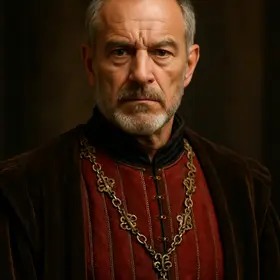
Tybalt is a proud, quick‑tempered kinsman of the Capulet household who serves as an active enforcer of family honor. From the first public skirmish he turns a servants’ quarrel into a dangerous duel, making clear his readiness to answer any slur from Montagues with violence. He recognizes Romeo at the Capulet feast and demands immediate punishment for the perceived insult of a Montague’s presence, though Capulet restrains him. His insistence on confrontation culminates in the fatal street encounter where he wounds Mercutio and then is slain by Romeo in revenge. Tybalt’s actions directly provoke the chain of punishments and reprisals—Romeo’s banishment and the rapid unraveling of Juliet’s safety and plans—so, while not central to the lovers’ private relationship, he is a catalyst whose aggression converts private love into public catastrophe.
In the book: Tybalt is Juliet’s hot-tempered cousin and one of the Capulet family’s fiercest defenders. A proud, skilled swordsman, he bristles at any perceived insult and relentlessly polices the family honor, escalating tensions with the Montagues. His confrontational nature sparks key conflicts that drive the lovers’ world toward crisis, making him a pivotal force in the play’s unfolding tragedy without being its central figure.
Personality
- Hot‑tempered
- In Act 1 Scene 1 he intervenes in a servants’ quarrel and turns it into a serious duel at the first sign of insult.
- Proud
- At the Capulet feast (Act 1 Scene 5) he angrily demands a weapon and immediate punishment when he recognizes Romeo.
- Skilled swordsman
- In Act 3 Scene 1 his fencing with Mercutio and later duel with Romeo lead directly to Mercutio’s mortal wound and subsequent violence.
- Honor‑obsessed
- He relentlessly polices perceived slights to the Capulets, repeatedly provoking and escalating public confrontations (Act 1 Scene 1; Act 1 Scene 5; Act 3 Scene 1).
- Provocative
- His taunting and readiness to fight in the public square (Act 3 Scene 1) transform a tense moment into fatal consequences.
Character arc
Tybalt remains consistent in temperament and purpose from his first appearance to his death; he does not soften or reevaluate the feud. Early scenes establish him as an immediate, militant defender of Capulet honor who responds to slights with violence. At the masked ball he insists on punishing Romeo’s presence despite Capulet’s rebuke, showing that his loyalty to family pride overrides social restraint. That same confrontational pattern reaches its climax in the public fight where his duel wounds Mercutio and provokes Romeo’s lethal retaliation. Tybalt’s death is decisive: it removes one of the play’s primary engines of public aggression but at the cost of setting in motion Romeo’s banishment, Juliet’s despair, and the accelerated plotting that leads to the lovers’ ruin. Rather than changing, Tybalt’s steadfast aggression functions as a pivot that transforms private grief into irreversible tragedy.
Tybalt in pictures



Relationships
- Juliet His kinswoman and cousin; her grief over his death immediately conflicts with her loyalty to Romeo.
- Capulet A fellow Capulet who commands household authority; Tybalt acts to defend the family’s honor, reflecting Capulet clan pride.
- Lady Capulet His aunt by family tie, who demands justice for Tybalt after his death.
- Mercutio A verbal antagonist whose exchange with Tybalt escalates into the duel that wounds Mercutio and sparks further violence.
- Romeo A Montague enemy whom Tybalt seeks to punish and who ultimately kills Tybalt in revenge for Mercutio’s death.
- Benvolio A Montague peace‑seeker who contrasts Tybalt’s eagerness for violence and later explains the fight’s sequence to authorities.
Quotes by Tybalt
“This by his voice, should be a Montague. Fetch me my rapier, boy. What, dares the slave Come hither, cover’d with an antic face, To fleer and scorn at our solemnity?”
Act 1, Scene 5Tybalt recognizes Romeo at the feast, reacts with angry hostility, and seeks to punish him for attending the Capulet gathering.
Why Tybalt matters
Tybalt embodies the social logic of honor and feud that fuels the play’s public violence. His uncompromising defense of Capulet prestige transforms personal slights into deadly consequences, showing how rigid codes of masculine honor escalate conflicts beyond private control. By provoking the chain that leads to Mercutio’s death, Romeo’s vengeance and exile, and Juliet’s ensuing desperation, he converts family enmity into the immediate cause of the lovers’ misfortunes. Tybalt thus dramatizes how inherited hostility and impulsive aggression sustain tragedy within a divided society.
Chapters with Tybalt
More Romeo and Juliet characters
 RomeoProtagonist
 JulietProtagonist
 NurseMajor character
 CapuletMajor character
 Friar LaurenceMajor character
 Lady CapuletMajor character
 ParisMajor character
 BenvolioMajor character
All chapter summaries ›Characters ›
Read Romeo and Juliet illustrated
Every scene in these notes comes from the Book2Life reader, where the full public-domain text is illustrated as you read, with character portraits and narration. Free in your browser and on iPhone.
