Romeo and Juliet Act 5, Scene 3 Summary
The Tomb and Tragedy
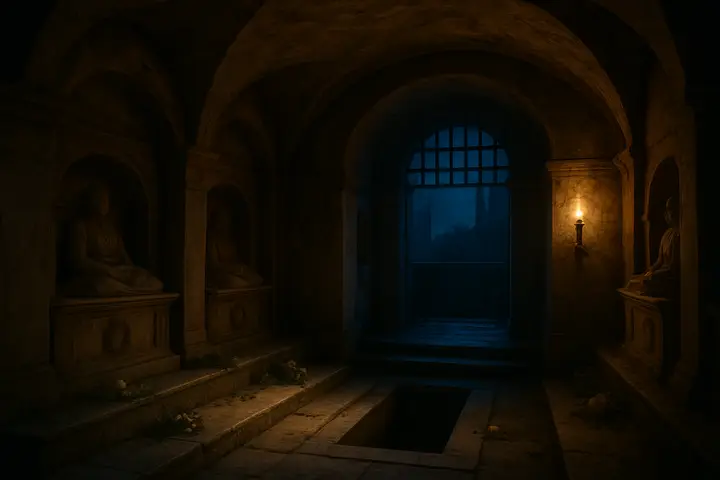
Romeo arrives at the Capulet tomb, kills Paris, takes his own life beside Juliet; Juliet awakens, kills herself; the city discovers the bodies.
Summary
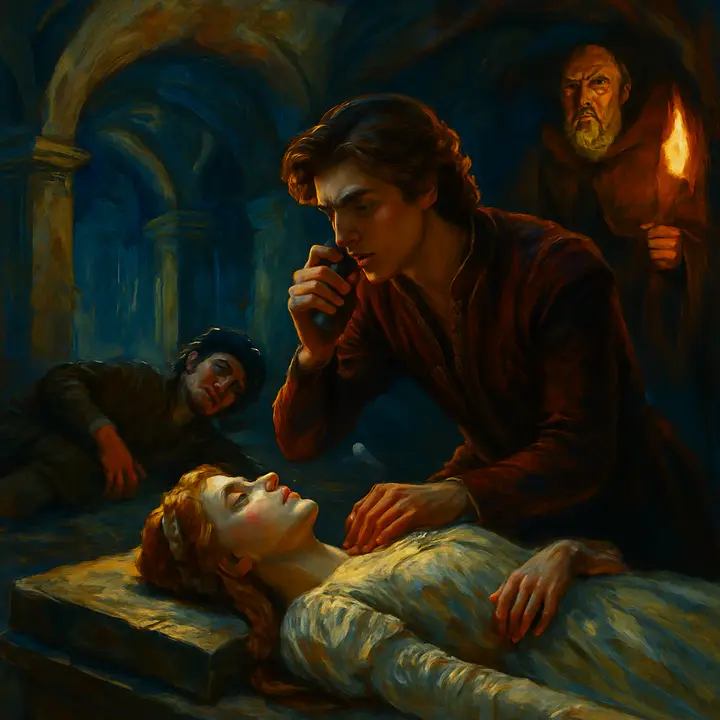
Paris arrives at the Capulet monument to strew flowers and keep vigil for Juliet, instructing his Page to hide and signal if anyone approaches. He mourns aloud and waits. Romeo and Balthasar enter with tools and a letter; Romeo forces Balthasar away and breaks open the tomb to see Juliet and reclaim a ring. Paris confronts Romeo, believing him a vandal and the murderer of a kinsman; they fight and Paris is slain. Romeo, lamenting and believing Juliet truly dead, lays Paris in the tomb and speaks to Juliet, embracing death himself after drinking poison.
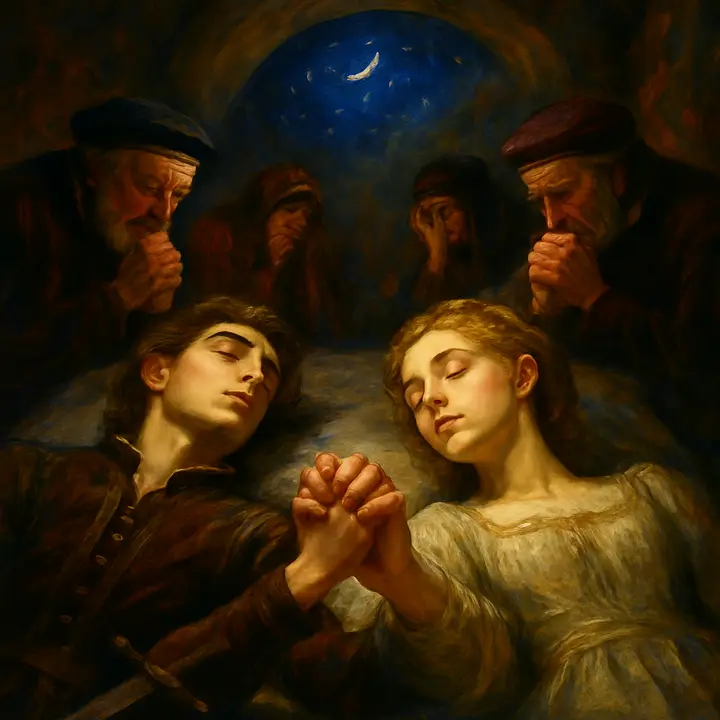
Friar Laurence arrives soon after and finds the scene bloodstained; he enters the tomb and discovers Romeo and Paris dead and Juliet revived from her potion. The Friar panics when the watch is heard approaching and tries to persuade Juliet to leave with him, but she refuses. Finding Romeo's cup and left with no other help, Juliet kisses Romeo and stabs herself. The Watch, Capulet, Lady Capulet, the Prince, Montague and others arrive, and the Friar confesses the secret marriage and the plan: he gave Juliet the sleeping potion and sent word to Romeo, but Friar John failed to deliver the letter. Balthasar and the Page give their accounts. The Prince reads Romeo’s letter describing the poison. Faced with the literal fruits of their feud, Capulet and Montague reconcile in grief, promising monuments to the dead; the Prince sums up the catastrophe and declares the tragic moral of the lovers’ fate.
Key events
- Paris keeps vigil at Juliet's tomb and hides his Page.
- Romeo arrives, sends Balthasar away, and breaks into the tomb.
- Paris confronts Romeo; they fight and Paris dies.
- Romeo mourns Juliet, drinks poison, and dies beside her.
- Friar Laurence finds the scene and Juliet wakes; she refuses to flee.
- Juliet kills herself with Romeo’s dagger.
- Officials, families, and the Prince arrive; Friar Laurence explains the secret marriage and misdelivered letter; Capulet and Montague reconcile.
Act 5, Scene 3 in pictures
Analysis
This scene functions as the play’s catastrophic dénouement, concentrating Shakespeare’s themes of fate, miscommunication, and the destructive consequences of entrenched hatred. The rapid series of reversals—Romeo’s arrival, Paris’s death, Romeo’s suicide, Juliet’s awakening and suicide—turns private passion into public tragedy. The dramatic structure uses tight, immediate action and overlapping entrances to produce inevitability: the characters narrowly miss rescuing or informing one another, and timing becomes a cruel agent of fate. Symbolically, the Capulet tomb is both literal grave and perverse bridal chamber, a place where love and death fuse; Romeo’s language treats the tomb as a “palace of dim night,” and the imagery of light and darkness repeats the play’s oppositions.
Shakespeare also uses irony and moral weight here: Friar Laurence’s plans, meant to reconcile and heal, indirectly precipitate the catastrophe through a misdelivered letter and his own tardiness. The public revelation in the final pages reframes private choices in civic terms—only the deaths force the families and the Prince to reckon with their feud. The scene’s narrative techniques—abrupt shifts in tone, juxtaposed speeches of grief, and moments of intimate soliloquy—make the ending both emotionally immediate and thematically conclusive, transforming personal tragedy into social admonition.
Important quotes
“This is that banish’d haughty Montague That murder’d my love’s cousin,—with which grief, It is supposed, the fair creature died,—”
ParisParis confronts Romeo at the tomb, thinking Romeo has come to dishonor the dead and recalling Tybalt's death as the cause of Juliet's grief.
“Thus with a kiss I die.”
RomeoRomeo finishes his farewell to Juliet and drinks the poison he bought, sealing his resolve to die beside her.
“For never was a story of more woe Than this of Juliet and her Romeo.”
Prince EscalusThe Prince closes the play, pronouncing the tragic moral after the families reconcile over the lovers’ bodies.
Characters in Act 5, Scene 3
- Paris
- Page
- Romeo
- Balthasar
- Friar Laurence
- Juliet
- First Watch
- Second Watch
- Third Watch
- Prince Escalus
- Capulet
- Lady Capulet
- Montague
- Lady Montague
- Tybalt
- Friar John
- Nurse
- Apothecary
All chapter summaries ›Characters ›
Read Romeo and Juliet illustrated
Every scene in these notes comes from the Book2Life reader, where the full public-domain text is illustrated as you read, with character portraits and narration. Free in your browser and on iPhone.
