
Dolon in The Iliad
Minor character
A Trojan volunteer spy who seeks Achilles’ horses and is captured and killed by Odysseus and Diomedes.
Who is Dolon?
Dolon is a Trojan youth, son of the wealthy Eumedes, who volunteers to sneak into the Achaean camp at night after Hector seeks an informant. Motivated by the promise of Achilles’ chariot and magnificent horses, he accepts the dangerous espionage mission. Odysseus and Diomedes, meanwhile, slip from the Achaean lines and lie in ambush. Dolon is seized among the corpses, questioned, and reveals strategic details: the dispositions of allied contingents and the presence of the Thracian king Rhesus with his extraordinary white horses. Although Dolon begs to be ransomed, Diomedes executes him. His interrogation leads Odysseus and Diomedes to Rhesus’s bivouac, where they kill Rhesus, seize the horses, and return with the spoils. Dolon’s short episode exposes the dangers of covert action, the price of misplaced ambition, and the lethal pragmatism of enemy scouts.
In the book: Dolon, a Trojan and son of the wealthy Eumedes, volunteers to act as a night scout against the Achaeans. His brief but memorable episode in Book 10 highlights the dangers of espionage, the value and risks of cunning, and the tense cat‑and‑mouse tactics that unfold beyond the formal clashes of the battlefield.
Personality
- ambitious
- He volunteers to spy after Hector’s offer, tempted by the promise of Achilles’ chariot and horses.
- naïve
- He ventures out at night believing he can penetrate the Achaean camp without detection, ignoring the risks.
- talkative
- Once captured, he freely divulges detailed intelligence about allied dispositions and Rhesus’s horses.
- fearful
- After capture he pleads for ransom, begging Odysseus and Diomedes to spare his life.
- disposable
- Despite his pleas, Diomedes executes him, showing how little value the enemy places on a captured spy.
Character arc
Dolon’s arc is brief and downward: he appears eager and hopeful, lured by the extravagant reward Hector offers, and steps forward to undertake a perilous night mission. That hope turns quickly to peril when Odysseus and Diomedes ambush and seize him among the corpses. Confronted by superior enemies, Dolon shifts from confident volunteer to frightened captive who attempts persuasion by offering information and begging for ransom. His cooperation yields significant intelligence, but it does not save him: his execution by Diomedes closes his story. There is no moral triumph or redemption; Dolon’s trajectory demonstrates how personal ambition and overconfidence lead directly to exposure, humiliation, and death. The episode leaves him static in moral terms—he does not grow wiser or repent; instead his brief initiative results in catastrophic consequences, underscoring the harsh calculus of wartime intelligence.
Relationships
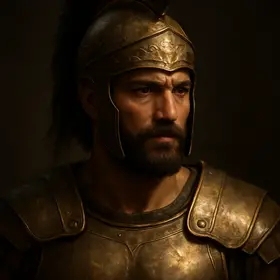
- Hector Hector solicits an informant and motivates Dolon with the promise of Achilles’ chariot and horses.
- Eumedes Eumedes is named as Dolon’s wealthy father, marking Dolon’s social background.
- Odysseus Odysseus ambushes and captures Dolon and extracts intelligence from him.
- Diomedes Diomedes co-captures Dolon, questions him, and ultimately executes him despite Dolon’s pleas.
- Rhesus Dolon provides the information that leads Odysseus and Diomedes to Rhesus’s bivouac and extraordinary horses.
Why Dolon matters
Dolon embodies the perils of espionage and the fatal intersection of ambition and naivety in wartime. His episode highlights themes of cunning versus brute force: cleverness yields useful intelligence but not mercy. The quick reversal from promise to punishment emphasizes the precarious value of individuals in war and the moral indifference of victors. Dolon’s death also propels plot action—his disclosures enable the raid on Rhesus—showing how even brief, secondary figures can have strategic impact while illustrating the poem’s larger meditation on fate, violence, and the costs of desire.
Chapters with Dolon
More The Iliad characters
 Hector
 Achilles
 Agamemnon
 Apollo
 Menelaus
 Zeus
Zeus Nestor
 Patroclus
All chapter summaries ›Characters ›
Read The Iliad illustrated
Every scene in these notes comes from the Book2Life reader, where the full public-domain text is illustrated as you read, with character portraits and narration. Free in your browser and on iPhone.
