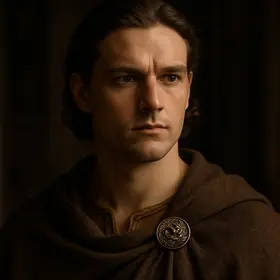
Hrothulf in Beowulf
Major character
Hrothulf is King Hrothgar’s nephew, a prominent young member of the Danish royal household tied to questions of succession and loyalty.
Who is Hrothulf?
Hrothulf appears at Heorot as a valued kinsman of King Hrothgar, present during the hall’s restoration and the great celebratory feast that follows the defeat of the monster. He occupies a visible place in the king’s retinue and is named when the court’s order, rewards, and future are being publicly arranged. Though he does not act in the narrated episodes, his presence matters: Wealhtheow invokes the need to secure the kingdom’s succession and praises likely fidelity among the king’s household, implicitly including Hrothulf as part of that circle. His status and promise within the lineage function less as plot-driving action and more as a standing pressure point, a reminder that loyalties and the distribution of honor will shape the court’s future stability. The text uses him to make the themes of kinship, obligation, and the precariousness of royal succession concrete inside the restored yet still-damaged hall.
In the book: Hrothulf is King Hrothgar’s nephew and a prominent member of the Danish royal household, valued for his promise and position within the lineage. His presence highlights questions of succession and the fragile balance of alliances around Heorot, adding depth to the poem’s exploration of kinship, loyalty, and the stability of a kingdom without disclosing the outcomes of those tensions.
Personality
- Situated heir
- He appears among Hrothgar’s kinsmen at the feast, presented as a notable member of the royal household during the hall’s restoration.
- Trusted
- Wealhtheow invokes fidelity and the duties of the lord in a speech that includes praise for the expected loyalty of figures like Hrothulf.
- Passive presence
- He is onstage as part of the retinue and bench-crowd during the banquet but performs no decisive actions in the narrated scenes.
- Symbolic
- His mention during public reward-giving highlights his role as a living sign of succession and the court’s future, rather than as an active agent.
Character arc
Hrothulf’s appearance is static in the chapter notes: he is introduced and consistently presented as a promising kinsman of the king whose place in the household is recognized and whose loyalty is assumed. In the restorative feast at Heorot he stands among Hrothgar’s retinue while honors are distributed to Beowulf; the hall’s material repairs and the king’s largesse emphasize the court’s attempt to reassert order. Later, during the continued banquet and the Finn lay’s return to the hall, Wealhtheow verbally frames concerns about succession and fidelity—naming the duties that will fall on Hrothulf’s generation—without narrating any decisive choices or conflicts involving him. Because the notes do not record any overt action or turning point for Hrothulf, his narrative movement is one of potential rather than realized change: he remains an emblem of the kingdom’s future and the fragile bonds that must hold, leaving the outcome of those pressures unspecified in the provided text.
Relationships
- Hrothgar His uncle and the reigning king; Hrothulf is a member of the king’s retinue and of the royal lineage.
- Wealhtheow The queen’s remarks about succession and fidelity implicitly address Hrothulf as part of the household whose loyalty will secure the realm.
- Hrethric One of the queen’s sons whose place at the bench highlights the immediate context of succession and who stands alongside Hrothulf in courtly order.
- Hrothmund Another of the queen’s sons whose presence in the hall further frames the succession questions that touch Hrothulf’s position.
- Scyldings Hrothulf is counted among the Scylding kinsmen; his standing reflects the internal bonds and obligations of the Danish royal clan.
- Beowulf A celebrated guest who receives Hrothgar’s gifts while Hrothulf watches; Beowulf’s reward ceremony helps define the courtly honor code that shapes Hrothulf’s world.
Why Hrothulf matters
Hrothulf functions as a symbol of succession, kinship, and the uncertain future of the kingdom. By appearing as a promising but largely passive royal youth, he focuses attention on the social machinery—gift-giving, public praise, and speech—by which a court tries to bind loyalties and secure continuity. His presence sharpens the poem’s recurring concerns with obligation, the distribution of honor, and the fragility of peace after violence: the restored hall and munificent king can celebrate now, but the mention of Hrothulf reminds readers that the long-term stability of the realm depends on how these inherited relationships hold together.
Chapters with Hrothulf
More Beowulf characters
 BeowulfProtagonist
 HrothgarMajor character
 GrendelAntagonist
 EcgtheowMinor character
 The DragonAntagonist
- HHealfdeneMinor character
 HygelacMajor character
- HHigelacMajor character
All chapter summaries ›Characters ›
Read Beowulf illustrated
Every scene in these notes comes from the Book2Life reader, where the full public-domain text is illustrated as you read, with character portraits and narration. Free in your browser and on iPhone.
