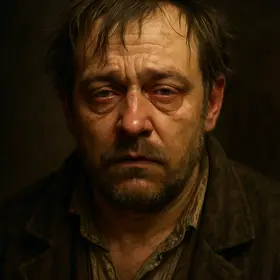
Semyon Zakharovich Marmeladov in Crime and Punishment
Minor character
A dishevelled, alcoholic ex-clerk whose confession and tragic death expose his family's shame, poverty, and moral suffering.
Who is Semyon Zakharovich Marmeladov?
Semyon Zakharovich Marmeladov is a dismissed minor civil servant whose alcoholism has ruined his household. In a crowded tavern he delivers a long, shame‑filled confession to Raskolnikov about his habitual drinking, his inability to provide, and the desperate condition of his wife and children. He repeatedly insists on his educated past and explains how poverty and humiliation drive his stepdaughter Sofya into prostitution. Marmeladov seeks pity and understanding rather than concrete solutions; he talks and confesses, hoping for moral recognition and absolution. After being run over in a carriage accident, he is taken home by Raskolnikov, briefly revives to recognize Sonia and to absolve or bless his family, and then dies in Sonia’s arms. His public funeral and the chaotic memorial dinner that follows further reveal the family’s degradation and provoke reactions from Luzhin, Lebeziatnikov, and others. Marmeladov’s presence catalyzes compassion, shame, and practical interventions from several characters, though he never escapes the cycle of self‑destruction that defines him.
In the book: Semyon Zakharovich Marmeladov is a dismissed minor civil servant whose alcoholism has plunged his family into poverty and humiliation. His confessional loquacity in taverns and at home exposes the novel’s themes of suffering, guilt, and compassion, and his relationship to his daughter Sonya and to Raskolnikov helps illuminate the moral stakes of the story without occupying its center.
Personality
- Loquacious
- He launches into a long, fluent, shame‑filled account of his life in the crowded tavern, addressing Raskolnikov at length (Chapter 2).
- Self‑destructive
- His habitual drunkenness has plunged his family into poverty and leads directly to the carriage accident that mortally wounds him (Chapter 7).
- Shame‑laden
- He speaks repeatedly of his family’s humiliation and of how his conduct forced Sofya into reproachful circumstances (Chapter 2 and Chapter 4).
- Appealing
- Even while drunk, he instinctively seeks pity and confesses to Raskolnikov, hoping for understanding rather than practical aid (Chapter 2).
- Momentarily lucid
- On his deathbed he briefly revives, recognizes Sonia, and dies in her arms after a short, clear exchange (Chapter 7).
Character arc
Marmeladov appears first as a loquacious, pitiable figure in a tavern, confessing the moral and material ruin he has brought upon his household through alcoholism. His speech exposes his longing for moral recognition and his alternating pride and self‑hatred; he narrates Katerina Ivanovna’s decline and the sacrifices forced on Sofya. That confession functions as a moral catalogue that others—especially Raskolnikov and Sonia—must confront. Marmeladov does not recover agency: his alcoholism and passivity continue, culminating in a street accident that mortally wounds him. Raskolnikov transports him home, where Marmeladov has a brief lucid moment of recognition of his daughter and then dies. His funeral and the chaotic memorial meal amplify the family’s degradation and set in motion social conflicts (Luzhin’s accusation, Lebeziatnikov’s intervention) and charity or manipulation from neighbors. Marmeladov’s personal trajectory is a decline from articulate self‑exposure to violent, dependent death; he never reforms but his end sharpens the moral stakes for others, especially Sonia and Raskolnikov.
Semyon Zakharovich Marmeladov in pictures


Relationships
- Sofya Semyonovna Marmeladova His stepdaughter, whom he recognizes on his deathbed and whose shame and sacrifice he recounts in confession.
- Katerina Ivanovna Marmeladova His wife, whose genteel past and present illness he describes, and who tends him feverishly at his deathbed.
- Rodion Romanovich Raskolnikov The listener of his tavern confession who later carries him from the street after the carriage accident and pays for his transport home.
- Andrey Semyonovich Lebezyatnikov A neighbor whose earlier confrontation and alleged beating of Katerina Ivanovna Marmeladova is recounted in Marmeladov’s confession.
- Polenka One of his children; after Marmeladov’s death she warms to Raskolnikov and promises to pray for him.
- Lida Another child in the household affected by his poverty and present at the scenes of familial suffering.
Quotes by Semyon Zakharovich Marmeladov
“May I venture, honoured sir, to engage you in polite conversation? Forasmuch as, though your exterior would not command respect, my experience admonishes me that you are a man of education and not accustomed to drinking.”
Chapter 2Marmeladov addresses Raskolnikov in the tavern, initiating the long confession that reveals his family's plight.
“I ought to be crucified, crucified on a cross, not pitied! Crucify me, oh judge, crucify me but pity me! And then I will go of myself to be crucified, for it’s not merry-making I seek but tears and tribulation!...”
Chapter 2Marmeladov, in a fever of religious and self-abasing rhetoric, demands punishment while pleading for compassion, revealing his contradictory self-view.
“It’s the fifth day since I left home, and they are looking for me there and it’s the end of my employment, and my uniform is lying in a tavern on the Egyptian bridge.”
Chapter 2Marmeladov confesses he stole his wages and abandoned his post, a turning point that precipitates the family’s immediate crisis.
Why Semyon Zakharovich Marmeladov matters
Marmeladov embodies Dostoevsky’s exploration of suffering, guilt, and compassion: his loquacious confessions make visible the social and moral costs of poverty and addiction. He is less an agent of plot than a moral mirror, forcing characters—and readers—to confront the human consequences of degradation. His death dramatizes the collapse of a once‑respectable family and precipitates actions and confrontations among other characters, particularly Sonia’s sacrificial role and Raskolnikov’s oscillation between pity and intellectual detachment. Marmeladov’s presence thus sharpens the novel’s questions about responsibility, mercy, and the possibility of spiritual redemption amid social ruin.
Chapters with Semyon Zakharovich Marmeladov
More Crime and Punishment characters
 Rodion Romanovich RaskolnikovProtagonist
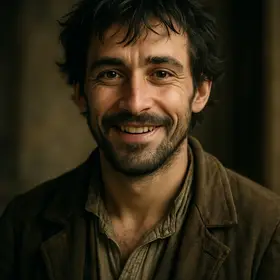 Dmitri Prokofych RazumikhinMajor character
 Avdotya Romanovna RaskolnikovaMajor character
 Sofya Semyonovna MarmeladovaMajor character
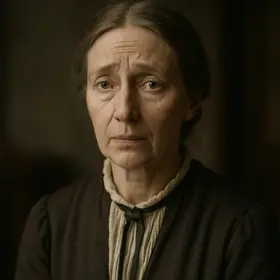 Pulcheria Alexandrovna RaskolnikovaMajor character
 Nastasya PetrovnaMinor character
 Pyotr Petrovich LuzhinAntagonist
 Katerina Ivanovna MarmeladovaMajor character
All chapter summaries ›Characters ›
Read Crime and Punishment illustrated
Every scene in these notes comes from the Book2Life reader, where the full public-domain text is illustrated as you read, with character portraits and narration. Free in your browser and on iPhone.
Read Crime and Punishment free
