Don Quixote Chapter 1 Summary
Character and Pursuits
An unnamed gentleman of La Mancha becomes obsessed with chivalric books, refashions himself and his horse, and decides to be a knight-errant.

Summary
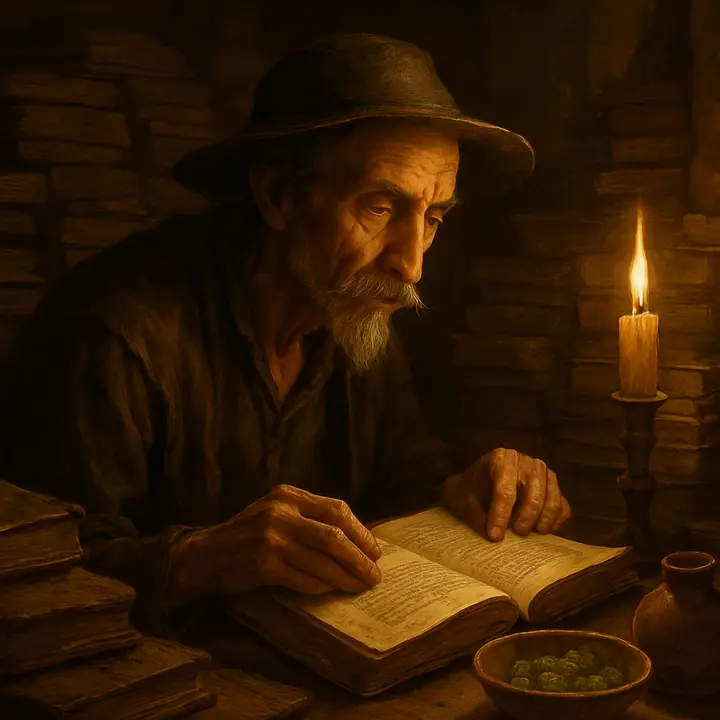
In a village of La Mancha an unnamed country gentleman, about fifty years old, lives a modest, orderly life with a housekeeper, a niece, and a servant who tends his hack. He spends his income on rustic comforts and occasional finery, but his chief occupation is reading books of chivalry day and night. The more he reads—especially works like those of Feliciano de Silva—the more he loses touch with practical life: he neglects his fields, quarrels with his parish curate and barber about the merits of famous knights, and grows convinced that the extravagant events in his books are literally true.
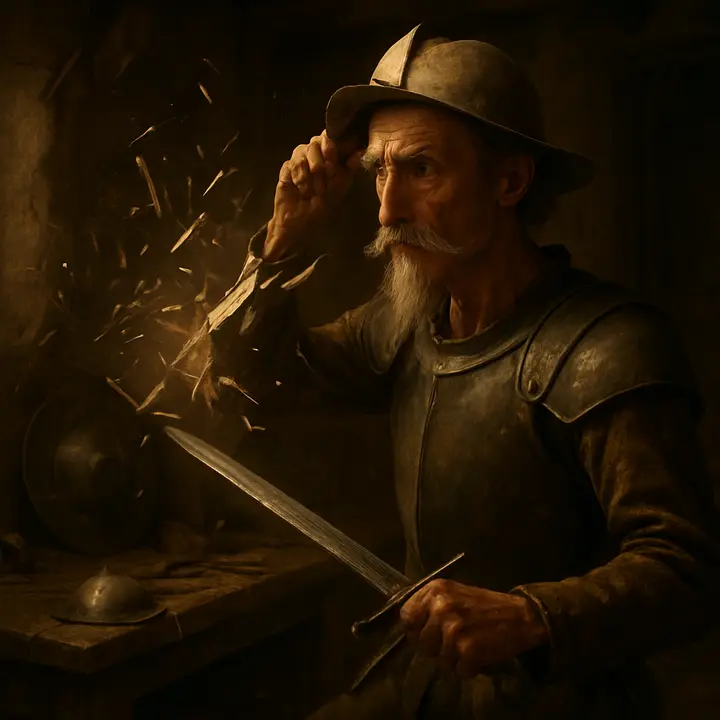
Driven mad by these romances, he resolves to become a knight-errant. He cleans and improvises his great-grandfather’s rusty armour (even rebuilding a broken pasteboard helmet with iron bars), and obsessively renames his worn horse Rocinante after long deliberation. He debates and composes an appropriate title for himself, ultimately choosing “Don Quixote,” and decides to add his home region to the name: Don Quixote of La Mancha. Finally, to complete his transformation he selects a lady to honor—Aldonza Lorenzo, a local farm-girl whom he renames Dulcinea del Toboso—thus adopting the full trappings and self-fashioning of a medieval knight despite the obvious mismatch between fantasy and his real world.
Key events
- Introduction of the unnamed gentleman and his household and habits
- Obsession with books of chivalry leads to neglect of property and sleep
- Literary disputes with the curate and the barber illustrate his absorption
- Decision to become a knight-errant and pursue adventures
- Restoration of ancestral armour and improvised helmet
- Naming of his horse Rocinante and himself Don Quixote of La Mancha
- Selection and renaming of Aldonza Lorenzo as Dulcinea del Toboso
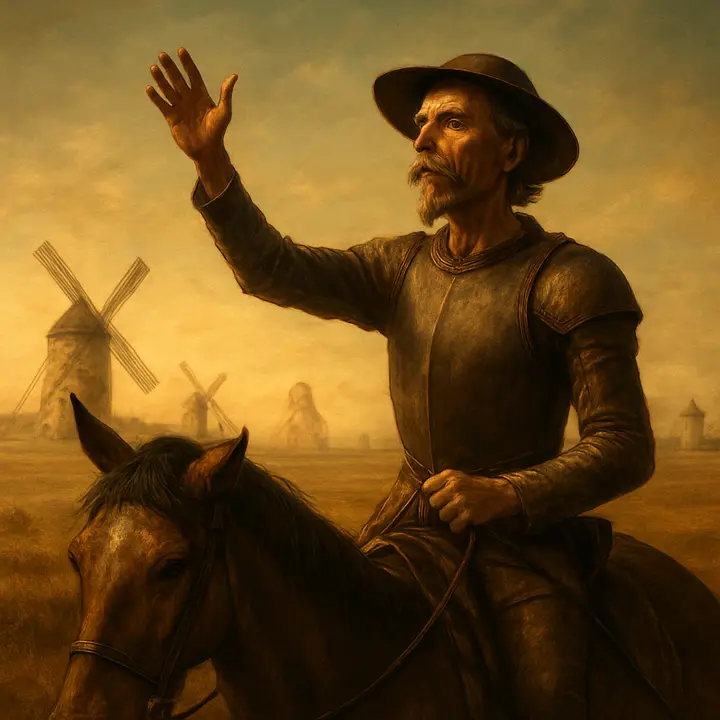
Chapter 1 in pictures


Analysis
This opening chapter establishes the novel’s central paradox: the collision between fantasy and everyday reality. By giving a meticulous portrait of the gentleman’s domestic life and then tracing the gradual, comic dissolution of his reason under the influence of chivalric romances, Cervantes frames the entire book as an exploration of imagination’s power and social consequence. The specifics—his diet, household staff, and petty expenditures—anchor the character in a believable village economy, making his later transformation both comic and poignant. The ritualized naming scenes (Rocinante, Don Quixote, Dulcinea) function as acts of self-creation; names convert ordinary objects and people into the icons of a private myth, showing how language and literature reshape identity.
Structurally, the chapter sets the narrator’s tone: ironic, deceptively plain, and attentive to small absurdities, which invites readers to laugh yet also to consider the deeper yearning behind the madness. The pastiche of learned references and the barber’s and curate’s counterarguments foreshadow a sustained interplay between learned discourse and popular belief that will recur throughout the novel. Symbolically, the battered armour and the pasteboard helmet already signal a theme of imitation versus authenticity: the gentleman’s gestures toward chivalry are earnest but patently inadequate, a source of comedy that also questions the value and limits of idealism when detached from social reality.
Important quotes
“he fancied it was right and requisite, as well for the support of his own honour as for the service of his country, that he should make a knight-errant of himself, roaming the world over in full armour and on horseback in quest of adventures, and putting in practice himself all that he had read of as being the usual practices of knights-errant;”
NarratorDeclares the mad decision that launches the main action: the gentleman resolves to become a knight-errant.
“he decided upon calling him Rocinante, a name, to his thinking, lofty, sonorous, and significant of his condition as a hack before he became what he now was, the first and foremost of all the hacks in the world.”
NarratorRecords the comical, ceremonial naming of his horse, which marks the protagonist’s self-fashioning.
“he made up his mind to call himself “Don Quixote,” whence, as has been already said, the authors of this veracious history have inferred that his name must have been beyond a doubt Quixada, and not Quesada as others would have it.”
NarratorExplains the choice of the protagonist’s knighthood name and the narrator’s playful insistence on ‘veracity.’
Characters in Chapter 1
- Don Quixote
- Rocinante
- Aldonza Lorenzo
- Dulcinea del Toboso
- The Barber
- The curate (parish curate)
All chapter summaries ›Characters ›
Read Don Quixote illustrated
Every scene in these notes comes from the Book2Life reader, where the full public-domain text is illustrated as you read, with character portraits and narration. Free in your browser and on iPhone.
