Don Quixote Chapter 69 Summary
Altisidora's mock-resurrection
Don Quixote and Sancho are brought into a theatrical court where Altisidora is mock-resuscitated after Sancho endures staged humiliations.
Summary
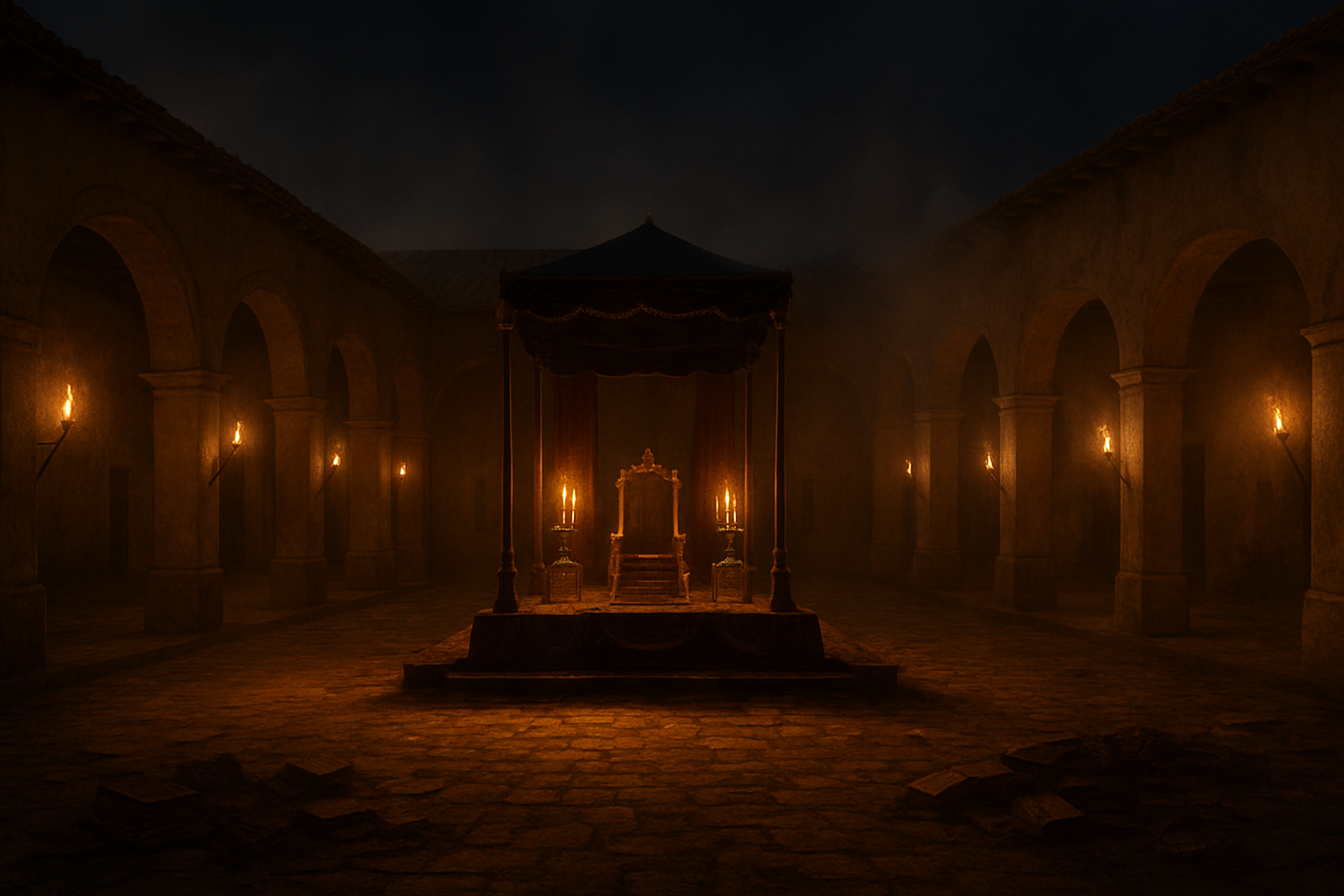
Don Quixote and Sancho are carried into a vast, torch-lit courtyard where an elaborate ceremonial scaffold holds the apparently dead Altisidora, her body crowned and laid out as for a solemn funeral. On a raised stage sit two crowned figures who resemble kings; the duke and duchess also appear and the two prisoners are seated nearby, commanded to keep silence. The spectacle is heavily ritualized: flutes and a harp accompany a youth who sings two stanzas in praise of Altisidora, and one of the kingly figures invokes Rhadamanthus to proclaim the terms for her restoration.
Rhadamanthus orders that Sancho receive “four-and-twenty smacks,” pinches, and pricks as the necessary ceremony to restore Altisidora. Sancho protests at the absurdity and resists especially the idea of being touched by duennas; he erupts, seizes a torch, and threatens the assembly. At that moment Altisidora stirs, turns on her side, and the crowd proclaims her alive. Don Quixote urges Sancho to complete the penance he has started, but Sancho balks at further abuse. Altisidora makes a light, mocking speech thanking Don Quixote and promising Sancho six shirts; the duke and duchess remove Sancho’s mock mitre and burning robe and order the court dispersed, returning Don Quixote and Sancho to their old quarters.
The chapter reads like a staged pageant within the novel: a mixture of mock-solemn ritual, comedy, and social satire. The episode resolves in a theatrical revival rather than a supernatural event, and both the duke and duchess and the pseudo-judges orchestrate the spectacle that both humiliates and rewards Sancho while reaffirming Don Quixote’s chivalric position in their entertainments.
Key events
- Don Quixote and Sancho are carried into a torch-lit court and seated beside a catafalque holding Altisidora.
- A youth sings two stanzas in praise of Altisidora as part of the ceremony.
- Rhadamanthus orders that Sancho be smacked, pinched, and pricked to effect Altisidora’s restoration.
- Sancho resists and bursts into violence with a torch when duennas approach to touch him.
- Altisidora stirs and is proclaimed alive; Don Quixote urges Sancho to finish the penance.
- Altisidora thanks Don Quixote and rewards Sancho; the duke and duchess clear the court and return the pair to their quarters.
Chapter 69 in pictures


Analysis
This chapter functions as a theatrical set-piece that highlights the novel’s recurring interplay between illusion and reality, mockery and mercy. The mock-resurrection of Altisidora stages human artifice—music, costume, ritual—against the purportedly transcendent claims of chivalry and miracle. By making Sancho the instrument of the spectacle, Cervantes satirizes how social hierarchies and aristocratic pastimes manufacture meaning and impose humiliations for entertainment. Sancho’s comic protests and eventual violence puncture the pageant’s pretensions: his bodily resistance exposes the cruelty beneath the jest, even as the staged revival allows the nobles to appear magnanimous.
Narratively, the episode reinforces Don Quixote’s role as the sympathetic—if deluded—hero whose presence lends gravity to the court’s farce; he responds sincerely to Altisidora’s apparent revival and urges Sancho to accept suffering for a higher end. The pseudo-judges Minos and Rhadamanthus, and the use of classical allusion, create an ironic judicial frame: judgment here is theatrical and arbitrary rather than just. Symbolically, the catafalque, the burning robe, and the mitre parody religious and judicial rites, suggesting that communal rituals can be manipulated into spectacle. The chapter thus satirizes social performance while deepening our sense of the novel’s world as a stage where meanings are negotiated, not absolute.
Important quotes
“In the middle of the court was a catafalque, raised about two yards above the ground and covered completely by an immense canopy of black velvet, and on the steps all round it white wax tapers burned in more than a hundred silver candlesticks.”
NarratorSets the solemn, theatrical scene and introduces the impressive, ritualized staging around Altisidora’s body.
“By all that’s good, I’ll as soon let my face be smacked or handled as turn Moor.”
Sancho PanzaSancho’s first loud protest against the humiliation ordered for him, combining bravado and comic resistance.
“God forgive thee, insensible knight, for through thy cruelty I have been, to me it seems, more than a thousand years in the other world; and to thee, the most compassionate upon earth, I render thanks for the life I am now in possession of.”
AltisidoraAltisidora’s ironic, performative thanksgiving that frames the mock-resurrection as both accusation and reward.
Characters in Chapter 69
- Don Quixote
- Sancho Panza
- Altisidora
- The Duke
- The Duchess
- Rhadamanthus
- Minos
- duennas
- officials
- a fair youth
All chapter summaries ›Characters ›
Read Don Quixote illustrated
Every scene in these notes comes from the Book2Life reader, where the full public-domain text is illustrated as you read, with character portraits and narration. Free in your browser and on iPhone.
