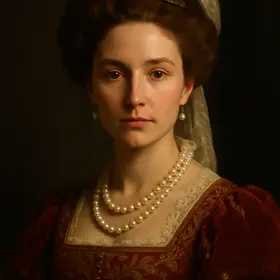
The Duchess in Don Quixote
Major character
A witty, high-born hostess who, with her husband the Duke, stages elaborate practical jokes to entertain and test Don Quixote and Sancho.
Who is The Duchess?
The Duchess is an intelligent, curious noblewoman who appears in Part II as the central instigator of court entertainments designed to humour and probe Don Quixote and Sancho Panza. Knowing of Don Quixote from the First Part, she and the Duke welcome the pair at their castle and set up a series of theatrical episodes—ceremonial receptions, mock enchantments, processions, staged rescues, and faux trials—that both flatter and ridicule the knightly ideal. The duchess listens, teases, and sometimes scolds (notably intervening when servants mistreat Sancho) while delighting in the spectacle of belief and confusion she helps create. Though she is not a villain in the novelistic sense, her playful cruelty and appetite for elaborate jesting drive many of the book’s most revealing scenes, testing the limits of honour, fidelity, and credulity in Don Quixote and exposing Sancho’s mixture of shrewdness and gullibility. Her actions set much of the second half’s tone, moving events forward without seeking to be a protagonist herself.
In the book: A high-born lady who, with her husband the Duke, hosts Don Quixote and Sancho Panza in Part II, the Duchess becomes a central instigator of courtly entertainments that test and tease the knight-errant’s ideals. Her intelligence, curiosity, and playful cruelty drive several episodes that explore appearance versus reality and the power of storytelling, making her a key catalyst for character development and thematic depth without being a primary protagonist.
Personality
- Playful
- She devises and enjoys elaborate jests such as the staged hunt, the Clavileño flight, and Altisidora’s mock-funeral (Chapters 34–41, 69–70).
- Curious
- Upon first meeting Don Quixote she questions Sancho and invites them to the castle to observe the knight more closely (Chapter 30).
- Manipulative
- She helps orchestrate prolonged deceptions—employing actors, pageantry, and props—to produce specific reactions from Don Quixote and Sancho (Chapters 34–36, 41).
- Amused compassion
- When Sancho is angered by a coarse prank, the duchess rebukes the servants and promises to press the duke to fulfil Sancho’s governorship (Chapter 32).
- Socially commanding
- She receives petitioners and elevates Doña Rodríguez and her daughter’s status while the castle entertains their suit (Chapters 52, 56).
Character arc
From her first appearance the duchess functions as an amused, probing observer who quickly becomes playwright and director of events at her husband’s castle. She initially greets Don Quixote and Sancho with courteous hospitality (Chapter 30) and soon takes delight in testing them—arranging ceremonies that allow Don Quixote to enact his identity while subjecting him and Sancho to ordeals that reveal their characters (Chapters 31–35). Rather than experiencing a moral conversion, she remains consistently the sophisticated hostess who prefers theatrical control to straightforward compassion: she intervenes on Sancho’s behalf when joking crosses a line but continues to stage elaborate deceptions (Chapters 32, 36, 50). By the time Don Quixote takes his leave she has both entertained and instructed the visitors, ensuring the episodes conclude with flattering proclamations of success and with social order restored (Chapters 57, 69–70). Her role ends without dramatic inward change; she sustains her position as an agent of social experiment and amusement throughout her appearances, preserving her curiosity and taste for spectacle rather than repenting of the playful cruelties she orchestrates.
The Duchess in pictures


Relationships
- The Duke Her husband and co-conspirator; together they stage the entertainments and practical jokes on Don Quixote and Sancho.
- Don Quixote The object of her curiosity and theatrical tests—she treats him as a living romance to be honoured, mocked, and observed.
- Sancho Panza A favourite of her amusement whose simplicity she both teases and protects, promising to press for his governorship and moderating excesses of the household.
- Doña Rodríguez An ally in the household who shares duties and whose petition and humiliation the duchess oversees during the duenna episodes.
- Altisidora A maid used in the duchess’s entertainments—Altisidora performs ballads, mock death, and other staged scenes to provoke Don Quixote.
- Tosilos A lacquey employed as a pawn in the duchess and duke’s mock combat, illustrating how she manipulates others for spectacle.
Quotes by The Duchess
“Tell me, brother squire," asked the duchess (whose title, however, is not known), "this master of yours, is he not one of whom there is a history extant in print, called ‘The Ingenious Gentleman, Don Quixote of La Mancha,’ who has for the lady of his heart a certain Dulcinea del Toboso?”
Chapter 30The duchess shows she knows of Don Quixote’s printed fame, which frames how she and the duke choose to receive him.
“Go your ways in a good hour, and in a good hour be it said to you. Go home and bring up your children if you have any, and attend to your business, and give over going wandering about the world, gaping and making a laughing-stock of yourself to all who know you and all who don’t.”
Chapter 31A grave churchman angrily denounces Don Quixote's knight-errant project at the dinner table, provoking Don Quixote to rise and reply.
“May the great Dulcinea del Toboso live a thousand years, and may her fame extend all over the surface of the globe, for she deserves to be loved by a knight so valiant and so virtuous;”
Chapter 44The duchess flatters Don Quixote by praising Dulcinea, reinforcing his chivalric devotion and providing comic noble support for his ideals.
Why The Duchess matters
The duchess embodies the novel’s fascination with appearance versus reality and the ethics of storytelling. Her staged entertainments collapse boundaries between play and cruelty, exposing how social power can manufacture belief and manipulate honor. By provoking Don Quixote’s chivalric responses and Sancho’s pragmatic reactions, she helps Cervantes explore themes of deception, authorship, and the social performance of identity. The duchess’s interventions make visible how narratives—whether romances, histories, or courtly jests—shape conduct and perception in the world of the book.
Chapters with The Duchess
More Don Quixote characters
 Don QuixoteProtagonist
 Sancho PanzaMajor character
 Dulcinea del TobosoMinor character
- RRocinanteMajor character
 The DukeMajor character
- DDappleMinor character
 The BarberMajor character
 Cide Hamete BenengeliNarrator
All chapter summaries ›Characters ›
Read Don Quixote illustrated
Every scene in these notes comes from the Book2Life reader, where the full public-domain text is illustrated as you read, with character portraits and narration. Free in your browser and on iPhone.
