Frankenstein Letter 1 Summary

Walton's Arctic Ambition

Robert Walton writes to his sister from St. Petersburgh about his excited preparations and motives for a perilous voyage toward the North Pole.

A broad, snow-swept avenue of St. Petersburgh at pale winter light, iron-gray sky above and frost riming the bare branches of avenue trees. The cobbles are half-buried under a drifting crust of snow, with parallel ruts of sledges etched into the whiteness and gas lamps blurred by a thin mist. The scene feels empty and bracing, the wind-twisted banners and shutters clinging to still buildings along the street.

Summary

Robert Walton addresses his sister, Margaret, from St. Petersburgh, reporting his safe arrival and his high spirits at beginning an ambitious polar voyage. He describes the northern breeze and how it invigorates him, transforming the pole in his imagination from a place of frost into one of perpetual light and wondrous discovery. Walton explains that his voyage aims both at scientific gains—understanding the magnet and celestial phenomena—and at opening a faster passage to northern regions. He presents these hopes as sufficient to overcome danger and death.

Walton recounts how his youthful dreams of travel and fame were shaped by reading accounts of explorers from his uncle Thomas’s library, and how he once aspired to be a poet before inheriting his cousin’s fortune and returning to the path of exploration. For six years he prepares physically and intellectually: joining whalers, enduring hardship, studying mathematics, medicine, and physical science, and even serving as an under-mate. He takes pride in having proved his competence at sea. He balances ambition and vulnerability—claiming resolute courage while admitting fluctuating hopes and occasional depression. Practically, he plans to leave for Archangel soon, hire a ship in June, and recruit experienced sailors; he acknowledges that the voyage might separate him from his sister for many years or bring him home no more. He ends with affectionate blessings and a plea for divine protection to allow him to return and repay her kindness.

Key events

  1. Walton arrives in St. Petersburgh and writes to his sister about his welfare.
  2. He describes the northern breeze and idealizes the polar regions as places of perpetual light.
  3. He explains scientific and practical motives for the voyage (magnet, passage to pole).
  4. He recounts how reading and youthful dreams shaped his ambitions and return to exploration.
  5. He details his six years of physical and intellectual preparation, including whaling service.
  6. He outlines practical travel plans and acknowledges the uncertain length or outcome of the voyage.

Letter 1 in pictures

A broad, snow-rimed avenue of St. Petersburgh stretches into a pale, wind-scoured sky; cobbles peek through packed snow, iron lamp-posts wear icicles, and drifts gather against the bases of stone buildings and shuttered shopfronts. The scene is empty and sharply articulated by the cold: a thin ribbon of hard-packed sledge tracks leads the eye toward a distant, low sun hovering near the horizon.
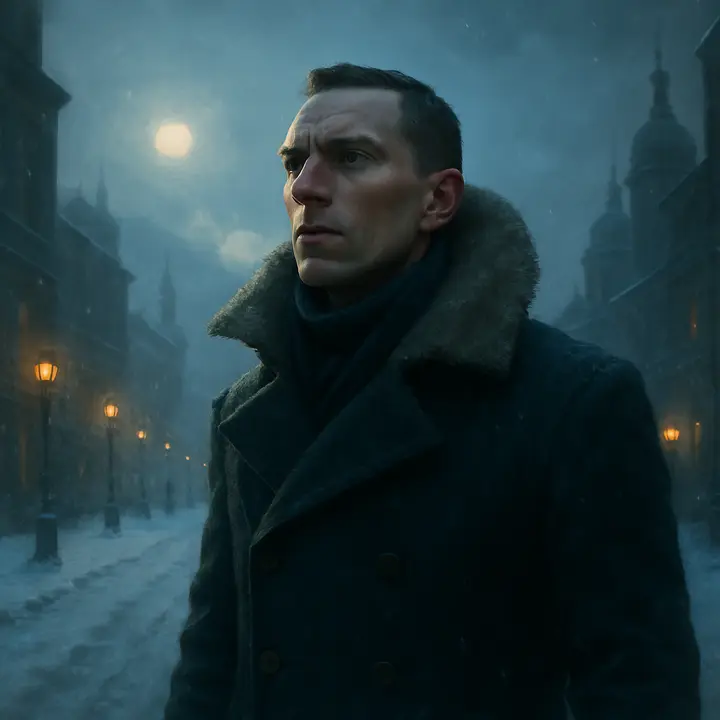
Robert Walton strides through the broad, snow-dusted avenues of St. Petersburgh, fur collar turned up, breath clouding as a cold northern breeze lifts his hair; his face is lit with exhilaration as he looks toward the north, eyes bright with the imagined splendor of a land of perpetual light. Carriages and bundled figures blur behind him, sledges gliding over snow, while distant spires and pale winter sky frame his rapt expression.
On the pitching deck of a Greenland whaler, Walton—hands rough, clothes weather-beaten—works among hauling sailors; the captain clasps his shoulder and, with an approving nod, indicates a promotion, while spray and ice floes flash in the pale northern light. Walton stands slightly apart, proud and flushed, the tumult of sailors and the white, cold sea stretching to the horizon underscoring his hard-won confidence.
The deck of a stout whale-ship frozen with a dusting of hoarfrost, ropes and spars stiff with rime, the planked foredeck streaked dark where ice has melted and refrozen. Beyond the rail the polar horizon stretches flat and luminous, the sun a broad pale disk skimming the skyline and throwing a hard, silvery sheen across a calm, ice-scattered sea. The vessel sits ready and waiting in a wide, empty Arctic expanse, rigging creaking gently in a cold breeze.
Robert Walton strides through the snow-swept streets of St. Petersburgh, fur collar up, breath clouding the air as a keen northern wind plays across his cheeks. He gazes northward with rapt wonder; in the pale sky above him a faint, imagined disk of a low sun hovers on the horizon, hinting at the eternal light he dreams of.

Analysis

This opening letter establishes the novel’s epistolary frame and introduces a narrator (Robert Walton) whose ambitions and voice parallel themes of exploration, knowledge, and the costs of striving. Walton’s energetic and idealistic language sets the tone of Romantic wonder—the pole is imagined as a region of perpetual light and possibility—while also hinting at obsessive longing that will echo in other characters. By emphasizing both scientific curiosity (the magnet, navigation) and personal glory, the letter raises the novel’s central tension between noble discovery and the hazards of overreaching.

Narratively, the letter positions Walton as an intermediary: he will frame Victor Frankenstein’s later account and thereby invites readers to observe a story about ambition from multiple perspectives. Walton’s candid admissions of vulnerability (hopes that fluctuate; need to sustain others) humanize him and make his voice believable as a correspondent; they also foreshadow the emotional costs of single-minded pursuits. Small details—the uncle’s voyages, the transition from poetry to exploration, and his sea experience—symbolize competing forms of aspiration (artistic vs. scientific) and set up recurring questions about the proper limits and moral responsibilities of seekers of knowledge.

Important quotes

“I feel a cold northern breeze play upon my cheeks, which braces my nerves and fills me with delight.”

Robert WaltonWalton describes how the northern air invigorates him and fuels his optimistic imagination of the polar regions.

“Nothing contributes so much to tranquillise the mind as a steady purpose—a point on which the soul may fix its intellectual eye.”

Robert WaltonHe explains how his voyage gives him psychological steadiness and justifies the risks of his enterprise.

Characters in Letter 1

Read Frankenstein illustrated

Every scene in these notes comes from the Book2Life reader, where the full public-domain text is illustrated as you read, with character portraits and narration. Free in your browser and on iPhone.

Read Frankenstein free

Download Book2Life on the App Store