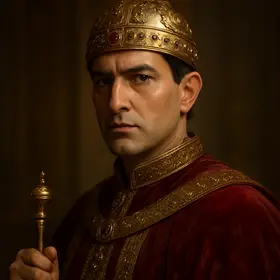
The Emperor of Lilliput in Gulliver's Travels
Major character
Absolute, ceremonious ruler of Lilliput who greets Gulliver with protocol, tests him, and grants him honours while managing court anxieties.
Who is The Emperor of Lilliput?
The Emperor of Lilliput is the young, proud sovereign who first inspects Gulliver when the giant washes ashore. He wants to preserve the safety and sovereignty of his tiny empire while controlling the potential threat and spectacle Gulliver represents. At first he approaches cautiously, presiding over councils that order Gulliver searched, fed, and taught the language; he supervises the formal inventory of Gulliver's belongings and arranges entertainments to test and amuse both court and guest. As Gulliver proves gentle and useful — rescuing the state from Blefuscu's fleet and later quelling the palace fire indirectly — the Emperor rewards him with the highest title, the nardac, and a pension. Yet the Emperor also tolerates court rivalries and the machinations of ministers who resent Gulliver’s independence. Throughout his appearances the Emperor balances ceremony, gratitude, and political calculation, treating Gulliver as both honored protector and regulated curiosity in the fragile politics of Lilliput.
In the book: He’s the absolute ruler Gulliver first encounters in Lilliput, presiding over a nervous but curious court. Proud and intensely formal, he approaches the “Man-Mountain” with a mix of caution and fascination, setting strict conditions while staging displays of pageantry and clever entertainments to test and impress his enormous guest.
Personality
- Ceremonious
- He presides in great formality at Gulliver’s first inspection and stages pageants and entertainments to receive and test his guest.
- Cautious
- He convenes councils to debate Gulliver’s disposition, orders a formal search of his pockets, and restricts his liberty with a signed set of articles.
- Pragmatic
- He accepts Gulliver’s help in dragging fifty Blefuscudian ships into port and confers the nardac to secure the empire’s advantage.
- Vindictive (by influence)
- Although he pardons breaches after Gulliver saves the palace, court gossip and the empress’s anger indicate the Emperor’s favour is fragile and open to revenge from offended parties.
Character arc
On first appearance the Emperor is a nervous but authoritative monarch: he inspects Gulliver at a safe distance, orders searches, and tightly regulates the giant’s movement. As Gulliver learns the language and demonstrates restraint, the Emperor moves from wary spectacle-maker to benefactor — commissioning entertainments, granting freedom under strict articles, and arranging daily provisions. When Gulliver captures the Blefuscudian fleet and assists in peace negotiations, the Emperor rewards him with the highest honour and publicly acknowledges his service. However, the Emperor’s benevolence is limited by court politics and ceremonial obligations; he tolerates ministers who resent Gulliver’s independence and must placate an offended empress after the palace fire episode. By the end of his appearances the Emperor remains a ceremonious, politically calculating sovereign: generous when it secures the state and his prestige, but constrained by faction and protocol, so his gratitude never fully shields Gulliver from the court’s latent hostility.
Relationships
- Lemuel Gulliver The Emperor treats Gulliver as at once a dangerous curiosity and a valued protector, granting him honours and strict freedoms after Gulliver proves useful and obedient.
- The Empress of Lilliput The Empress shares the imperial stage in entertainments and palace life and reacts strongly when palace customs are breached, complicating the Emperor’s handling of Gulliver.
- Reldresal Reldresal, the principal secretary, advises the Emperor on state matters and explains Lilliput’s factions and the Blefuscu threat, shaping imperial policy toward Gulliver.
- Skyresh Bolgolam Skyresh Bolgolam opposes Gulliver’s release and represents ministerial resistance the Emperor must manage in court decisions.
- Flimnap Flimnap’s intrigues and the treasurer’s slanders contribute to the instability of the Emperor’s favour toward Gulliver and to palace scandals the Emperor must address.
Why The Emperor of Lilliput matters
The Emperor embodies the book’s exploration of power as spectacle and the fragile authority of rulers who govern through ceremony and faction. His mixture of admiration, prudence, and political calculation shows how states respond to extraordinary challenges — rewarding usefulness while policing difference. Through his handling of Gulliver (from strict articles to exaltation and uneasy protection) Swift examines themes of sovereignty, the performative nature of rule, and how court rivalries and petty formalities can undermine justice and genuine gratitude. The Emperor thus represents both the dignity and the limitations of institutional power.
Chapters with The Emperor of Lilliput
More Gulliver's Travels characters
 Lemuel GulliverProtagonist
 The YahoosAntagonist
 GlumdalclitchMajor character
- tthe kingMajor character
 The King of BrobdingnagMajor character
 The Queen of BrobdingnagMajor character
 The Empress of LilliputMajor character
 The Farmer of BrobdingnagMinor character
All chapter summaries ›Characters ›
Read Gulliver's Travels illustrated
Every scene in these notes comes from the Book2Life reader, where the full public-domain text is illustrated as you read, with character portraits and narration. Free in your browser and on iPhone.
