the king in Gulliver's Travels
Major character
The monarch of the flying island Laputa, an abstruse ruler obsessed with mathematical and astronomical order.
Who is the king?
The king of Laputa rules the floating island and its dependent territories. He values mathematical knowledge and celestial observation above common concerns, directing his court and policies through those priorities. He orders Gulliver lodged, taught the Laputan tongue, and allows him supervised access to the island’s instruments; his ministers and astronomers maintain the mechanisms that let him move the island. He uses the island’s mobility as a political tool—to hover over rebellious towns, pelt them with stones, or threaten crushing force—while practical limits and ministerial self-interest check such extremes. He is wary of celestial dangers and cultivates an atmosphere of anxious, specialized scholarship in court life. He prescribes strict rules about who may leave the island, underlining his interest in preserving Laputa’s isolation and the stability of its scientific regime.
Personality
- mathematical
- Gulliver finds the king in the throne chamber absorbed in a mathematical problem and later converses with him mainly on mathematical topics.
- authoritative
- The king orders Gulliver lodged and taught the language and commands the island’s movement as a political instrument.
- detached
- He shows little curiosity about Gulliver’s worldly travels, limiting questions to mathematics despite Gulliver’s broader experiences.
- cautious
- When Lindalino resists by placing loadstones on towers, the king negotiates rather than risking damage to the island’s adamantine underside.
Character arc
Across his appearances the king remains largely constant: a sovereign shaped by scientific obsession and practical calculation. On first meeting he is preoccupied with abstract problems and institutes protocols to incorporate Gulliver into court life—teaching him language and fitting him to Laputan measurement. As Gulliver explores the island’s mechanics, the king’s character shows through his control of powerful instruments and legal restraints (forbidding the royal family from leaving the island). The Lindalino episode demonstrates his willingness to wield intimidation but also his restraint when faced with technical limits and political pushback; he negotiates rather than destroys when towers’ loadstones threaten the island. He never undergoes a personal transformation in sympathy or outlook; instead his actions consistently reveal the priorities and limits of a ruler who privileges theoretical knowledge and centralized power over practical well-being.
Relationships
- Lemuel Gulliver A curious foreign visitor whom the king lodges, instructs in Laputan language, and questions largely on mathematical subjects.
- Lord Munodi An outside proprietor whose lands and conventional methods stand in contrast to the king’s Laputan projects and whose region is affected by the island’s policies.
- Glumdalclitch Indirectly connected through Gulliver’s passage from the giant court back to European life; the king’s decisions about Laputa influence Gulliver’s later movements.
Why the king matters
The Laputan king embodies Swift’s satire of abstract learning divorced from practical life. As a ruler who privileges mathematics and celestial speculation, he dramatizes the dangers of specialized knowledge that loses sight of human concerns. His legal and mechanical controls—like moving the island or restricting movement—illustrate how technocratic power can become arbitrary and detached. Through him Swift critiques intellectual arrogance, the political use of scientific instruments, and the sterile court culture that values form over useful action.
Chapters with the king
More Gulliver's Travels characters
 Lemuel GulliverProtagonist
 The YahoosAntagonist
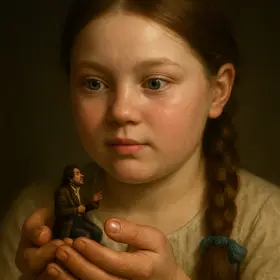 GlumdalclitchMajor character
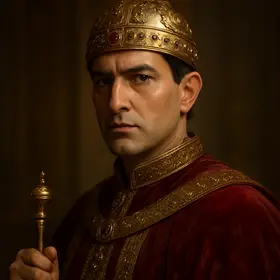 The Emperor of LilliputMajor character
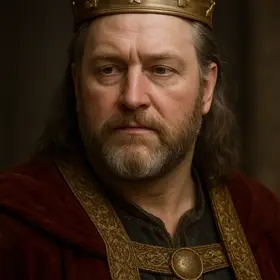 The King of BrobdingnagMajor character
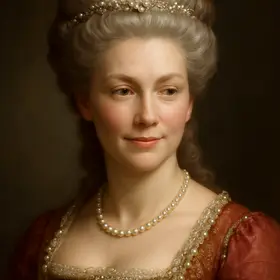 The Queen of BrobdingnagMajor character
 The Empress of LilliputMajor character
 The Farmer of BrobdingnagMinor character
All chapter summaries ›Characters ›
Read Gulliver's Travels illustrated
Every scene in these notes comes from the Book2Life reader, where the full public-domain text is illustrated as you read, with character portraits and narration. Free in your browser and on iPhone.
