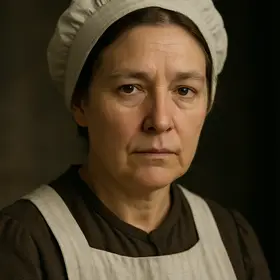
Nelly Dean in Wuthering Heights
Narrator
Long‑serving housekeeper and the primary storyteller, caregiver and moral commentator for the Earnshaw and Linton households.
Who is Nelly Dean?
Nelly Dean (Ellen) is the experienced housekeeper who serves Earnshaw and Linton families and narrates almost the entire history to Mr. Lockwood. She cares for children, tends the sick, runs households, and constantly negotiates between conflicting wills: she washes and raises the foundling Heathcliff, nurses Catherine Earnshaw and later Catherine Linton, and manages Hareton’s upbringing. Nelly both intervenes in events (shielding Hareton, concealing or destroying letters, arranging visits) and records them with an often moralizing tone. She aims to preserve domestic order and protect those in her charge, balancing loyalty to employers with practical judgments about dangerous people—most notably Heathcliff. Because Lockwood receives the tale through her, her selective memory, omissions, and condemnations shape readers’ access to motives and facts. Her presence ties together generations: she recounts childhood play on the moors, quarrels that lead to lasting enmities, the death of Catherine Earnshaw, Heathcliff’s revenge, and the later entanglements of the younger Cathy, Linton, and Hareton.
In the book: Nelly Dean (Ellen) is the long‑serving housekeeper to the Earnshaw and Linton families and the principal storyteller, recounting the history of Wuthering Heights and Thrushcross Grange to Mr. Lockwood. Acting as caregiver, confidante, and moral commentator, her choices and perceptions shape how events and characters are understood, making her a central lens through which the novel unfolds.
Personality
- practical
- She organizes care and funerals (Ch. 16–17) and arranges the household’s routines and protections for children (Ch. 8, Ch. 20).
- protective
- She prevents Hareton’s fall during Hindley’s rage (Ch. 9) and later nurses and shields Catherine Linton through illness and captivity (Ch. 12, Ch. 28).
- judicious
- She destroys many letters between Cathy and Linton to curb dangerous correspondence and limit influence (Ch. 21).
- moralizing
- She frequently comments on characters’ virtues and vices, expressing private wishes that Heathcliff should suffer (Ch. 17) and warning Lockwood about household dangers (Ch. 4, Ch. 11).
- resilient
- She endures long years of household decline under Hindley, Heathcliff’s rule, and difficult confinements while continuing to serve and care (Ch. 8, Ch. 20–21, Ch. 27–30).
Character arc
Nelly begins as the competent servant of Mr. Earnshaw, entrusted with the household and children; early on she washes and cares for the foundling Heathcliff and becomes intimately involved in the children’s confidences (Ch. 4–7). As the family fractures—Mr. Earnshaw’s death, Hindley’s cruelty, Heathcliff’s return—she oscillates between loyalty to different masters and efforts to limit harm (Ch. 5–11). Her narrative role grows as she is forced out and later recalled: she cares for Catherine Linton during Edgar’s decline (Ch. 18–19), attempts to prevent dangerous contacts (burning letters in Ch. 21), and endures the moral crises of Isabella’s flight and Heathcliff’s revenge (Ch. 13–17). In the later years she becomes the guardian and chronicler of the younger generation, attempting to civilize Hareton and comfort Cathy, bringing books, teaching, and fostering reconciliation (Ch. 31–33). She remains essentially consistent in values—practical care, moral judgment, and a desire to protect—but her voice grows weary and reflective, shifting from active household manager to the story’s authoritative retrospective narrator who both shaped events and preserved them for Mr. Lockwood (throughout, especially Ch. 4 and final sections).
Relationships
- Edgar Linton Her employer and the man whose household she tends; she nurses his daughter and reports to him (Ch. 18, Ch. 20, Ch. 28).
- Mr. Lockwood Her principal listener and the frame narrator to whom she recounts the families’ history (Ch. 4 and framing chapters).
- Catherine Linton Her young mistress and long‑term charge whom she nurses, advises, and tries to protect from Heathcliff (Ch. 18, Ch. 24–28, Ch. 31–33).
- Heathcliff A central, dangerous subject of her narration—she cares for him as a child, condemns his cruelty, and negotiates with or resists his designs (Ch. 4, Ch. 10–11, Ch. 27–30).
- Hareton Earnshaw A boy she helps raise and later attempts to civilize and reconcile with Catherine, acting as guardian and mediator (Ch. 8, Ch. 31–33).
- Linton Heathcliff A sickly ward she escorts, tends, and whose manipulated courtship of Cathy she tries to curtail (Ch. 19–21, Ch. 27–30).
Quotes by Nelly Dean
“He has nobody knows what money, and every year it increases.”
Chapter 4Nelly sums up Heathcliff’s puzzling wealth and miserly nature, shaping Lockwood’s early impression of him.
“They entirely refused to have it in bed with them, or even in their room; and I had no more sense, so I put it on the landing of the stairs, hoping it might be gone on the morrow.”
Chapter 4Nelly admits her initial cruelty and fear toward the foundling, dramatizing the child’s difficult first reception and linking to his later marginalization.
““Master Heathcliff is requested to send no more notes to Miss Linton, as she will not receive them.””
Chapter 21After discovering Cathy’s correspondence, Nelly forbids further exchanges by notifying Heathcliff that Cathy will not accept letters.
“I’ll not disguise but you might kill him if you were wild and reckless, and cherished a foolish, fanciful affection for the son of a person who would be glad to have him in his grave; and allowed him to discover that you fretted over the separation he has judged it expedient to make.”
Chapter 22Nelly warns Cathy that thoughtless emotional behavior could harm her father, simultaneously condemning any attachment to Linton Heathcliff.
“I’ll have that lock mended, and you can escape by no way else.”
Chapter 23Nelly's practical attempt to control Catherine's risky visits to Wuthering Heights and to protect her from Linton's influence.
““These things happened last winter, sir,” said Mrs. Dean; “hardly more than a year ago.”
Chapter 25Opens the chapter and situates the recounted events in time, reminding the reader this is a retrospective narration.
Why Nelly Dean matters
Nelly is both the novel’s moral center and its interpretive filter: her practical caregiving gives her access to intimate moments, while her judgments steer the reader’s sympathies. Because the entire multi‑generational tale is mediated through her memory and choices—what she reveals, conceals, or destroys—she shapes how themes of revenge, social class, and domestic authority are understood. Her attempts to protect the vulnerable highlight the costs of pride and brutality; her failures and compromises underscore how personal loyalties and class positions perpetuate cycles of harm. As narrator, she embodies the limits of retrospective judgment: reliable in detail, partial in sympathy, and central to the book’s interrogation of who gets to tell a family’s story.
Chapters with Nelly Dean
- Chapter 4
- Chapter 5
- Chapter 6
- Chapter 7
- Chapter 8
- Chapter 9
- Chapter 10
- Chapter 11
- Chapter 12
- Chapter 13
- Chapter 14
- Chapter 15
- Chapter 16
- Chapter 17
- Chapter 18
- Chapter 19
- Chapter 20
- Chapter 21
- Chapter 22
- Chapter 23
- Chapter 24
- Chapter 25
- Chapter 26
- Chapter 27
- Chapter 28
- Chapter 29
- Chapter 30
- Chapter 31
- Chapter 32
- Chapter 33
- Chapter 34
More Wuthering Heights characters
 HeathcliffProtagonist
 Catherine LintonMajor character
 JosephMinor character
 Edgar LintonMajor character
 Hareton EarnshawMajor character
 Linton HeathcliffMajor character
 Mr. LockwoodNarrator
 Hindley EarnshawMajor character
All chapter summaries ›Characters ›
Read Wuthering Heights illustrated
Every scene in these notes comes from the Book2Life reader, where the full public-domain text is illustrated as you read, with character portraits and narration. Free in your browser and on iPhone.
