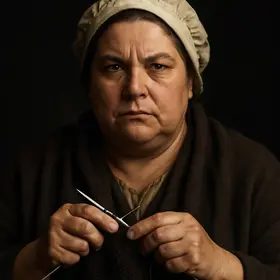
Madame Defarge in A Tale of Two Cities
Antagonist
Calm, implacable revolutionary who records and pursues vengeance for the oppressed through secret knitting.
Who is Madame Defarge?
Madame Defarge is the steely co‑owner of the Saint Antoine wine‑shop and a central, quiet force in the revolutionary underground. She wants systematic retribution against the Evrémonde/aristocratic line for old cruelties and the collective wrongs suffered by her neighborhood. She presides over the shop as a meeting place for the Jacques, observes customers and spies, and methodically registers names in a coded knitting that becomes a mnemonic roll of the condemned. She organizes and influences other women of the Quarter (notably The Vengeance) to turn private resentment into public violence, attends the Bastille assault and subsequent tribunals, and personally pursues the annihilation of the Manette/Darnay connection. Though she sometimes works alongside her husband Ernest Defarge, she often acts independently and distrusts any half‑measures, pressing for thorough extermination. Her outward composure and domestic guise mask ruthless, deliberate political action.
In the book: Madame Defarge is the implacable co‑owner of the Paris wine shop and a quiet power within the revolutionary underground. Calm, observant, and fiercely committed to retribution, she organizes and records enemies through her coded knitting, embodying the collective rage and resolve of the oppressed without revealing her plans outright.
Personality
- Implacable
- In the wood‑sawyer meeting she insists on pursuing the Manette family to annihilation and distrusts her husband to do it fully (The Knitting Done).
- Calm
- She presides at the bar of the wine‑shop knitting with an impassive composure while Jacques gather and plan (Knitting; Still Knitting).
- Observant
- She notes John Barsad’s appearance and immediately begins to stitch his name into her pattern when he enters the shop (Still Knitting).
- Secretive
- She uses coded knitting as a private register of those to be proscribed, revealing names only through its stitches (Knitting; Still Knitting).
- Ruthless
- She answers that she knits 'shrouds' and actively helps mobilize the crowd that executes Foulon and others (Knitting; The Sea Still Rises).
Character arc
Madame Defarge enters the story as a composed, inscrutable presence behind the wine‑shop counter, knitting while she watches and registers grievances. Early chapters show her as both practical helper (bringing news of Dr. Manette) and a cold political operator who records enemies in secret stitches. As revolutionary events escalate she becomes more openly instrumental: present at the Bastille assault, at tribunals, and among the crowds that seize and punish enemies; her knitting is revealed as a deliberate, coded ledger of vengeance. Her single‑minded hatred deepens into personal fixation on the Evrémonde line when she identifies Lucie and the child as legitimate targets and presses to pursue them even when others hesitate. She moves from private, patient plotting to active participation in executions and denunciations, culminating in her traveling to England to follow and threaten Lucie’s household. That personal pursuit ends abruptly and violently when Miss Pross resists her attempt to force entry and Madame Defarge is killed in the struggle, cutting short her campaign of extermination and leaving her project of eradication interrupted rather than consummated.
Relationships
- Ernest Defarge Husband and co‑proprietor of the wine‑shop who shares revolutionary aims but whom she distrusts to carry vengeance as far as she will.
- The Vengeance Lieutenant among the women of Saint Antoine and a close associate who helps execute the popular violence Madame Defarge encourages.
- Jacques Three Revolutionary co‑conspirator who participates in the secret meetings where she outlines and enforces extermination plans.
- Dr. Manette Principal target by association with the Evrémonde crimes; she pursues his family as part of her mandate for vengeance.
- Lucie Manette Marked by Madame Defarge as part of the Evrémonde line to be destroyed; Lucie’s presence and domestic life are objects of Madame Defarge’s hostility.
- Charles Darnay Aristocratic relation to the Evrémonde family whose link to Lucie and Dr. Manette makes him a proscribed figure in her register.
Quotes by Madame Defarge
“For instance," returned Madame Defarge, composedly, "shrouds.”
Chapter 15When asked what she is knitting, Madame Defarge coldly replies 'shrouds,' revealing the menacing purpose of her knitting.
“It is necessary to register him.”
Chapter 16Madame insists that the suspected spy John Barsad must be recorded among those known to the Defarges.
“It is the daughter of your father who is my business here.”
Chapter 3Madame Defarge coldly declares that her concern is Lucie’s lineage, not Lucie’s husband, intensifying the visit’s menace.
““I swear to you, like Evrémonde!””
Chapter 12Madame Defarge utters this in the wine-shop to associate the English visitor with the hated Evrémonde family and to express her vow of vengeance.
““Let me but lift my finger—!””
Chapter 12This threat, delivered while she alludes to the axe, signals that she intends to bring about Lucie’s ruin and foreshadows the personal power she wields in revolutionary justice.
“I shall be there before the commencement.”
Chapter 14Madame Defarge instructs The Vengeance to take her knitting and occupy her usual place at the execution, showing her determination and punctuality in carrying out vengeance.
Why Madame Defarge matters
Madame Defarge embodies collective, organized vengeance and shows how righteous anger can harden into implacable cruelty. Through her knitting—an apparently domestic, feminine craft turned into a ledger of death—Dickens links private grief and public violence, demonstrating how social injustice incubates systematic retribution. Her inscrutable calm and single‑minded pursuit of extermination dramatize the theme that revolution can consume both oppressors and those who become consumed by hatred, and her fate underscores the moral cost and human destructiveness of unrelenting revenge.
Chapters with Madame Defarge
More A Tale of Two Cities characters
 Dr. ManetteMajor character
 Lucie ManetteMajor character
 Jarvis LorryMajor character
 Charles DarnayProtagonist
 Ernest DefargeMajor character
 Miss ProssMajor character
 Sydney CartonProtagonist
 Jerry CruncherMajor character
All chapter summaries ›Characters ›
Read A Tale of Two Cities illustrated
Every scene in these notes comes from the Book2Life reader, where the full public-domain text is illustrated as you read, with character portraits and narration. Free in your browser and on iPhone.
Read A Tale of Two Cities free
