
Sydney Carton in A Tale of Two Cities
Protagonist
A brilliant but wasted English barrister whose cynicism and drinking hide a capacity for self-sacrifice and moral renewal.
Who is Sydney Carton?
Sydney Carton is an intelligent, dissipated barrister who performs the legal labor behind C. J. Stryver’s courtroom triumphs while presenting himself as a cynical, hopeless man. He drifts through the lives of Lucie Manette, her father, and Charles Darnay, first as a gloomy, drinking figure who describes himself as "a disappointed drudge," then as a quietly devoted presence who asks only to be tolerated in the Darnay household. Carton confesses a deep, unrequited love for Lucie and vows, in private, that he would give his life to secure the happiness of those she loves. As danger gathers in revolutionary Paris, Carton moves from passive resignation to decisive action: he engineers access to the Conciergerie, compels Darnay to exchange clothes, and takes Darnay’s place as the condemned man. In the final sequence he comforts a fellow prisoner and meets death with composed vision, imagining a redeemed future for those he cares about. Carton’s arc centers on sacrifice, atonement, and the discovery of purpose at the cost of his life.
In the book: Sydney Carton is a brilliant yet self‑destructive barrister whose cynicism and heavy drinking mask a deep capacity for feeling. Through his connection to Lucie Manette and Charles Darnay, he becomes central to the novel’s exploration of identity, love, and the possibility of moral renewal, embodying the theme that even wasted lives can find purpose.
Personality
- Brilliant
- He compiles Stryver’s legal arguments late into the night, preparing the casework that wins trials (The Jackal, Chapter 5).
- Self-destructive
- He drinks heavily, falls asleep drunk after Darnay’s trial, and describes himself as "a disappointed drudge" (Congratulatory; The Jackal).
- Compassionate
- He lifts the fainting Lucie to her rooms after her parting with the condemned Darnay and tends to her with tenderness (A Last Embrace).
- Sacrificial
- He forces Darnay to swap clothes with him in the prison and takes the condemned man’s place, enabling Darnay’s escape (Prison and Escape Plan).
- Resolute
- On the tumbril and at the scaffold he comforts the seamstress and faces death with composed vision and assurance (The Footsteps Die Out For Ever).
Character arc
Carton first appears as a wasted but capable man: indispensable as the anonymous labor behind Stryver’s success, drink and self-contempt define his outward life (The Jackal; Congratulatory). His intelligence and melancholy make him an observer of the Manette household rather than a participant, yet Lucie’s goodness softens him and elicits from him a private, heartfelt confession of love and a vow that he would die to secure her happiness (The Fellow of No Delicacy). After Lucie’s marriage he asks only to be allowed a small, tolerated place in their lives, showing resignation mixed with a new steady fidelity (A Plea for Carton). When Darnay is re-arrested and danger to Lucie’s family intensifies, Carton moves from passivity to decisive agency: he negotiates access to the Conciergerie, maneuvers Barsad and others into position, and executes the plan to exchange himself for Darnay (The Game Made; Prison and Escape Plan). In the final scenes he becomes consoling and composed, offering comfort to fellow condemned prisoners and meeting death as atonement and fulfillment of his earlier pledge (The Footsteps Die Out For Ever). His change is from wasted resignation to purposeful, self-giving action, finding moral renewal through sacrifice.
Relationships
- Lucie Manette He loves Lucie silently and pledges his devotion to her happiness while asking that she remember him kindly and keep his secret.
- Charles Darnay He admires and resembles Darnay; ultimately he saves Darnay by taking his place at the scaffold.
- Dr. Manette He respects the Doctor and acts to protect him and his family, including rousing the Doctor and organizing their planned flight (Darkness).
- C. J. Stryver Stryver is the ambitious barrister who depends on Carton’s legal labor while belittling him socially; Carton serves as Stryver’s ‘jackal.’
- John Barsad Carton manipulates and confronts Barsad, using his vulnerability and access to arrange the prison exchange (A Hand at Cards; Prison and Escape Plan).
- Miss Pross She knows Carton as a frequent but melancholy visitor to the Manette household and sees him act concretely in times of crisis (A Last Embrace; A Hand at Cards).
Quotes by Sydney Carton
“I am a disappointed drudge, sir. I care for no man on earth, and no man on earth cares for me.”
Chapter 4Carton’s blunt confession of self-disgust and isolation, revealing his bleak inner life despite outward wit.
“This is a strange chance that throws you and me together. This must be a strange night to you, standing alone here with your counterpart on these street stones?”
Chapter 4Carton provocatively points out the physical resemblance and implied parallel between himself and Darnay as they walk into the night.
“There is a great crowd bearing down upon us, Miss Manette, and I see them—by the Lightning.”
Chapter 6Carton utters a vivid, ominous image during a thunderstorm, foreshadowing an approaching mass force and amplifying the chapter’s mood of impending upheaval.
“I wish you to know that you have been the last dream of my soul.”
Chapter 13Carton confesses the depth and tragic nature of his devotion to Lucie, framing it as a final, secret sentiment he asks her to preserve.
“I have had unformed ideas of striving afresh, beginning anew, shaking off sloth and sensuality, and fighting out the abandoned fight.”
Chapter 13He describes fleeting aspirations toward reform inspired by Lucie, then immediately dismisses them as a 'dream' he cannot realize.
““Mr. Darnay,” said Carton, “I wish we might be friends.””
Chapter 20Carton opens the private, awkward request that he be allowed as a tolerated presence in Darnay's household.
Why Sydney Carton matters
Carton embodies the novel’s themes of resurrection, sacrifice, and moral transformation. His wasted intellect and despair illustrate the human cost of self-neglect, while his final, voluntary death reframes that wasted life as a source of redemption for others. Through Carton Dickens explores how personal regeneration can be achieved not by social advancement but by selfless action; Carton’s swap and composed acceptance of death dramatize the book’s conviction that even a life long gone to ruin can attain meaning and effect deliverance for the innocent.
Chapters with Sydney Carton
More A Tale of Two Cities characters
 Dr. ManetteMajor character
 Lucie ManetteMajor character
 Jarvis LorryMajor character
 Charles DarnayProtagonist
 Ernest DefargeMajor character
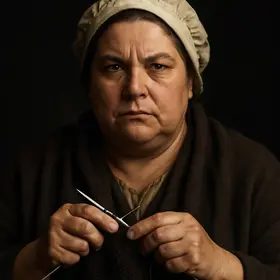 Madame DefargeAntagonist
 Miss ProssMajor character
 Jerry CruncherMajor character
All chapter summaries ›Characters ›
Read A Tale of Two Cities illustrated
Every scene in these notes comes from the Book2Life reader, where the full public-domain text is illustrated as you read, with character portraits and narration. Free in your browser and on iPhone.
Read A Tale of Two Cities free
