
The Seamstress in A Tale of Two Cities
Minor character
A humble, condemned young prisoner who offers quiet companionship and faith at the novel's climax.
Who is The Seamstress?
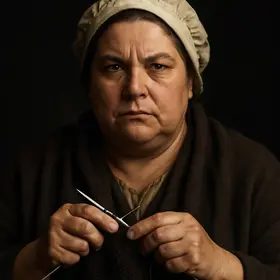
The Seamstress is a meek, young female prisoner in the Conciergerie during the Terror. Facing execution, she embodies the ordinary victims of revolutionary violence: frightened, humble, and clinging to hope for a surviving relative. She appears in the prison scene where condemned men, including Charles Darnay, are prepared for transport, and later rides in the tumbril toward the guillotine among the condemned. When Sydney Carton sits beside her on the cart, she asks simple, tender questions about the afterlife and her cousin’s fate; her conversation with Carton reveals her need for reassurance. She goes to the block before Carton, receiving his consolations and calm courage. Her presence and gentle manner humanize the anonymous mass of executed citizens and underscore the personal cost of the Revolution. She neither plots nor resists; her role is to receive comfort, to offer quiet companionship, and to show the reader the everyday humanity extinguished by the political terror.
In the book: A humble prisoner during the French Revolution, the Seamstress appears in the novel’s climax and offers quiet companionship and courage. Through her tenderness and faith, she humanizes the suffering of ordinary people and helps illuminate the story’s themes of sacrifice, redemption, and grace without drawing attention to herself.
Personality
- Humble
- She is introduced as a meek prisoner in the Conciergerie who speaks simply about a cousin she hopes will live on.
- Timid
- In the tumbril she asks Carton nervously whether the waiting will seem long in the next life.
- Faithful
- She expresses hope for her cousin’s survival and looks for comfort about the afterlife rather than protesting her fate.
- Companionable
- She accepts Carton’s hand and conversation, allowing him to console her on the road to the Place of Execution.
Character arc
The Seamstress remains outwardly consistent from first appearance to last: she is introduced as a frightened, humble prisoner and she dies in the same meek, resigned spirit. Her internal state, however, subtly moves from solitary fear toward a calm sourced in shared consolation. Initially she is one more name among the condemned—an ordinary woman hoping for a relative’s survival—but Carton’s deliberate companionship draws her into a brief mutual intimacy. Through his reassurances she gains courage to face the block, and her questions about the next life shift the scene from anonymous brutality to intimate human exchange. She does not undergo dramatic change or moral development; instead, her arc is one of quiet reception: through Carton she accepts comfort and dies with the small peace that companionship and faith afford. Her unchanged humility to the end accentuates the novel’s focus on sacrifice and the dignity of ordinary sufferers.
Relationships
- Sydney Carton Carton sits beside her on the tumbril, comforts her with tender words, and gives her courage before she goes to the block.
- Charles Darnay She is a fellow condemned in the Conciergerie and shares the tumbril procession with Darnay as they are transported to execution.
- Dr. Manette She is among the condemned who travel in the same party that includes Dr. Manette, whose presence contrasts the familial ties he represents with her solitary fate.
- Lucie Manette She is indirectly connected to Lucie by being part of the group whose fate affects Lucie’s family and by receiving a consoling role relevant to Lucie’s loved ones.
- Jarvis Lorry She is transported alongside Mr. Lorry as part of the party escorting the condemned away from Paris.
Why The Seamstress matters
The Seamstress personifies the ordinary, mostly unnamed victims of revolutionary violence. By giving a face, a voice, and a small story—a cousin she hopes will live—Dickens turns mass executions into intimate human loss. Her gentle faith and willingness to accept Carton’s consolation highlight themes of compassion, sacrifice, and redemption: she benefits from Carton’s sacrificial act and, in dying calmly, helps make his atonement morally vivid. Her quiet dignity also critiques the Revolution’s indiscriminate cruelty and deepens the novel’s moral contrast between brutality and grace.
Chapters with The Seamstress
More A Tale of Two Cities characters
 Dr. ManetteMajor character
 Lucie ManetteMajor character
 Jarvis LorryMajor character
 Charles DarnayProtagonist
 Ernest DefargeMajor character
 Madame DefargeAntagonist
 Miss ProssMajor character
 Sydney CartonProtagonist
All chapter summaries ›Characters ›
Read A Tale of Two Cities illustrated
Every scene in these notes comes from the Book2Life reader, where the full public-domain text is illustrated as you read, with character portraits and narration. Free in your browser and on iPhone.
Read A Tale of Two Cities free
