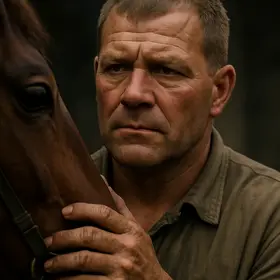
Detering in All Quiet on the Western Front
Minor character
A peasant conscript whose fierce homesickness and love of his farm and horses contrast with the front's brutality.
Who is Detering?
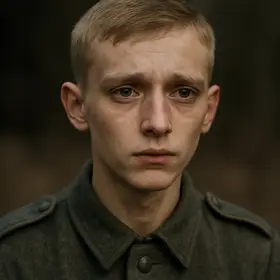
Detering is a peasant farmer conscripted into Paul Bäumer’s company who represents the soldiers’ attachment to prewar rural life. He appears in the unit’s quieter moments—queuing for rations, sharing leisure in meadows, and looting supply dumps—where his longing for home is visible in talk and mood. In combat he shows compassion, notably reacting with horror to the cries of wounded horses during a heavy bombardment, which crystallizes his inability to accept the industrialized violence around him. Between raids and hospital stints he participates in the men’s small rituals—delousing, the stolen goose feast, and guarding an abandoned village—yet his thoughts often stray to his orchard, wife, and animals. Ultimately his yearning drives him to run from the line in an attempt to return home; he is caught by the field gendarmes and disappears from the company’s story, leaving his fate unknown. Throughout, Detering functions as a tangible reminder of the civilian lives the soldiers have been torn from.
In the book: Detering is a peasant farmer serving alongside Paul, whose fierce love of his home, wife, and animals—particularly horses—embodies the soldiers’ yearning for the lives they left behind. His compassion and homesickness contrast with the brutal machinery of the front, reinforcing the novel’s themes of lost normalcy and the dehumanizing effects of war.
Personality
- Homesick
- In later front life Paul notes Detering’s constant longing for his cherry trees and farm, which drives him to attempt flight home (Chapter 11).
- Compassionate
- During the night work bombardment Detering is especially moved by the cries of wounded horses, showing intense pity (Chapter 4).
- Practical
- At the cook-house after relief he stands in the ration line alongside the others and helps secure the full issue for the reduced company (Chapter 1).
- Participatory
- He joins in camp life and camaraderie—delousing, banter about peacetime plans, and the communal goose feast—rather than isolating himself (Chapters 5, 10).
Character arc
Detering first appears as one of Paul’s comrades who shares the small comforts and routines that keep the men human: queuing for rations, relaxing in a meadow after relief, and taking part in the private theft and feast of a goose. In action he is a steady presence; when the company performs night work near the front his sensibilities surface most strikingly—he is deeply affected by the cries of wounded horses during a bombardment, revealing a vulnerability rooted in his rural background. Back in camp and on leave he participates in the men’s attempts to recreate normal life, helping to guard a supply dump and enjoying the stolen comforts of an abandoned village. But the cumulative strain and the distance from home intensify his longing until, late in the narrative, he can no longer bear it: he deserts his post to run for his orchard and is apprehended by field gendarmes. Unlike men who adapt to trench life or are killed in combat, Detering’s story ends with disappearance from the company—a failure to reconcile his civilian identity with the demands of industrial war.
Relationships
- Paul Bäumer Fellow soldier and member of Paul’s small group of comrades; Paul observes and reports Detering’s homesickness and capture (Chapters 1, 11).
- Stanislaus Katczinsky Comrade-in-arms who shares camp chores and looting moments with Detering during respite from the front (Chapters 1, 10).
- Müller Part of the same company routine and conversations about postwar life and practicalities; present together in multiple camp scenes (Chapters 1, 5, 11).
- Tjaden Fellow private who participates with Detering in barrack life and the group’s banter; they experience disciplinary incidents and feasts in common (Chapters 5, 10).
- Albert Kropp Another comrade who shares front duties and the hospital/return rhythms that frame Detering’s appearances (Chapters 6, 10).
Why Detering matters
Detering embodies what the soldiers have lost: rooted civilian obligations, home attachments, and care for animals. His acute homesickness and eventual flight underscore the novel’s themes of alienation and the corrosive effect of mechanized violence on ordinary lives. By reacting strongly to wounded horses and ultimately abandoning the front to try to return to his orchard, Detering personalizes the conflict between human feeling and military demand, highlighting how war systematically erases normal identities and severs ties to the prewar world.
Chapters with Detering
More All Quiet on the Western Front characters
 Paul BäumerProtagonist
 TjadenMajor character
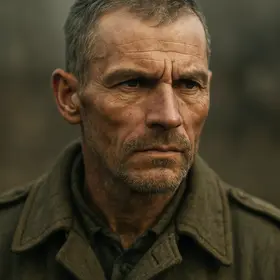 Stanislaus KatczinskyMajor character
 Albert KroppMajor character
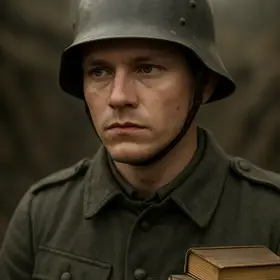 MüllerMajor character
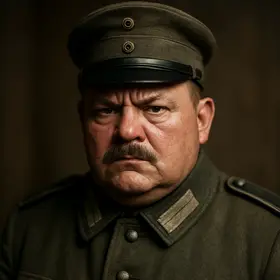 Corporal HimmelstossAntagonist
 Franz KemmerichMinor character
 Haie WesthusMajor character
All chapter summaries ›Characters ›
Read All Quiet on the Western Front illustrated
Every scene in these notes comes from the Book2Life reader, where the full public-domain text is illustrated as you read, with character portraits and narration. Free in your browser and on iPhone.
Read All Quiet on the Western Front free
