All Quiet on the Western Front Chapter 6 Summary
Bombardment and Counter-attack
Paul's company endures prolonged bombardment, a fierce counter-attack, and the shock of massive casualties before relief reduces their number to thirty-two.
Summary
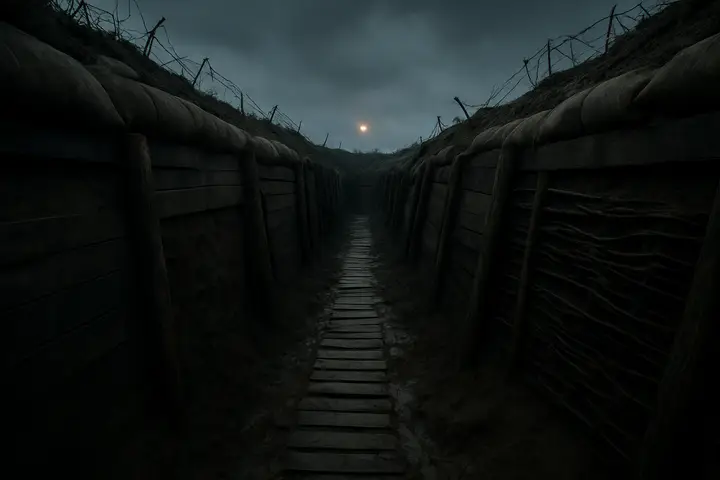
Paul Bäumer and his comrades return to the front earlier than expected amid rumours of an offensive and immediately confront preparations for a major attack: stacked coffins, increased enemy batteries, and new weapons. They endure uncertain shelling, the rats and deprivation in the dug-outs, and mounting tension as observation balloons and transports thrum behind enemy lines. Small comforts—rum, cheese, a scrap of bread—alternate with grotesque detail (corpse-rats, mutilated bodies) and the nervous breakdowns of inexperienced recruits.
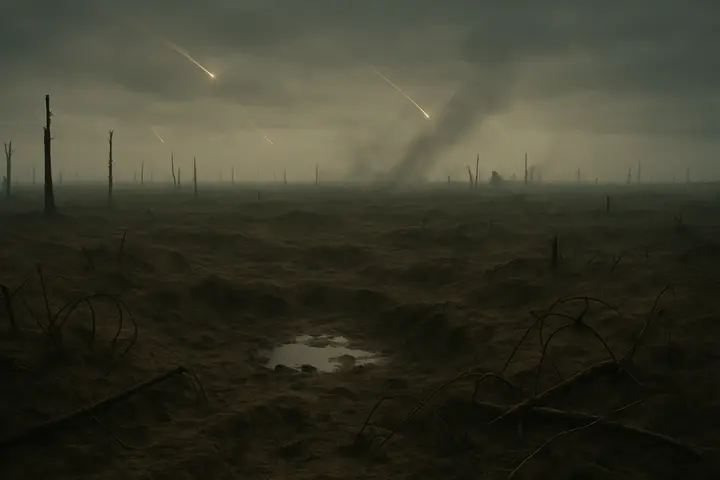
The bombardment escalates into a sustained barrage that buries trenches and shatters dug-outs; recruits crack under the strain and one becomes clinically insane. When the shelling lifts, the enemy launches a storm-troop assault: Paul’s unit fights back with grenades, spades, and bayonets in a furious, bestial defense. They counter-attack, capture enemy provisions and prisoners, and seize tins of corned beef and cognac. After hours of killing, exhaustion and numbed emotion set in; the men reflect on lost youth amid the cratered landscape. Reinforcements (green recruits) arrive and suffer horribly, while veterans teach them survival tricks. After relentless assaults, harrowing scenes of mutilation, and the attrition of men, Paul’s company is finally relieved and counted: from 150 they are reduced to thirty-two.
Key events
- Company moves up early and sees stacked coffins at a shelled school-house.
- Sustained enemy bombardment destroys trenches and dug-outs; recruits begin to panic.
- A full-scale assault follows; Paul’s men hurl grenades, use spades and retake ground.
- They seize enemy provisions and prisoners but suffer heavy casualties.
- Veterans instruct recruits; gas and air attack kill many inexperienced men.
- Relief arrives and roll-call reveals company reduced from 150 to 32 men.
Chapter 6 in pictures
Analysis
Chapter 6 intensifies the novel’s central themes of chance, dehumanization, and the erosion of youth. The prolonged barrage and subsequent assault dramatize how randomness (shelling, a stray grenade) governs survival, reinforcing Paul’s recurring meditation that soldiers live by luck rather than meaning. The chapter contrasts the mechanical, almost industrial nature of modern warfare—artillery barrages, observation balloons, flame-throwers—with intimate, grotesque detail (rats, mutilated corpses), underscoring alienation from earlier civilian life.
Narratively, the chapter functions as a set-piece battle episode: it begins with foreboding, builds psychological strain inside the dug-out, culminates in violent action, and ends with the grim arithmetic of loss. Remarque’s technique alternates clinical description and visceral sensory imagery to produce moral numbness—men become “automata” whose killing is less moral choice than instinctive self-preservation. Symbolically, elements like the poplars and cathedral memory puncture the contemporary horror with elegiac remembrance, emphasizing irreversible loss of innocence. The chapter also develops character dynamics: Kat’s grim instinct, Paul’s reflective narration, and petty humanity (raiding corned beef, collecting parachutes) reveal how camaraderie and small comforts persist amid devastation. The final roll-call crystallizes the war’s attrition: a statistical, almost liturgical accounting that transforms individual names into a depleted number, driving home the human cost without rhetorical flourish.
Important quotes
“The front is a cage in which we must await fearfully whatever may happen.”
NarratorEarly reflection inside the dug-out establishing the chapter's dominant mood of suspended chance and helplessness.
“We are deadened by the strain—a deadly tension that scrapes along one's spine like a gapped knife.”
NarratorDescribes the physical and psychological effects of continuous bombardment on the soldiers before the assault.
“Now we freeze, it is autumn, the leaves rustle, the voices flutter out wearily: "One—two—three—four——" and cease at thirty-two.”
NarratorFinal roll-call after relief that starkly counts the company's attrition from 150 to 32 men, underscoring the chapter's theme of loss.
Characters in Chapter 6
All chapter summaries ›Characters ›
Read All Quiet on the Western Front illustrated
Every scene in these notes comes from the Book2Life reader, where the full public-domain text is illustrated as you read, with character portraits and narration. Free in your browser and on iPhone.
Read All Quiet on the Western Front free
