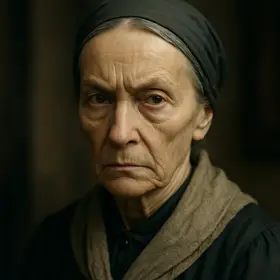
Alyona Ivanovna in Crime and Punishment
Antagonist
An avaricious, solitary pawnbroker whose stinginess and cold manner crystallize Raskolnikov’s theory and set the murder plot in motion.
Who is Alyona Ivanovna?
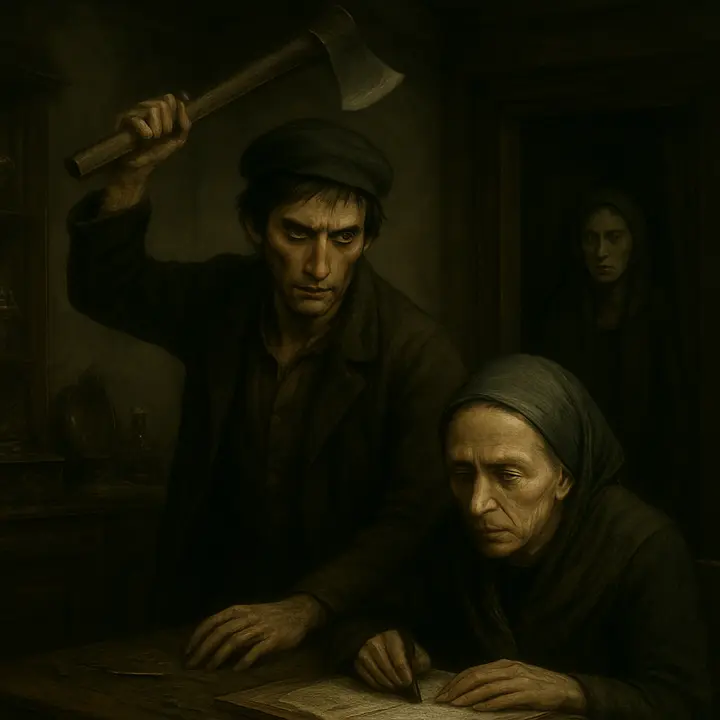
Alyona Ivanovna is the elderly pawnbroker who occupies a neat, sunlit flat where she buys and pawns items from the city’s poor. She deals harshly and sparsely, offering Raskolnikov a paltry sum for his silver watch, and her cramped apartment, large notched key, and the knowledge that her timid half-sister Lizaveta will be absent create the practical conditions Raskolnikov needs to act on his murderous idea. She appears as a concrete target for his abstract moral reasoning: to him she embodies selfishness and the parasitic use of others’ poverty. She performs no redeeming acts in the chapters in which she appears; instead her presence provokes Raskolnikov’s obsessive measurements, rehearsals, and ultimately the brutal double murder that drives the novel’s plot and psychological inquiry.
In the book: Alyona Ivanovna is a hard-nosed pawnbroker whose stingy bargains and cold demeanor make her a focal point of resentment and moral scrutiny. Her dealings with the protagonist crystallize his theories about power, guilt, and justification, setting key ethical and psychological conflicts in motion and shaping the novel’s examination of conscience and crime.
Personality
- Stingy
- She offers Raskolnikov only a rouble fifteen copecks for his silver watch during their bargaining in her sunlit room.
- Fastidious
- Her flat is described as spotless to the point of spitefulness when Raskolnikov first enters.
- Suspicious
- She admits Raskolnikov warily and handles the pledged case and keys with guarded attention, making him note a large notched key.
- Isolated
- She lives alone with only the timid Lizaveta to help, and Raskolnikov notes the flat’s quiet order and the old woman’s solitary routine.
Character arc
Alyona Ivanovna’s presence in the narrative is essentially static: she is introduced as a small, stingy, and exacting pawnbroker and remains that figure until her abrupt, violent end. From Raskolnikov’s first, humiliating bargaining with her through his later furtive observations of her keys and the layout of her apartment, she functions as the concrete embodiment of the moral and economic grievance Raskolnikov nurses. She does not change, repent, or influence events by action; instead she catalyzes Raskolnikov’s descent. Her murder — carried out in a burst of panic and instrumental violence when Raskolnikov seizes an opportunity — ends her limited narrative existence. After her death she continues to shape the plot indirectly: the discovery of the crime, the arrest of an innocent painter, and the psychological aftermath for Raskolnikov all hinge on her prior role as creditor and social irritant, while her immobility as a character contrasts with the profound internal changes in others.
Alyona Ivanovna in pictures



Relationships
- Lizaveta Ivanovna Her submissive half-sister who assists her and is present in the same flat; Lizaveta is killed moments after Alyona during Raskolnikov’s attack.
- Rodion Romanovich Raskolnikov The protagonist who visits her to pawn items, studies her flat and keys, and ultimately murders her as part of his experiment and rationale.
- Koch One of two men who try Alyona’s door shortly after the murders, his attempted entrance heightens the urgency of Raskolnikov’s escape.
- Nikolay Dementyev A journeyman painter later arrested in the murder investigation after a jewel-case connected to Alyona’s flat surfaces, making her death the center of a wrongful suspicion.
- Dmitri Prokofych Razumikhin Razumikhin recounts details of the pawnbroker’s murder and defends the wrongly accused painter, keeping Alyona’s case alive in conversations about justice.
Why Alyona Ivanovna matters
Alyona Ivanovna functions less as a developed person than as a moral and social symbol: she concretizes Raskolnikov’s abstract theory about extraordinary men and the permissibility of harming the ‘worthless’ for a higher good. Her miserly dealings and physical smallness make her an object of contempt and rationalization, enabling the novel to interrogate the ease with which intellectual rhetoric can justify violence. By remaining unchanged and by becoming the undeserving victim of a philosophical experiment, she exposes the brutality and moral blindness inherent in utilitarian calculations, and she forces other characters — and the reader — to confront the human cost of ideological arrogance.
Chapters with Alyona Ivanovna
More Crime and Punishment characters
 Rodion Romanovich RaskolnikovProtagonist
 Dmitri Prokofych RazumikhinMajor character
 Avdotya Romanovna RaskolnikovaMajor character
 Sofya Semyonovna MarmeladovaMajor character
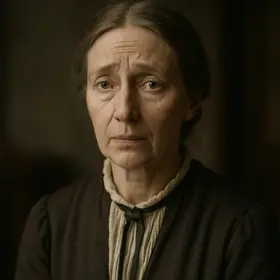 Pulcheria Alexandrovna RaskolnikovaMajor character
 Nastasya PetrovnaMinor character
 Pyotr Petrovich LuzhinAntagonist
 Katerina Ivanovna MarmeladovaMajor character
All chapter summaries ›Characters ›
Read Crime and Punishment illustrated
Every scene in these notes comes from the Book2Life reader, where the full public-domain text is illustrated as you read, with character portraits and narration. Free in your browser and on iPhone.
Read Crime and Punishment free
