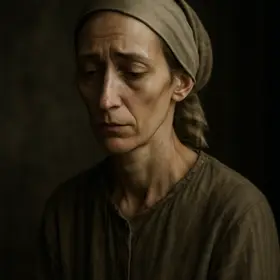
Lizaveta Ivanovna in Crime and Punishment
Minor character
Meek, devout half‑sister and companion to pawnbroker Alyona Ivanovna; innocent victim whose presence triggers key events.
Who is Lizaveta Ivanovna?
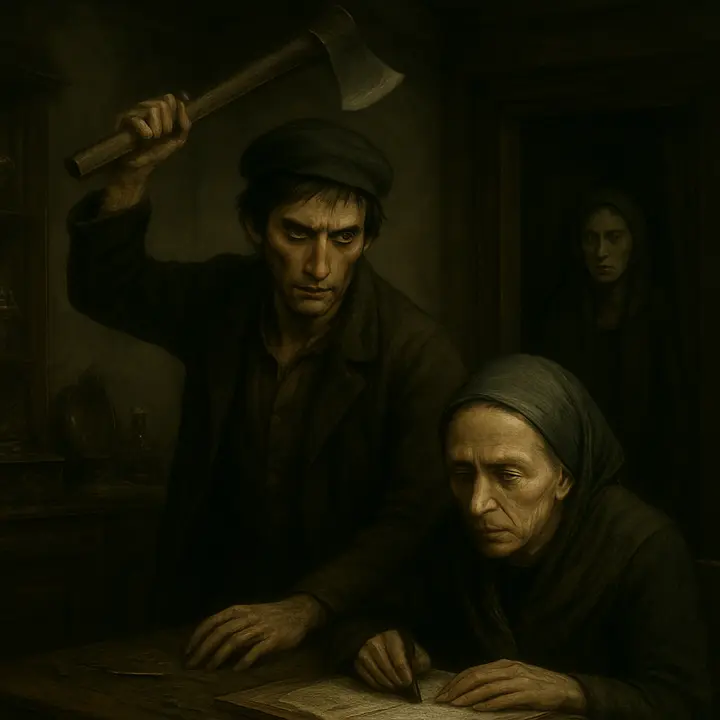
Lizaveta Ivanovna is the submissive, impoverished half‑sister and daily companion of the pawnbroker Alyona Ivanovna. She moves quietly through the novel’s poorer streets doing simple errands and talking with hawkers; in one chance street conversation she reveals that Alyona will be away the next morning, information that crystallizes an opportunity in Raskolnikov’s fevered planning. She appears in Alyona’s flat returning with a bundle and, astonished by her sister’s corpse, is unable to call out or defend herself; Raskolnikov kills her impulsively in the course of the same crime he had planned for Alyona. After her death she becomes an item in the police narrative and in the recollections of characters (notably Sonia), a tragic detail that reinforces the human cost of the central crime. Though she occupies little narrative space, her routine movements and gentle character intensify the moral stakes around Raskolnikov’s act and its consequences.
In the book: Lizaveta Ivanovna is the meek, much-abused half sister and companion of the pawnbroker Alyona Ivanovna. Poor, devout, and unfailingly kind, she moves through the story’s world of poverty as a figure of innocence and submission. Her routines and relationships place her near the novel’s central crime, and her presence intensifies the moral and psychological stakes for several characters without dominating the narrative.
Personality
- Meek
- She moves through the story as a submissive companion to Alyona, described as poor, devout, and unfailingly kind.
- Innocent
- She arrives at the flat with a bundle and, stunned by Alyona’s corpse, cannot cry out or defend herself when Raskolnikov attacks.
- Devout
- She is noted as devout and pious in the chapter notes that place her among the poor and religious figures of the city.
- Routine‑bound
- Her ordinary errands and conversation with hawkers (telling that Alyona will be away) provide a mundane detail that becomes decisive for Raskolnikov’s plan.
Character arc
Lizaveta’s onstage life is short and static: she is first presented as the gentle, long‑suffering half‑sister who runs small errands and endures her sister’s sharpness without complaint. Her everyday movement through the neighborhood — speaking with hawkers, accompanying Alyona, keeping to humble routines — places her physically and narratively near Raskolnikov’s preparations. She inadvertently furnishes crucial information (that Alyona will be alone the next morning) and then, in the climactic moment, her quiet life ends suddenly when she stumbles into the murder scene and is killed almost without resistance. She does not change or develop; rather, her personhood is fixed as an emblem of helplessness and moral collateral damage. After her death she persists only in other characters’ talk and memories (for example, Sonia recounts her death), serving as a fixed, mourned absence that amplifies the novel’s sense of loss and the irreversibility of Raskolnikov’s act.
Lizaveta Ivanovna in pictures


Relationships
- Alyona Ivanovna Half‑sister and long‑suffering companion who lives and works with her in the pawnbroker’s flat.
- Rodion Romanovich Raskolnikov Unwittingly becomes the victim of his impulsive violence when he kills her after murdering Alyona during his planned crime.
- Sofya Semyonovna Marmeladova Sonia recounts Lizaveta’s death when speaking with Raskolnikov, so Lizaveta figures in Sonia’s telling of recent tragedies.
- Nastasya Petrovna Present in the same tenement milieu and involved in household comings and goings that intersect with Lizaveta’s errands and Raskolnikov’s preparations.
- Razumikhin Razumikhin reports and discusses the murders, including Lizaveta’s death, when informing others about the police investigation.
Why Lizaveta Ivanovna matters
Lizaveta functions as the novel’s most direct symbol of innocent suffering and the human collateral of ideological or utilitarian violence. Her meek piety and routine presence highlight the brutal randomness of Raskolnikov’s act: a crime intended against a single ‘harmful’ figure immediately destroys a defenseless, blameless life. Her death sharpens the moral questions Dostoevsky pursues—about responsibility, the dignity of the poor, and the unforeseen consequences of abstract theories—and forces other characters to confront the tangible human cost of philosophical experiments in crime.
Chapters with Lizaveta Ivanovna
More Crime and Punishment characters
 Rodion Romanovich RaskolnikovProtagonist
 Dmitri Prokofych RazumikhinMajor character
 Avdotya Romanovna RaskolnikovaMajor character
 Sofya Semyonovna MarmeladovaMajor character
 Pulcheria Alexandrovna RaskolnikovaMajor character
 Nastasya PetrovnaMinor character
 Pyotr Petrovich LuzhinAntagonist
 Katerina Ivanovna MarmeladovaMajor character
All chapter summaries ›Characters ›
Read Crime and Punishment illustrated
Every scene in these notes comes from the Book2Life reader, where the full public-domain text is illustrated as you read, with character portraits and narration. Free in your browser and on iPhone.
Read Crime and Punishment free
