Don Quixote Chapter 46 Summary
The Bell and Cat Fright
Don Quixote sings for Altisidora at night and is terrorized by hundreds of bells and a sack of cats, leaving him wounded and bedridden.
Summary
Don Quixote wakes early, dresses in his chamois suit and scarlet mantle, and requests a lute for the night as a remedy for Altisidora’s feigned fainting. The duchess, the duke, and two damsels—Altisidora and her friend—plan a harmless jest to amuse themselves by satisfying Altisidora’s expectation that Don Quixote will play and sing for her.
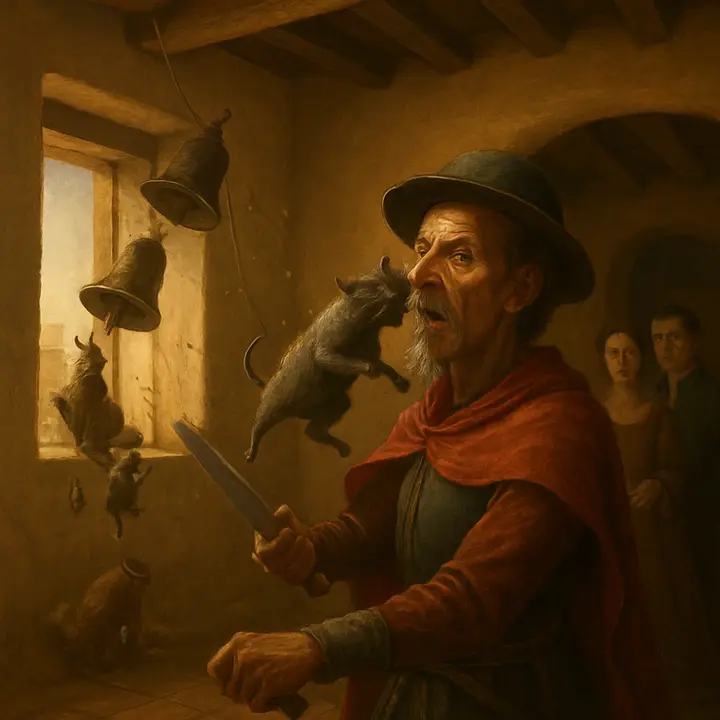
At eleven he finds the guitar placed in his chamber, tunes it, and sings a ballad he has composed that praises constancy and the image of Dulcinea del Toboso. While he performs, the household suddenly drops from an upper gallery a cord bearing more than a hundred bells and then discharges a large sack full of cats with little bells on their tails. The clamor and frantic animals terrify Don Quixote: candles are put out, cats tumble through the grating into his room, and he mistakes the scene for active enchantment. He draws his sword and attacks, crying out against malignant enchanters and defending his honour as Don Quixote of La Mancha. One cat clings to his nose, and he fights it until the duke and duchess break in with lights; the duke flings the cat out the window. Don Quixote is left battered, with his face scratched and his nose damaged; Altisidora bandages him and taunts him, suggesting his suffering is due to his stubborn love for an enchanted Dulcinea. He accepts the duke and duchess’s care and is confined to bed for five days. The chapter closes noting his convalescence and signals a shift of attention to Sancho Panza’s governance, which the chronicler will recount next.
Key events
- Don Quixote requests a lute to comfort Altisidora after her fainting.
- The duke, duchess, and damsels plan a prank to reward Altisidora.
- Don Quixote tunes the guitar and sings a ballad celebrating constancy and Dulcinea.
- A cord with many bells and a sack of cats is dropped into his window, creating pandemonium.
- Don Quixote attacks the cats, believing them to be enchanters; one bites his nose.
- The duke rescues him; Altisidora bandages his wounds and taunts him about Dulcinea.
- Don Quixote is confined to bed for five days; narration shifts toward Sancho.
Analysis
This chapter mixes comedy and pathos to highlight Cervantes’s blend of parody and humane observation. The staged prank exposes the contrast between Don Quixote’s chivalric self-image and plain reality: where the household intends a playful theatrical deception, Don Quixote interprets supernatural malice, reaffirming his delusions while eliciting sympathy for his earnest courage. The bells and cats function as instruments of farce—their absurdity undercuts the high romantic rhetoric of Don Quixote’s ballad and his talk of constancy—yet the physical injury he sustains gives real consequence to the mockery.
Narratively, the episode serves to show how noble hosts both indulge and manipulate the knight for amusement, complicating reader sympathy; the duke and duchess are kind but complicit in causing harm. Altisidora’s tenderness in bandaging him, paired with her taunt about Dulcinea, deepens the theme of unreciprocated desire and idealized love versus earthy, performative courtship. Technically, Cervantes uses a confined set-piece—nighttime, a window, a single chamber—to stage vivid action and to shift focalization smoothly from Don Quixote’s inner conviction to the external comedy, foreshadowing later episodes where social play and real injury mingle. The chapter advances the comic momentum while reminding readers of the tangible costs of Don Quixote’s fantasies.
Important quotes
“Dulcinea del Toboso Painted on my heart I wear; Never from its tablets, never, Can her image be eras’d.”
Don QuixoteHe sings this ballad line to assert his constancy and devotion to the idealised Dulcinea before the prank begins.
“I am Don Quixote of La Mancha, against whom your evil machinations avail not nor have any power.”
Don QuixoteShouted while fighting the cats, this line reveals how he interprets the chaos as magical assault rather than a prank.
“Let no one take him from me; leave me hand to hand with this demon, this wizard, this enchanter; I will teach him, I myself, who Don Quixote of La Mancha is.”
Don QuixoteAs the duke and duchess enter to rescue him, Don Quixote insists on continuing the fight, showing his commitment to chivalric combat even against absurd foes.
Characters in Chapter 46
All chapter summaries ›Characters ›
Read Don Quixote illustrated
Every scene in these notes comes from the Book2Life reader, where the full public-domain text is illustrated as you read, with character portraits and narration. Free in your browser and on iPhone.
