
Edward Fairfax Rochester in Jane Eyre
Major character
The brooding, mercurial master of Thornfield Hall whose secret past and passionate nature drive Jane’s moral and emotional trials.
Who is Edward Fairfax Rochester?
Edward Fairfax Rochester is the enigmatic proprietor of Thornfield Hall who hires Jane Eyre as governess to Adèle. He alternates between brusque aloofness and sudden warmth, testing Jane’s honesty and principles while withholding key truths about his life. Rochester seeks companionship, pleasure, and some form of moral regeneration; he flirts with confession (Chapter 14), manipulates social appearances (mention of Blanche Ingram, Chapters 16 and 20), and exerts guarded control over household secrets (Grace Poole and Mr. Mason’s injury, Chapter 20). He proposes to Jane in the orchard (Chapter 23), promising equality and partnership, but the revelation of a hidden wife destroys the wedding plans and precipitates Thornfield’s ruin. After the fire and catastrophic injuries he becomes dependent and humbled; Jane finds and restores him in Ferndean (Chapters 36–37). Their final union (Chapters 37–38) follows Rochester’s physical and moral unmasking and a mutual recognition that balances passion with restraint.
In the book: The master of Thornfield Hall and a quintessential Byronic hero, Edward Fairfax Rochester hires Jane Eyre as a governess to his ward and becomes the central catalyst for her moral and emotional growth. Commanding, mercurial, and enigmatic, he challenges Jane’s principles as much as he recognizes her independence, shaping the novel’s exploration of passion, integrity, and equality without overshadowing Jane’s own agency.
Personality
- Mercurial
- In Chapter 14 he shifts from cold aloofness to genial intimacy in the dining-room, alternating teasing irony with earnest confession.
- Secretive
- He conceals the truth about the third-storey disturbance and Grace Poole’s role, forbidding Mr. Mason to speak to Jane after the attack (Chapter 20).
- Manipulative
- He frames his impending marriage and arranges social impressions—discussing Blanche Ingram and hinting at plans—to test Jane’s feelings (Chapters 16 and 23).
- Repentant
- After Thornfield’s fire and his injuries he returns humbled and honestly seeks Jane’s care and forgiveness at Ferndean (Chapters 36–37).
- Passionate
- He offers Jane his hand, heart, and a share in his possessions beneath the chestnut tree, declaring a bond of feeling (Chapter 23).
Character arc
Rochester appears initially as a powerful, mysterious master who provokes Jane’s moral tests through teasing, equivocal confessions, and guarded control. Early scenes show him intriguing and testing Jane (Chapter 14), and later his secrecy produces danger and anxiety as the Mason attack exposes threats hidden in Thornfield (Chapter 20). He courts Jane with frank passion and offers equality (Chapter 23), but his concealed marriage collapses the wedding and precipitates Thornfield’s destruction. The fire and its aftermath strip him of social power and physical strength; he becomes disabled, humbled, and dependent (Chapter 36). Jane’s return finds him transformed but still himself—jealous, grateful, and repentant—and their reunion at Ferndean (Chapter 37) completes his moral and emotional rehabilitation. The final chapters show him restored partially in sight and fully in domestic partnership, living a decade of mutual devotion with Jane and acknowledging the cost and consequence of earlier secrets (Chapter 38).
Relationships
- Jane Eyre Governess turned wife; he is her employer, romantic suitor, and eventual dependent whom she restores and marries.
- Adèle Varens His ward; he displays paternal concern and places her education and well-being under Jane’s care.
- Grace Poole A servant whose ambiguous behavior and guarded presence are connected to Rochester’s concealed domestic troubles (third-storey disturbances).
- Bertha Mason Rochester’s hidden wife whose confinement and later actions precipitate Thornfield’s ruin and his severe injuries.
- Mr. Mason A victim of an attack in Rochester’s house whose wounds expose the dangerous secret in Rochester’s household.
- Mrs. Fairfax Thornfield’s housekeeper who observes Rochester’s moods and mediates between him and the household, witnessing his intimacies with Jane.
Quotes by Edward Fairfax Rochester
““A servant has had the nightmare; that is all.””
Chapter 20Rochester publicly explains the disturbance to calm the other guests, while privately he knows the truth is more dire.
“If I dared, I’d touch you, to see if you are substance or shadow, you elf!—but I’d as soon offer to take hold of a blue ignis fatuus light in a marsh.”
Chapter 22Rochester teases Jane on her ghostlike return, blending affection with theatrical imagery that underscores his control of the encounter.
“Jane! Jane! Jane!”
Chapter 35An urgent, mysterious cry of Rochester's name interrupts Jane's near-surrender and compels her to resolve to find him.
Why Edward Fairfax Rochester matters
Rochester personifies the novel’s tensions between passion and principle, secrecy and confession, authority and vulnerability. His hidden past and moral ambiguity force Jane to articulate her own standards of integrity and spiritual equality. His downfall and physical humbling dramatize consequences of concealment and moral compromise, while his eventual repentance and partnership with Jane demonstrate reconciliation through honesty and mutual respect. Rochester’s trajectory thus anchors themes of autonomy, moral testing, and the redemptive possibility of love balanced by truth.
Chapters with Edward Fairfax Rochester
More Jane Eyre characters
 Jane EyreProtagonist
 Mrs. FairfaxMinor character
 Adèle VarensMinor character
- MMr. RochesterMajor character
 Mrs. ReedAntagonist
 St. John RiversMajor character
 Grace PooleMinor character
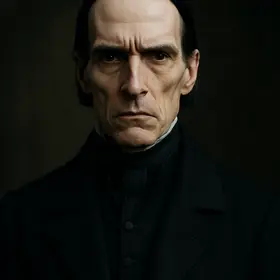 Mr. BrocklehurstAntagonist
All chapter summaries ›Characters ›
Read Jane Eyre illustrated
Every scene in these notes comes from the Book2Life reader, where the full public-domain text is illustrated as you read, with character portraits and narration. Free in your browser and on iPhone.
