
Eliza Reed in Jane Eyre
Major character
Jane Eyre’s older cousin at Gateshead: a dutiful, pious, and emotionally reserved woman who becomes austere and retreats into religious seclusion.
Who is Eliza Reed?
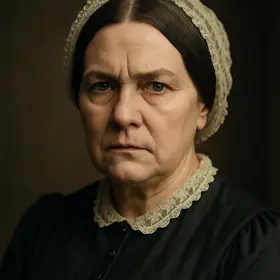
Eliza Reed appears as the eldest of the Reed cousins at Gateshead, presenting a model of strict self-discipline, practical management, and religious seriousness. From Jane’s childhood she functions as a foil to Georgiana’s vanity and to Jane’s passionate independence: Eliza keeps household order, speaks little, and judges others by rigid moral standards. After Mrs. Reed’s decline and death, Eliza’s character hardens further; she is outwardly calm at the funeral, makes cynical remarks about suffering, and announces her intention to withdraw from society. Ultimately she chooses a conventual life, deliberately separating herself from worldly comforts and familial affection. In the narrative she catalyzes Jane’s recognition that the Reed household has produced two divergent responses to injustice—Georgiana’s indulgence and Eliza’s self-denying austerity—thereby clarifying for Jane what she must resist and what kind of integrity she seeks.
In the book: Eliza Reed is Jane Eyre’s older cousin at Gateshead, the dutiful and self-disciplined foil to her vain sister Georgiana and to Jane’s passionate independence. Practical, pious, and emotionally reserved, she manages household matters with cool efficiency and judges others by strict standards, serving as a portrait of rigid self-denial that contrasts with Jane’s search for balanced integrity and affection.
Personality
- Self-disciplined
- At Mrs. Reed’s funeral Eliza stands austere and unmoved, embodying the strict control she maintains over emotion.
- Pious
- Jane notes Eliza’s announcement that she will enter a convent, showing Eliza’s turn to religious seclusion as her chosen response.
- Reserved
- Throughout Jane’s returns to Gateshead Eliza speaks little and keeps an impassive exterior, contrasting with Georgiana’s talk and display.
- Judgmental
- Eliza comments cynically after their mother’s death that trouble hastened Mrs. Reed’s end, revealing a hard, moralizing posture.
- Practical
- Early household scenes present Eliza as the one who manages household matters with cool efficiency while others indulge themselves.
Character arc
Eliza first appears as the dutiful, controlled eldest cousin who upholds Mrs. Reed’s household order and moral strictness. In Jane’s childhood she is a steady, reserved presence—neither openly cruel like John nor foolish like Georgiana—but marked by emotional restraint and a disposition toward self-denial. When Mrs. Reed becomes infirm and dies, Eliza’s stoicism hardens rather than softens: she remains outwardly unmoved at the funeral and delivers a cold, moral remark about suffering. After these events she makes a decisive turn away from the world, choosing a conventual life that literalizes her inner austerity and religious seriousness. Rather than developing greater openness or reconciliation, Eliza doubles down on detachment; she moves from being a controlled manager of family life to withdrawing entirely into ascetic seclusion. Her trajectory is one of intensification rather than transformation—she embraces an extreme of duty and denial that stands in moral and emotional contrast to Jane’s path toward balanced integrity and affectionate independence.
Eliza Reed in pictures


Relationships
- Jane Eyre Cousin; Eliza is a calm, disciplinarian foil to Jane’s passionate independence and treats her with reserved superiority.
- Georgiana Reed Younger sister; Georgiana’s vanity and social ambitions contrast with Eliza’s austerity and religious withdrawal.
- Mrs. Reed Aunt and household head; Eliza upholds her mother’s regime and remains emotionally controlled at Mrs. Reed’s illness and death.
- John Reed Younger brother whose cruelty and ultimate downfall elicit little overt sympathy from Eliza, who reacts with detached remarks.
- Bessie Lee Former servant and occasional comforter to Jane; Eliza occupies the social role above Bessie as household manager while Bessie offers warmth Jane lacks from her cousins.
Why Eliza Reed matters
Eliza embodies the novel’s warnings about extremes: her self-denial and rigid piety stand as a critique of a life that rejects human affection in the name of duty. As a foil to Jane, Eliza helps define what balance the protagonist seeks—integrity joined to compassion rather than austere renunciation. Her withdrawal into a convent highlights themes of social expectation, religious earnestness, and the costs of emotional repression, showing one possible outcome of upbringing rooted in moral severity rather than nurturing love.
Chapters with Eliza Reed
More Jane Eyre characters
 Jane EyreProtagonist
 Mrs. FairfaxMinor character
 Adèle VarensMinor character
- MMr. RochesterMajor character
 Mrs. ReedAntagonist
 St. John RiversMajor character
 Edward Fairfax RochesterMajor character
 Grace PooleMinor character
All chapter summaries ›Characters ›
Read Jane Eyre illustrated
Every scene in these notes comes from the Book2Life reader, where the full public-domain text is illustrated as you read, with character portraits and narration. Free in your browser and on iPhone.
