
Mr. Briggs in Jane Eyre
Minor character
A professional solicitor who appears to assert legal facts that abruptly reshape Jane’s prospects and Rochester’s future.
Who is Mr. Briggs?
Mr. Briggs is a solicitor who appears at two decisive moments to present legal evidence that changes the plot’s direction. In Chapter 26 he interrupts Jane and Rochester’s wedding at the church to announce a legal impediment: Rochester is already married, and he reads the record that identifies Bertha Mason as Rochester’s lawful wife. His formal intervention forces the ceremony to stop and precipitates the discovery of Bertha in the third-floor room. In Chapter 33 Mr. Briggs resurfaces through a written communication: he notifies interested parties about the death of Mr. Eyre of Madeira and that Jane is the heir, setting in motion her inheritance and reunion with kin. Mr. Briggs does not engage emotionally with the characters; his function is professional and documentary. He catalyzes revelation and legal closure, moving characters into new social and moral positions by making previously concealed facts publicly known.
In the book: Mr. Briggs is a solicitor who enters the story at pivotal moments to assert and clarify legal facts. He intervenes during a crucial ceremony to raise a formal objection, and later reappears with important news about Jane’s family and inheritance. Though not emotionally central, he acts as a catalyst who brings hidden information to light and alters the course of events.
Personality
- formal
- He interrupts the matrimonial service in Chapter 26 to read the legal record of Rochester’s prior marriage.
- impartial
- He delivers the marriage impediment and later the news of Mr. Eyre’s death without personal commentary, treating both as matters of fact.
- catalytic
- His announcement at the church immediately halts the wedding and leads to the unmasking of Bertha in the third-floor room (Chapter 26).
- efficient
- He communicates Jane’s inheritance via solicitor’s letter in Chapter 33, prompting swift family and financial arrangements.
Character arc
Mr. Briggs’ presence is functionally consistent rather than developmental: he does not undergo personal change but triggers change in others. He first appears in person at the church (Chapter 26), where his formal reading of the marriage record exposes Rochester’s prior legal bond and collapses Jane’s immediate future; his arrival forces the emotional crisis that follows. Later, he operates at a distance via written communication (Chapter 33), announcing Mr. Eyre’s death and Jane’s inheritance; this second intervention transforms Jane’s material and social standing and redirects her path toward Moor House and kinship with the Rivers. Across these episodes Mr. Briggs remains an external, authoritative agent of the law: he appears when legal facts must be clarified and then withdraws, leaving the human consequences to unfold. He thus functions as a steady, impersonal instrument of disclosure rather than a character who develops through the narrative.
Relationships
- Jane Eyre He interrupts her wedding and later sends the letter that announces her inheritance, dramatically altering her life.
- Edward Fairfax Rochester He publicly declares the legal impediment to Rochester’s marriage by presenting the record of Rochester’s prior marriage to Bertha Mason.
- Richard Mason He appears with Richard Mason at the church, whose identification of Bertha supports the solicitor’s statement.
- Mr. Eyre He conveys the news of Mr. Eyre of Madeira’s death and the resultant inheritance that names Jane as heir.
- St. John Rivers His letter about Jane’s identity and inheritance is received and shown by St. John at Moor House, initiating Jane’s reunion with the Rivers.
Quotes by Mr. Briggs
“"That is my wife," said he. "Such is the sole conjugal embrace I am ever to know—such are the endearments which are to solace my leisure hours!"”
Chapter 26Rochester presents the bound, violent Bertha to the visitors, contrasting her with Jane and making a bitter, ironic statement about his marriage.
Why Mr. Briggs matters
Mr. Briggs embodies the power of law and documentation in the novel: factual, public records intrude on private intentions and emotional plans. By enforcing legal truth—stopping a marriage and declaring an inheritance—he demonstrates how social identities and moral choices are constrained and reshaped by institutional facts. His interventions propel themes of revelation, justice, and providence: hidden realities surface and reconfigure relationships, forcing characters to reckon with duty, property, and legitimacy.
Chapters with Mr. Briggs
More Jane Eyre characters
 Jane EyreProtagonist
 Mrs. FairfaxMinor character
 Adèle VarensMinor character
- MMr. RochesterMajor character
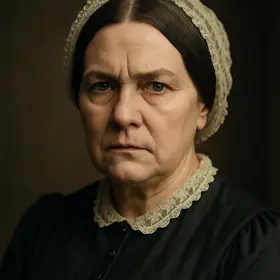 Mrs. ReedAntagonist
 St. John RiversMajor character
 Edward Fairfax RochesterMajor character
 Grace PooleMinor character
All chapter summaries ›Characters ›
Read Jane Eyre illustrated
Every scene in these notes comes from the Book2Life reader, where the full public-domain text is illustrated as you read, with character portraits and narration. Free in your browser and on iPhone.
