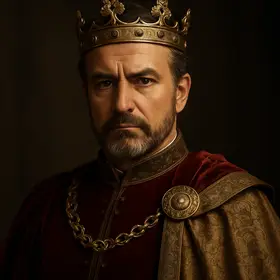
Prince Escalus in Romeo and Juliet
Major character
Ruler of Verona who enforces civic law and tries to contain the deadly feud between the Montagues and Capulets.
Who is Prince Escalus?
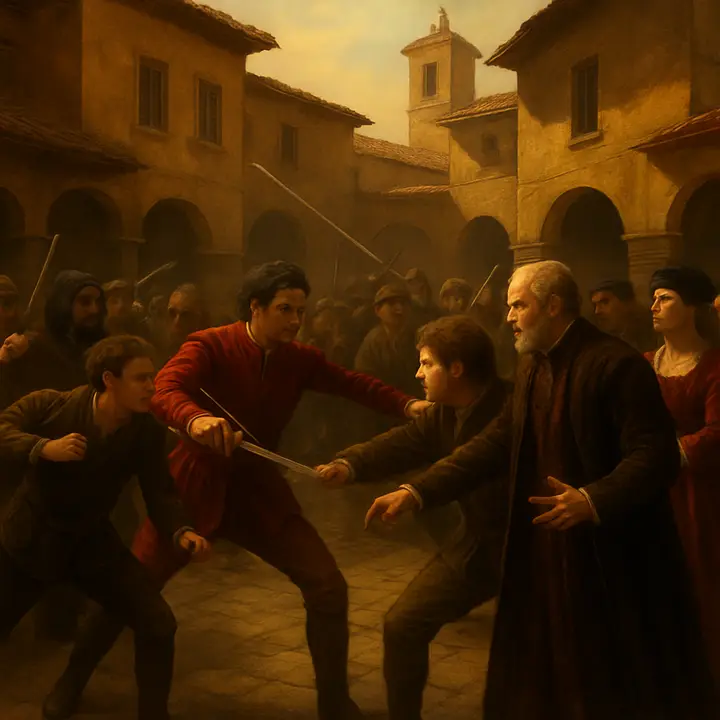
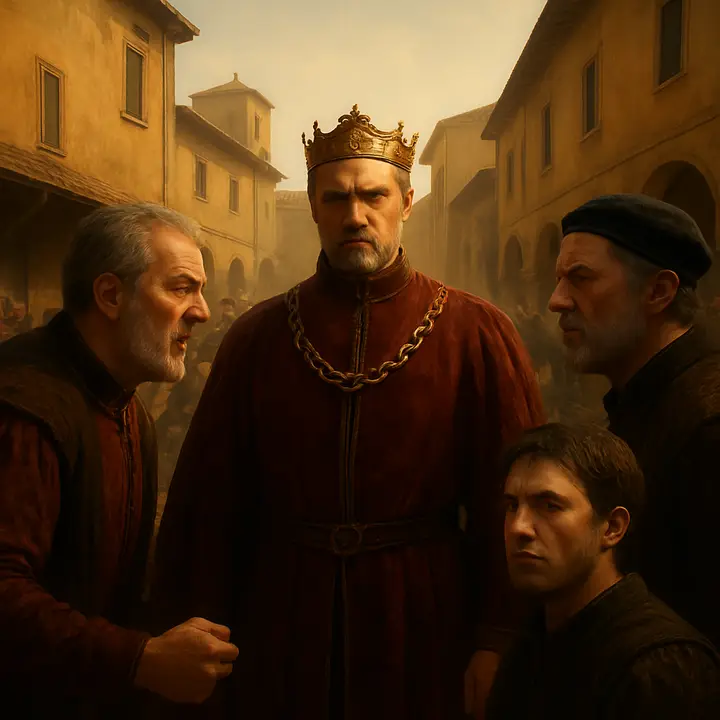
Prince Escalus is Verona’s civic authority who appears when the private violence of the two noble houses spills into public life. He wants to keep order in the streets and prevent the feud from destabilizing the city. Early, he breaks up a brawl between servants and nobles, sternly warning Capulet and Montague that further public breaches of the peace will be punished by death. When Tybalt kills Mercutio and Romeo kills Tybalt, the Prince presides over the aftermath, hears testimony, and pronounces Romeo’s punishment: banishment rather than execution. At the tragedy’s end he arrives at the Capulet tomb with the watch and the grieving families, hears the Friar’s confession and the youths’ accounts, reads Romeo’s letter, and pronounces the moral summation that frames the catastrophe. Across these appearances he acts as the voice of civic law, administering sentences and publicly naming the social cost of private passions.
In the book: Prince Escalus is the ruler of Verona and the chief authority figure in the play, stepping in to quell public violence and impose order on the feuding houses. He issues stern warnings and judgments, acts as the voice of civic law and reason, and frames the moral stakes of the lovers’ world by showing the social consequences when private passions disrupt public peace.
Personality
- authoritative
- He disperses the crowd in Act 1, Scene 1 and threatens death for future breaches of the peace.
- stern
- After the duel in Act 3, Scene 1 he enforces a punishment—banishment—on Romeo and threatens further penalties for public brawling.
- impartial (procedural)
- He listens to accounts from Benvolio, Montague and Capulet before announcing Romeo’s sentence in Act 3.
- moralizing
- At the tomb in Act 5, Scene 3 he sums up the tragic consequences and declares the lesson of the lovers’ deaths.
Character arc
Prince Escalus’s role remains institutionally consistent from his first to his final appearance, but the force of his authority and the limits of civic power become clearer over time. In Act 1 he appears as a deterrent: a formal, public authority who breaks up a street brawl and issues a stark warning meant to suppress the feud. In Act 3 his impartial, legal position is tested by revenge and personal violence; he convenes the leaders, hears testimony, and metes out banishment to Romeo rather than death, balancing a desire for order with a measure of mercy. By Act 5 his earlier warnings have not prevented the private passions that lead to multiple deaths; when he arrives at the tomb he must confront the catastrophic failure of civic measures to contain private grief and vendetta. He does not undergo a personal transformation into a different kind of character, but the story uses his judgments and final summation to reveal both the reach and the limits of law: his authority remains intact, yet it cannot reverse the losses caused by the houses’ hatred, and he ends as the one who must publicly name the cost and demand reconciliation.
Prince Escalus in pictures
Relationships
- Capulet A civic superior who must answer to the Prince for public breaches of peace committed by his household.
- Montague Another noble head whom the Prince rebukes and summons to account for his family’s role in street violence.
- Romeo The Prince judges Romeo’s role in Tybalt’s death and imposes banishment as civic punishment.
- Tybalt As the combatant whose actions help precipitate public disorder, Tybalt’s death triggers the Prince’s formal judgment.
- Friar Laurence A witness at the tomb whose confession the Prince hears when piecing together the chain of events that led to the tragedy.
- Benvolio A citizen and witness whose account the Prince receives when reconstructing the duel and its causes.
Quotes by Prince Escalus
“Rebellious subjects, enemies to peace, Profaners of this neighbour-stained steel,—”
Act 1, Scene 1The Prince rebukes the fighting citizens and frames the brawl as a serious threat to public order.
“For never was a story of more woe Than this of Juliet and her Romeo.”
Act 5, Scene 3The Prince closes the play, pronouncing the tragic moral after the families reconcile over the lovers’ bodies.
Why Prince Escalus matters
Prince Escalus personifies the public sphere and the limits of law in the play. He frames the conflict as not only a private quarrel but a civic emergency, warning that unchecked private passions produce public harm. His sentences and final summary highlight the trade-offs between justice and mercy and show that legal authority can punish and admonish but cannot by itself heal entrenched hatred. The Prince’s presence transforms private tragedy into a communal lesson, forcing the city’s leaders to acknowledge responsibility and prompting the reconciliation that follows the lovers’ deaths.
Chapters with Prince Escalus
More Romeo and Juliet characters
 RomeoProtagonist
 JulietProtagonist
 NurseMajor character
 CapuletMajor character
 Friar LaurenceMajor character
 TybaltAntagonist
 Lady CapuletMajor character
 ParisMajor character
All chapter summaries ›Characters ›
Read Romeo and Juliet illustrated
Every scene in these notes comes from the Book2Life reader, where the full public-domain text is illustrated as you read, with character portraits and narration. Free in your browser and on iPhone.
