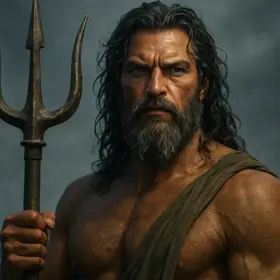
Poseidon in The Iliad
Major character
Olympian god of the sea and earthquakes who repeatedly intervenes to aid the Achaeans and alter battles.
Who is Poseidon?
Poseidon is the Olympian lord of the sea who intervenes at critical moments to bolster the Achaeans and frustrate Trojan success. Motivated by ancient grievances against Troy and by the shifting rivalries of the gods, he first appears disguised among the Argives to shame them into renewed fighting and to turn back a near-collapse at the ships. Later, when the gods assemble, he takes the field for the Achaeans, directly rescuing Aeneas from Achilles’ spear and spiriting him away to safety. At the river-ford he lends strength to Achilles against the river-god Scamander and joins other immortals in a pitched divine clash that changes the course of the fighting. Throughout these episodes Poseidon uses disguise, direct physical intervention, and battlefield influence to rally warriors, protect chosen mortals, and assert the overwhelming, unpredictable power of the sea and earth even under Zeus’s watchful authority.
In the book: Poseidon, the Earth‑shaker and lord of the sea, is a major Olympian who periodically intervenes in the Trojan War, often aiding the Achaeans. Motivated by old grievances against Troy and rivalry among the gods, he rallies warriors, turns the tide of battles, and asserts his power despite Zeus’s oversight, embodying the unpredictable force of the sea and earthquake.
Personality
- interventionist
- He appears disguised among the Achaeans in Book 14 and shames them into a counterattack that shifts the battle.
- partisan
- In the gods’ council of Book 20 he chooses the Achaean side and repeatedly aids their champions.
- powerful
- In Book 21 he reinforces Achilles against the enraged river-god Scamander and takes part in a divine skirmish.
- protective
- When Achilles is about to kill Aeneas in Book 20, Poseidon shrouds him in darkness and carries him to safety.
- defiant
- He acts decisively on the plain despite Zeus’s overarching authority by joining other gods in direct combat.
Character arc
Poseidon’s role is consistently active rather than developmental: from his first notable action he appears as an assertive, hands-on supporter of the Achaeans. In Book 14 he adopts a disguise to reawaken Achaean courage, changing the immediate fortunes at the ships. By Book 20 he openly takes his place among the gods arrayed for battle, making strategic, large-scale interventions such as rescuing Aeneas from death. In Book 21 his presence is both martial and elemental: he strengthens Achilles against the river-god Scamander and becomes embroiled in the gods’ combat that follows. Throughout the episodes supplied in the notes Poseidon refuses to recede into passive observation; he repeatedly exerts divine force to influence mortal fate. He does not undergo a moral or psychological transformation in these chapters—rather, his arc is one of sustained, escalating involvement that reinforces his identity as an unpredictable, commanding divine power who will act decisively to support his chosen side and to assert his domain.
Relationships
- Zeus A fellow Olympian whose supreme authority Poseidon acknowledges but on whose oversight he often acts assertively, even defying Zeus's passive stance.
- Hera An ally on Olympus who conspires against Zeus and whose schemes (Book 14) coordinate with Poseidon’s support for the Achaeans.
- Athena A fellow Achaean-supporting deity who fights alongside Poseidon in the divine interventions on the plain.
- Aeneas A mortal beneficiary whom Poseidon directly rescues from Achilles, carrying him to safety in Book 20.
- Achilles A mortal champion whom Poseidon bolsters in combat (Book 21), aiding his slaughter of Trojans and opposing river-god resistance.
- Apollo A divine rival who supports the Trojans and whose actions (e.g., emboldening Aeneas) Poseidon counters in battle.
Why Poseidon matters
Poseidon exemplifies how the gods shape human warfare and fate: his interventions underline the poem’s theme that mortal fortunes depend on divine favor and rivalry. He embodies elemental, disruptive power—the sea and the earthquake—that can overturn campaigns and protect or doom individuals. By acting both covertly (disguise) and overtly (direct rescue, fighting other gods), Poseidon demonstrates the gods’ caprice and the porous boundary between human endeavor and divine will, emphasizing the Iliad’s exploration of agency, honor, and the limits of mortal control in a world governed by powerful, competitive immortals.
Chapters with Poseidon
More The Iliad characters
 Hector
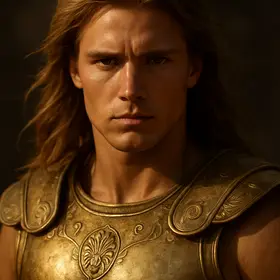 Achilles
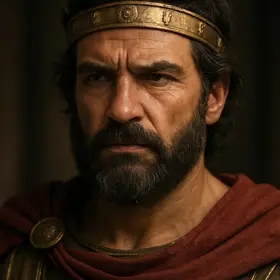 Agamemnon
 Apollo
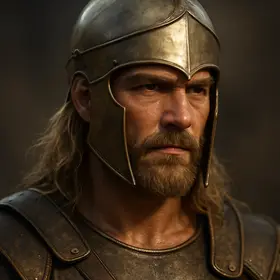 Menelaus
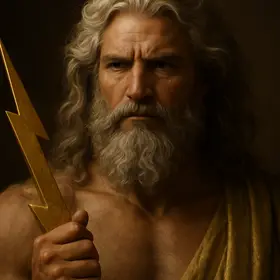 Zeus
Zeus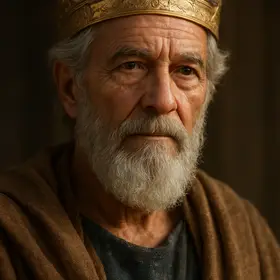 Nestor
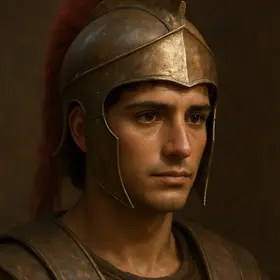 Patroclus
All chapter summaries ›Characters ›
Read The Iliad illustrated
Every scene in these notes comes from the Book2Life reader, where the full public-domain text is illustrated as you read, with character portraits and narration. Free in your browser and on iPhone.
