The Iliad Book 20 Summary
The Gods Enter Battle
The gods take sides and descend to watch and influence the combat as Achilles slaughters Trojans while Aeneas is rescued by Poseidon.
Summary
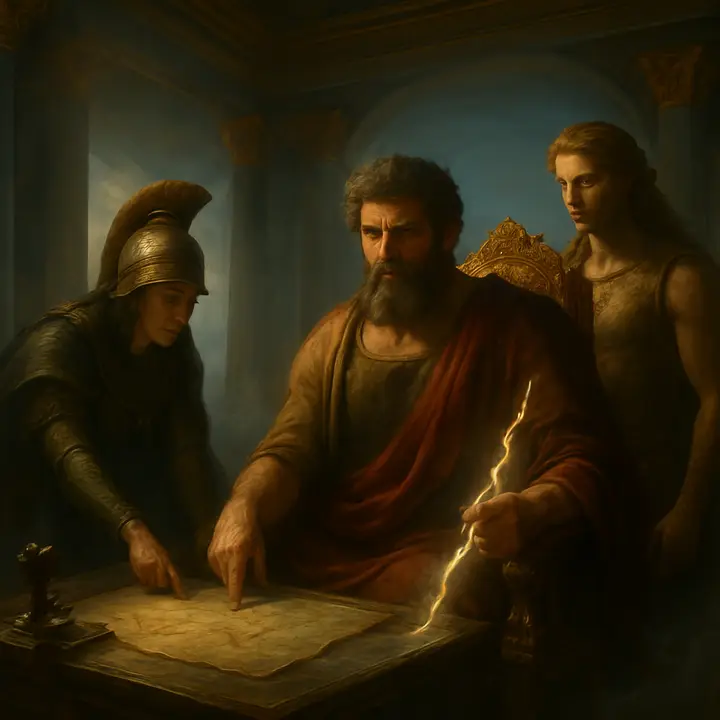
Zeus calls a council on Olympus and summons the gods to decide whether and how to intervene in the combat between Achaeans and Trojans. He declares he will remain on high to look on, but permits the other immortals to take sides: Hera (Juno), Athena (Pallas Minerva), Poseidon (Neptune), Hephaestus (Vulcan) and others join the Achaeans, while Ares (Mars), Apollo, Aphrodite (Venus) and several divine allies support the Trojans. The gods take positions on nearby hills (Callicolone and the earth-barrow of Hercules) and watch, stirring mortal armies to renewed fury.
Achilles longs above all to fight Hector, but Apollo urges Aeneas to challenge the son of Peleus. Aeneas advances to meet Achilles; they exchange proud words and clash with spears. Achilles' spear pierces Aeneas' shield, but Apollo emboldens Aeneas and then Poseidon intervenes directly when Achilles is about to kill him: Poseidon shrouds Aeneas in darkness, removes his spear, lifts him from the field and deposits him safely among the Cauconians, warning him to avoid Achilles. Angered, Achilles rallies the Achaeans and storms the Trojan ranks, slaying many men (Iphition, Demoleon, Hippodamas, Polydorus, Dryops, and others). Hector nearly confronts Achilles but is warned by Apollo to avoid single combat for now. Achilles' fury turns the battlefield into a blood-soaked rout as he pursues troopers, cuts down charioteers and infantry, and boasts over the fallen.
The book ends with Achilles in full slaughter, his chariot and hands covered in blood, while the gods watch from their high places and the fate of many Trojans hangs in the balance.
Key events
- Zeus summons a council of the gods and permits them to take sides.
- Gods seat themselves on Callicolone and the earth-barrow of Hercules to watch the fight.
- Apollo urges Aeneas to fight Achilles; Aeneas and Achilles battle and hurl words and spears.
- Poseidon (Neptune) rescues Aeneas from imminent death and deposits him safely away from the front.
- Achilles, enraged, leads a devastating slaughter of many named Trojans.
- Apollo warns Hector to avoid single combat with Achilles for the present.
Analysis
Book 20 thrusts divine will and human violence into their fullest collision: Zeus authorizes direct divine partisanship, transforming the battlefield into an arena where immortal preferences shape mortal fate. The scene dramatizes the Iliad’s recurring tension between fate and agency—Zeus watches but does not micromanage, while other gods act on personal loyalties, reviving the poem’s central ambivalence about divine justice. By placing gods on opposing hills and having them spur or check warriors, Homer externalizes moral and emotional conflicts: Achilles’ unstoppable rage is both personal (for Patroclus) and enabled by a heavenly endorsement that renders him almost unstoppable when gods favor him.
Narratively, the book shifts focus from dueling interlocution (the Paris/Hector episodes) to raw carnage: a long, accumulating catalogue of named victims conveys the scale of Achilles’ wrath and restores the epic’s catalogue tradition, anchoring abstract fury in concrete human losses. The rescue of Aeneas by Poseidon introduces divine favoritism and foreshadows that not all key Trojans will fall here—religious piety and ancestral lines (the genealogy Aeneas recites) matter to the gods’ choices. Symbolically, the divinities’ seating (Callicolone, Hercules’ barrow) and the darkness Poseidon casts emphasize visibility and concealment as instruments of power: to see is to act, and to hide is to preserve. The technique of alternating speeches, single combats interrupted by gods, and graphic death-scenes accelerates tempo and heightens tragic inevitability while keeping attention on Achilles as the poem’s centrifugal force.
Important quotes
“I take thought for them even in their destruction.”
ZeusZeus explains his purpose in summoning the gods: to observe and allow them to intervene while he sits apart.
“Let him go hang; he will be in no mood to fight me further, seeing how narrowly he has missed being killed.”
AchillesAchilles reacts after Poseidon rescues Aeneas and removes his spear, redirecting his fury to other Trojans.
“Aeneas, counsellor of the Trojans, where are now the brave words with which you vaunted over your wine before the Trojan princes, saying that you would fight Achilles son of Peleus in single combat?”
Apollo (in Lycaon's voice)Apollo taunts and goads Aeneas into facing Achilles, initiating their duel.
Characters in Book 20
- Zeus
- Themis
- Poseidon
- Hera
- Athena
- Hephaestus
- Ares
- Apollo
- Aphrodite
- Xanthus
- Venus
- Thetis
- Aeneas
- Achilles
- Lycaon
- Anchises
- Hector
- Polydorus
- Iphition
- Demoleon
- Hippodamas
- Dryops
- Demouchus
- Laogonus
- Dardanus (son of Bias)
- Tros (son of Alastor)
- Mulius
- Echeclus
- Deucalion
- Rhigmus
- Areithous
- Talthybius
- Priam
- Dardanus
- Erichthonius
- Tros
- Ilus
- Assaracus
- Ganymede
- Laomedon
All chapter summaries ›Characters ›
Read The Iliad illustrated
Every scene in these notes comes from the Book2Life reader, where the full public-domain text is illustrated as you read, with character portraits and narration. Free in your browser and on iPhone.
