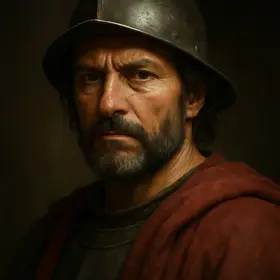
Francesco Sforza in The Prince
Major character
Condottiero who rose by his own arms to become Duke of Milan and serves as Machiavelli’s model of martial prudence and secure rule.
Who is Francesco Sforza?
Francesco Sforza appears in The Prince as a historical exemplar of a man who attains and maintains power through military skill, prudence, and personal initiative. Machiavelli points to Sforza’s trajectory from private captain to Duke of Milan as evidence that a prince who relies on his own arms, cultivates native forces, and acts with foresight can convert fortune into lasting authority. Sforza’s example is used against the failures of those who rely on fortune, mercenaries, or absentee rule: he is contrasted with rulers who lose territories by neglecting to settle, plant colonies, or secure loyal troops. Across discussions of mixed principalities, kinds of soldiery, the art of war, and fortresses, Sforza exemplifies the virtues Machiavelli prescribes—military competence, readiness in peace, sensible use of fortifications, and building stable foundations for rule.
In the book: Francesco Sforza appears in The Prince as a real historical example used to illustrate Machiavelli’s lessons about gaining and maintaining power. A condottiero who rose to become Duke of Milan through his own arms and ability, he embodies the virtues of military prowess, prudence, and personal initiative. Machiavelli contrasts his success with the failures of less capable heirs to show how states are won and lost.
Personality
- Martial
- Machiavelli cites Sforza as a private man who rose to dukedom by being martial and mastering arms (Chapters 12, 14).
- Prudent
- He is credited with keeping his state with comparative ease through prudent measures rather than relying on fortune (Chapter 7).
- Self-reliant
- Sforza is presented as an example of a prince who relied on his own ability and native forces instead of mercenaries or auxiliaries (Chapter 12).
- Practical
- Machiavelli uses Sforza to illustrate a prince who prepares in peace by practicing war and using sensible defenses rather than trusting forts alone (Chapters 14, 20).
Character arc
Sforza’s arc in Machiavelli’s text is not a narrative of personal transformation but a steady exemplification of an ideal method for acquiring and holding power. In the first appearance he is introduced as a successful model of a man who rose by his own arms—an answer to princes who depend on fortune—and is used to show that a newly acquired state can be secured when the conqueror builds loyal military foundations. Later chapters develop this example into practical counsel: Sforza’s reliance on native troops and personal martial skill contrasts with the failures of mercenary-dependent states, and he illustrates the value of continual military study and practice in peacetime. Finally, his castle is mentioned among examples in discussion of fortifications, showing that even successful martial founders can create future problems if fortresses substitute for popular goodwill. Throughout, Sforza remains the steady prototype Machiavelli invokes to show how ability, arms, and prudent governance produce durable rule.
Relationships
- Louis XII Contrasted with Louis XII to show how one who fails to secure a conquered state loses it, unlike Sforza’s steady foundations.
- Cesare Borgia Compared with Cesare Borgia as alternative models for new princes: Sforza rose by his own arms, while Cesare used fortunes and papal favor.
- Florentines Serves as an example against the Florentines’ reliance on mercenaries and divided defenses, highlighting Sforza’s native-military example.
- Messer Nicolo Vitelli Mentioned in the same discussion of fortresses—Vitelli’s demolition of castles contrasts with problems Machiavelli associates with Sforza’s castle.
- Alexander the Great Placed among exemplars for military study and imitation; Sforza embodies the practical martial virtues Machiavelli also praises in leaders like Alexander.
Why Francesco Sforza matters
Francesco Sforza functions as Machiavelli’s concrete proof that mastery of arms, self-reliance, and prudent administration can convert private force into lasting sovereignty. He reinforces central themes: the primacy of military foundations over laws alone, the dangers of mercenaries and absentee rule, and the necessity of preparing in peace for wartime challenges. By juxtaposing Sforza with failed rulers, Machiavelli shows that virtue in the form of martial skill and political prudence, not mere fortune or good intentions, secures power and stability.
Chapters with Francesco Sforza
More The Prince characters
 Cesare BorgiaMajor character
 Pope Alexander VIMajor character
 Ferdinand II of AragonMajor character
- AAlexander the GreatMajor character
- FFlorentinesMajor character
 Lorenzo de' MediciMajor character
 Louis XIIMajor character
- PPope JuliusMajor character
All chapter summaries ›Characters ›
Read The Prince illustrated
Every scene in these notes comes from the Book2Life reader, where the full public-domain text is illustrated as you read, with character portraits and narration. Free in your browser and on iPhone.
