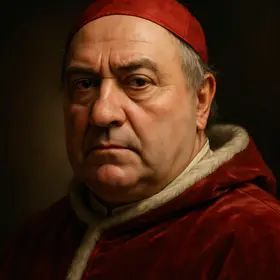
Pope Alexander VI in The Prince
Major character
Ruthless Renaissance pope who expands papal temporal power through patronage, deceit, and the agency of his son Cesare Borgia.
Who is Pope Alexander VI?
Pope Alexander VI appears in The Prince as a contemporary exemplar of how an ecclesiastical ruler can build temporal dominion by mixing money, military force, and political cunning. Machiavelli points to Alexander’s calculated use of French intervention and his patronage of Cesare Borgia to weaken traditional Roman barons, seize territories in the Romagna, and restructure papal power. Alexander promises and deploys resources, tolerates or sanctions ruthless measures (carried out by Cesare and agents like Ramiro d’Orco), and thereby reshapes the political landscape of Italy. He functions as proof that ecclesiastical principalities can be strengthened not only by divine mandate but by shrewd manipulation of factions, rewards, and cruelty used decisively. Yet Machiavelli also emphasizes the fragility of projects built on fortune and on the life of a single powerful patron: Alexander’s death and the subsequent reversals (including Cesare’s loss of support) show how sudden misfortune can undo well-planned schemes. Throughout, Alexander serves as a practical lesson about the effective (and amoral) tools rulers may use to secure and extend power.
In the book: In The Prince, Pope Alexander VI appears as a historical example of a ruler adept at manipulation and political cunning. Machiavelli highlights how, through bold promises, strategic deceit, and the calculated use of his son Cesare Borgia’s force, Alexander expanded and secured power for the papacy. He serves as a case study in how rulers may break faith and employ shrewd tactics to achieve stability and advantage.
Personality
- Cunning
- Machiavelli highlights Alexander’s use of money and alliances amid French intervention to expand papal territory (Chapter 11).
- Pragmatic
- He sponsors Cesare’s ruthless campaigns and tolerates the installation and later execution of Ramiro d’Orco to win popular approval (Chapter 7).
- Opportunistic
- Alexander exploits the chaos of French involvement to weaken Roman barons and consolidate papal rule (Chapter 11).
- Instrumental
- He treats ecclesiastical authority as a means to temporal power, using religion’s reverence as a stable base for political gains (Chapter 11).
Character arc
Alexander VI is presented from his rise as a decisive, resourceful pope who transforms a traditionally factional and weak papacy into a strong temporal power. Early examples show him deploying wealth and foreign help to back his son, Cesare, and to reduce the influence of the Orsini and Colonna factions, thereby creating a new foundation for papal governance. Machiavelli credits these measures with enabling the seizure of the Romagna and other territories and with demonstrating how an ecclesiastical principality can become unusually secure when its religious authority is combined with force and shrewd policy. However, his gains reveal a structural vulnerability: they depend heavily on the life and fortune of Alexander and his chosen agents. The narrative stops short of chronicling a long decline in Alexander’s person, but his death and the subsequent failure of Cesare’s project serve as the turning point that undoes much of the work he set in motion. Thus Alexander’s arc is less a moral transformation than a demonstration that brilliant political engineering can be suddenly undone by changes in fortune.
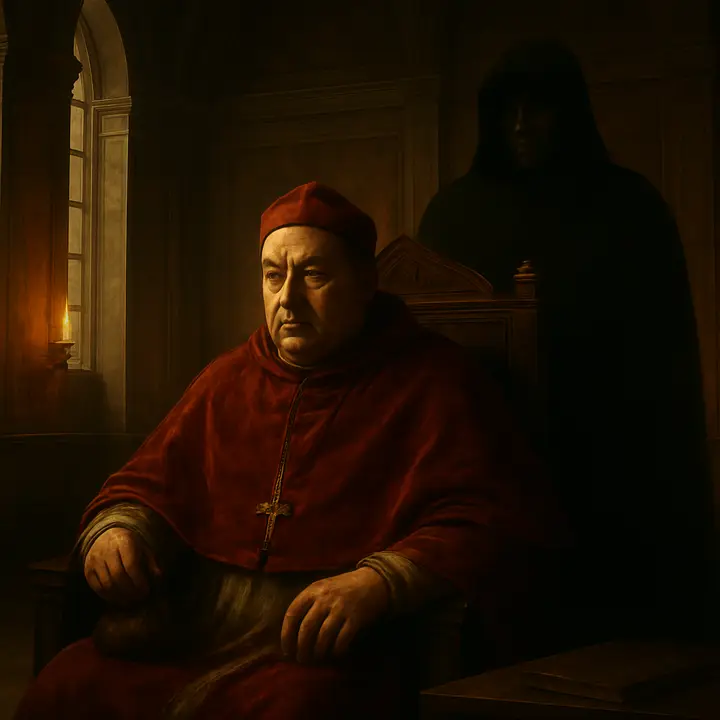
Pope Alexander VI in pictures
Relationships
- Cesare Borgia Alexander’s son and primary agent: Alexander empowers Cesare with money, offices, and military support to seize territories and suppress rivals.
- Pope Julius A political antagonist whose election after Alexander contributes to shifts in papal policy and exposes the perils of factional revenge.
- Ferdinand II of Aragon A contemporary ruler whom Machiavelli pairs with Alexander as an example of a prince who increases renown through bold enterprises and religious pretexts.
- Louis XII A foreign power whose intervention Alexander leverages—Machiavelli notes the French role in the political reorganizations Alexander exploits.
- Florentines Members of the Italian political landscape whose fortunes are affected by the papal maneuvers Alexander helps to orchestrate during the League of Cambrai and subsequent conflicts.
Why Pope Alexander VI matters
Alexander VI embodies Machiavelli’s pragmatic argument that political success often requires deceit, calculated cruelty, and the skilful use of both money and arms. As an ecclesiastical prince who turns religious authority into temporal advantage, he illustrates why ecclesiastical principalities can be unusually stable when their spiritual legitimacy is combined with ruthless statecraft. At the same time, his dependence on fortune and on a narrow set of actors (notably Cesare) underlines Machiavelli’s warnings about the fragility of regimes built on contingent advantages rather than broad, institutional foundations.
Chapters with Pope Alexander VI
More The Prince characters
 Cesare BorgiaMajor character
 Francesco SforzaMajor character
 Ferdinand II of AragonMajor character
- AAlexander the GreatMajor character
- FFlorentinesMajor character
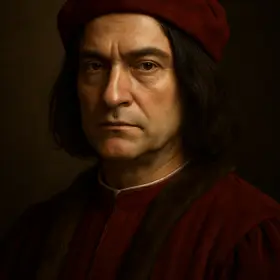 Lorenzo de' MediciMajor character
 Louis XIIMajor character
- PPope JuliusMajor character
All chapter summaries ›Characters ›
Read The Prince illustrated
Every scene in these notes comes from the Book2Life reader, where the full public-domain text is illustrated as you read, with character portraits and narration. Free in your browser and on iPhone.
