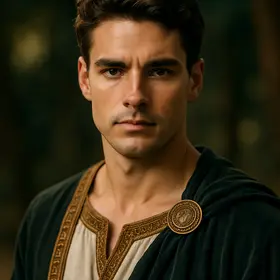
Demetrius in A Midsummer Night's Dream
Major character
An Athenian courtier favored by Egeus as Hermia’s suitor, whose pursuit triggers the lovers’ flight and fairy-caused confusion.
Who is Demetrius?
Demetrius is one of the four young Athenian lovers whose quarrel propels much of the play’s action. Presented in the Athenian court as the man Egeus has chosen for his daughter Hermia, Demetrius pursues Hermia despite her love for Lysander and despite Helena’s devoted affection for him. When Hermia and Lysander plan to flee Athens to escape Athenian law, Helena betrays their plan to Demetrius, setting the group on a chase into the enchanted wood. In the forest Demetrius responds to Helena’s pleading with harsh rejection until Oberon, witnessing Helena’s loyalty, instructs Puck to use a magical flower to amend the imbalance. Under the spell, Demetrius abruptly transfers his devotion to Helena. By dawn, after fairy interventions are corrected and the lovers awaken, Demetrius openly declares he loves Helena and abandons his claim on Hermia, allowing the couples to be reconciled and married at Theseus’s court.
In the book: Demetrius is one of the four young lovers at the heart of the comedy. Favored by Hermia’s father as her suitor, he pursues Hermia despite Helena’s steadfast love for him, setting off a chase that drives the lovers into the enchanted forest. There, his stubbornness and jealousy collide with fairy mischief, and his shifting affections help explore themes of desire, consent, and the instability of love, providing both conflict and comedy.
Personality
- Persistent
- Egeus brings Demetrius to court as the suitor chosen for Hermia, and Demetrius continues to pursue Hermia even after she rejects him and plans to flee.
- Cruel (to Helena)
- In the wood he brusquely dismisses and rejects Helena’s ardent pleading when she follows him, prompting Oberon’s intervention.
- Romantic (capricious)
- After Oberon applies the love-juice to him in the wood, he quickly declares passionate love for Helena, abandoning his previous claim on Hermia.
- Instrumental to plot
- His pursuit of Hermia and Helena’s decision to tell him of the elopement set the four lovers’ midnight chase into the forest in motion.
Character arc
At first appearance Demetrius is the socially approved suitor for Hermia and the target of Egeus’s demand for obedience; he functions as the obstacle to Hermia and Lysander’s preferred union. He pursues Hermia with determination and treats Helena’s devotion with contempt, prompting Helena to follow and plead for his love. This behavior draws Oberon’s attention in the wood, where the fairy lord decides to alter Demetrius’s feelings by applying the magic flower’s influence. After Puck anoints him, Demetrius abruptly shifts from scorn to ardor for Helena, a change that persists through the dawn. When Theseus’s hunting party wakes the lovers, Demetrius proclaims that his love for Hermia is gone and that he now loves Helena faithfully. He ends the play reconciled and paired with Helena, having undergone a sudden but decisive reversal from obstinate suitor and persecutor to devoted lover.
Relationships
- Hermia The woman his father Egeus has chosen for him; she refuses him and elopes with Lysander, making Demetrius the rival.
- Helena A desperate admirer who follows and pleads with him; his affections shift to her under fairy influence and he ultimately declares love for her.
- Egeus Egeus is Demetrius’s patron in the conflict, bringing him to court as the lawful suitor for Hermia.
- Lysander Hermia’s chosen lover and Demetrius’s romantic rival; their competition escalates to threats and confusion in the wood.
- Oberon The fairy king who intervenes by ordering Demetrius (via Puck) to be anointed so his love will turn toward Helena.
- Puck Oberon’s servant who carries out the enchantment on the Athenian lovers that alters Demetrius’s feelings.
Why Demetrius matters
Demetrius embodies the play’s interrogation of desire as unstable and socially entangled: his shifting affections expose how love can be driven by status, coercion, or arbitrary force rather than mutual consent. His cruelty to Helena and subsequent enchanted conversion force characters and audience to question the authenticity and ethics of desire, consent, and reconciliation. Dramatically, he provides the necessary conflict that moves the lovers into the fairy realm, making the comic resolutions and the play’s exploration of love’s irrationality possible.
Chapters with Demetrius
More A Midsummer Night's Dream characters
 HelenaMajor character
 HermiaMajor character
 LysanderMajor character
 PuckMajor character
 OberonMajor character
 Peter QuinceMajor character
 Robin StarvelingMinor character
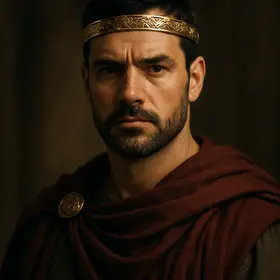 TheseusMajor character
All chapter summaries ›Characters ›
Read A Midsummer Night's Dream illustrated
Every scene in these notes comes from the Book2Life reader, where the full public-domain text is illustrated as you read, with character portraits and narration. Free in your browser and on iPhone.
Read A Midsummer Night's Dream free
