
The Duke in Adventures of Huckleberry Finn
Major character
A small‑time confidence man who calls himself the Duke and schemes to swindle towns along the Mississippi.
Who is The Duke?
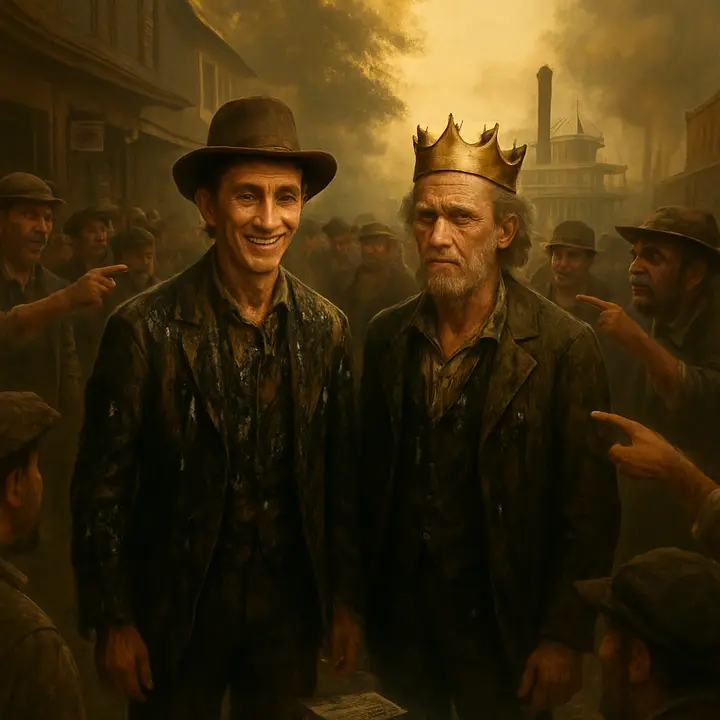
The Duke is a boastful, theatrical con man who, with the King, boards Huck and Jim’s raft and turns their voyage into a series of petty scams. He poses as nobility — “duke of Bridgewater” — and devises hustles that range from staged Shakespearean revivals and a sham circus attraction to the elaborate Wilks impersonation designed to steal an inheritance. He wants money, social deference, and the power that theatrical pretension brings; he uses performance, paperwork (handbills), and sham grief to manipulate small‑town crowds. In the Wilks episodes he plays the role of the deaf‑and‑dumb brother, helping the King enact a show of bogus kinship that fools sympathetic townspeople until suspicion arises. The Duke’s schemes propel key plot events (the Royal Nonesuch, the Wilks fraud, the selling of the Wilks slaves) and repeatedly force Huck to choose between complicity, resistance, and covert action. Though inelegant and often outwitted by circumstance and the King’s bluster, the Duke consistently generates moral crises and tests Huck’s judgment.
In the book: A small‑time confidence man who declares himself the “duke of Bridgewater,” he latches onto Huck and Jim and engineers a string of petty schemes. Through his puffed‑up airs and sham sophistication, he provides much of the book’s satire on pretension, gullibility, and fraudulent authority, while propelling several key episodes that test Huck’s judgment.
Personality
- Boastful
- He declares himself the “duke of Bridgewater” and insists on pompous titles and airs when he first joins Huck and Jim on the raft.
- Theatrical
- He organizes sham performances— rehearsing mangled Shakespeare and producing the Royal Nonesuch—using spectacle to deceive townspeople.
- Pragmatic
- He counsels using printed handbills and staged grief to keep traveling in daylight and to profit from Jim’s peril after the storm.
- Amoral
- He helps stage the Wilks fraud, sells the Wilks slaves at auction, and pockets proceeds while showing little real remorse.
- Resourceful
- He invents multiple schemes (camp‑meeting fundraising, printing jobs, theatrical baiting) to extract money from towns.
Character arc
From his first appearance as an eager, swaggering impostor aboard the raft, the Duke functions mainly as instigator: he proposes hustles, coaches performances, and manipulates crowds. Early chapters show him enjoying the power of pretended rank and theatrical deception (shabby Shakespeare shows, the Nonesuch). As the pair move into the Wilks scheme he adopts a more elaborate role—playing a grief‑stricken, deaf brother—and helps execute a long con that culminates in stealing the family’s money and selling the Wilks slaves. The Wilks episode exposes his willingness to exploit real human suffering for profit and places him in direct moral conflict with Huck, who ultimately works against the con. When the King and Duke bicker over the missing money, the Duke alternates between self‑preservation and moral posturing, rebuking the King at times but remaining complicit. After Jim is captured and sold, the Duke’s actions (and those of the King) deepen Huck’s disgust and spur Huck’s decisive choice to rescue Jim. The Duke never reforms; he remains a calculating, theatrical fraud whose schemes provoke consequences but who faces little genuine redemption by the novel’s later events.
The Duke in pictures
Relationships
- Huckleberry Finn He latches onto Huck, uses Huck to stage cons, and pressures or cajoles him while relying on Huck’s labor and discretion.
- Jim He treats Jim as an asset to be exploited—using Jim in displays (the painted Arab) and complicitly trading on Jim’s capture for schemes.
- The King He is the King’s partner in crime: they collaborate on cons but frequently quarrel, accuse one another, and humiliate each other.
- Mary Jane Wilks He helps enact the Wilks deception that wins Mary Jane’s sympathy and then benefits from the stolen money her family mourns.
- Silas Phelps His and the King’s hustles indirectly lead to Jim’s capture and sale to Silas Phelps, a consequence of their schemes.
- Tom Sawyer He intersects with Tom only indirectly—Tom later sees the public humiliation of the Duke, which forms part of the social fallout Tom and Huck witness.
Quotes by The Duke
“Gentlemen," says the young man, very solemn, "I will reveal it to you, for I feel I may have confidence in you. By rights I am a duke!”
Chapter 19The Duke dramatically announces his claim to nobility, initiating the con that disrupts the raft's peace.
“Bilgewater, I am the late Dauphin!" You bet you, Jim and me stared this time.”
Chapter 19The older man’s even more extravagant claim (to be the lost Dauphin) compounds the deception, shocking Huck and Jim.
“’Tis my fate to be always ground into the mire under the iron heel of oppression. Misfortune has broken my once haughty spirit; I yield, I submit; ’tis my fate.”
Chapter 20The duke performs a melodramatic speech to surrender the better straw bed, showcasing his theatricality and penchant for grandiose falsehoods.
“Sick Arab—but harmless when not out of his head.”
Chapter 24The duke nails this sign in front of Jim’s wigwam as part of the disguise to discourage questions while freeing Jim from being tied up.
“Broke his arm—very likely, ain’t it?—and very convenient, too, for a fraud that’s got to make signs, and ain’t learnt how.”
Chapter 29The king mocks the visitors' story about a broken arm and lost baggage to cast doubt on their claims.
“Tryin’ to give us the slip, was ye, you pup! Tired of our company, hey?”
Chapter 30The king seizes Huck and accuses him of trying to escape, setting off the chapter’s confrontation.
Why The Duke matters
The Duke embodies the novel’s satire of pretension, false authority, and small‑town gullibility: his theatrical frauds expose how performance and rhetoric can manufacture trust and sympathy. As a recurring agent of deception, he forces Huck into moral dilemmas that clarify Huck’s developing conscience; Huck’s responses to the Duke’s schemes help dramatize themes of integrity versus social performance. The Duke’s willingness to exploit grief and human vulnerability underscores the novel’s critique of opportunism and the social systems that allow frauds to prosper.
Chapters with The Duke
More Adventures of Huckleberry Finn characters
 Huckleberry FinnProtagonist
 JimMajor character
 Tom SawyerMajor character
 Pap FinnAntagonist
 The KingAntagonist
 Aunt SallyMajor character
 Miss WatsonMajor character
 Silas PhelpsMinor character
All chapter summaries ›Characters ›
Read Adventures of Huckleberry Finn illustrated
Every scene in these notes comes from the Book2Life reader, where the full public-domain text is illustrated as you read, with character portraits and narration. Free in your browser and on iPhone.
Read Adventures of Huckleberry Finn free
