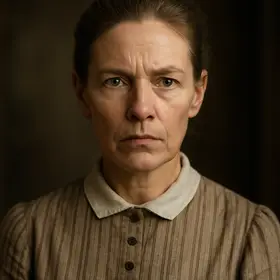
Aunt Sally in Adventures of Huckleberry Finn
Major character
Tom Sawyer’s warm, anxious aunt and housemistress whose household becomes the setting for Huck and Tom’s schemes to free Jim.
Who is Aunt Sally?
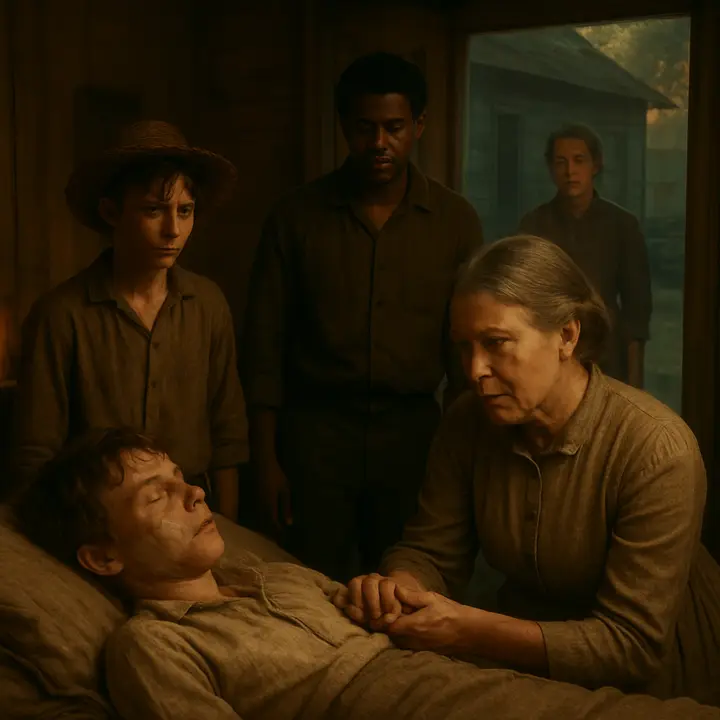
Aunt Sally Phelps is the kindly, excitable mistress of the Phelps farm who greets Huck (disguised as Tom) with open arms and maternal fussing. She wants order, propriety, and the comfort of family routines; she constantly frets over missing household items, lost children, and any hint of disorder. Over several chapters her kitchen and parlor become the stage for Tom and Huck’s elaborate, theatrical plans to free Jim: she reacts with exaggerated horror to pranks, scolds imagined misbehavior, and repeatedly forgives or frets over her presumed nephew’s antics. Though she never grasps the larger moral stakes, her genuine tenderness—staying up by the window watching for Sid, lighting a lamp through the night, and embracing the boy she believes to be Tom—creates both comic obstacles and emotional pressure that shape Huck’s decisions. Aunt Sally’s domestic authority repeatedly collides with the boys’ mischief and Tom’s romanticism, making her household the crucial, contained setting where the escape plot’s practical and theatrical elements unfold.
In the book: Aunt Sally Phelps is Tom Sawyer’s aunt and the matriarch of the Phelps farm, where Huck’s travels bring him late in the novel. She represents well‑meaning domestic authority—kind‑hearted yet anxious and easily flustered—and her household becomes the setting for key comic and tense interactions that shape Huck’s moral tests without upending the broader plot.
Personality
- Maternal
- She embraces and showers 'Tom' (Huck) with questions and affection the moment she finds him in Chapter 32.
- Anxious
- In Chapter 41 she keeps a light burning all night and watches for Sid, showing constant, fretful vigilance.
- Easily flustered
- Her repeated shrieks and exasperation at the menagerie of bugs and frogs in Chapter 39 show how quickly she is upset by disorder.
- Well-meaning
- She forgives Huck after his explanations and shows genuine concern for the household’s welfare in Chapter 41.
- Polite/Southern hospitality
- She receives Tom’s theatrical introduction with warm politeness and scolding affection when he arrives as 'William Thompson' in Chapter 33.
Character arc
Aunt Sally remains essentially the same figure from her first appearance through the novel’s end: a kind, anxious domestic authority who repeatedly oscillates between affectionate indulgence and flustered reproach. Her first encounter with the boy she believes to be Tom establishes her maternal warmth and tendency to forgive; these traits persist as Huck and Tom exploit her good nature to stage the escape. She grows increasingly alarmed by anonymous notes, missing items, and imagined threats, which heightens the household’s tension but does not harden her heart—she continues to worry and to act protectively, sending Uncle Silas out and keeping her lamp lit through the night. By the epilogue she returns to normal domestic relief and hospitality as Tom recovers and Jim is cared for, unchanged in temperament though shaken by events. Her constancy underscores the domestic world’s limited understanding of the boys’ moral complexities: she provides a stable, human center but does not undergo a moral awakening or a significant transformation herself.
Aunt Sally in pictures

Relationships
- Tom Sawyer Aunt and housemistress who treats the boy she believes is Tom with doting affection and polite scolding.
- Silas Phelps Husband and co-head of the Phelps farm whose absent-mindedness she balances with fussing and reproach.
- Huckleberry Finn She thinks Huck is Tom and shows him maternal kindness, unwittingly enabling his deception while inspiring his sympathy.
- Jim The enslaved man whose presence in her household provokes her anxiety about order but also elicits her practical concern during the crisis.
- Uncle Silas See Silas Phelps; she depends on him for physical tasks while she manages household order and emotional labor.
- Aunt Polly Fellow domestic figure in the cast list; both represent the older, steady domestic authority contrasted with the boys’ roguishness.
Quotes by Aunt Sally
““It’s you, at last!—ain’t it?””
Chapter 32Mrs. Phelps's sudden joyful recognition of Huck as Tom, which launches Huck’s impersonation and the household's affectionate response.
“For the land’s sake, what is the matter with the child? He’s got the brain-fever as shore as you’re born, and they’re oozing out!”
Chapter 40Aunt Sally mistakes the melted butter on Huck's head for a brain-fever, which inadvertently diverts suspicion and lets Huck escape interrogation.
““The door ain’t going to be locked, Tom, and there’s the window and the rod; but you’ll be good, won’t you? And you won’t go? For my sake.””
Chapter 41Aunt Sally’s tender plea to Huck reveals her genuine maternal concern and moves Huck to decide not to leave her, despite wanting to search for Tom.
Why Aunt Sally matters
Aunt Sally embodies the domestic, well-meaning but limited authority of antebellum Southern society: kind and maternal yet anxious and easily alarmed. Her household provides the contained arena where Tom’s romantic impulses and Huck’s growing conscience collide with real human consequences. By remaining unchanged—capable of tenderness but unaware of the deeper moral stakes—she highlights the novel’s tension between theatrical adventure and genuine ethical choice, and underscores the gulf between childhood romanticism and adult social order. Her presence amplifies both the comedy and the moral pressure that drive Huck’s final decision to flee rather than submit to conventional 'civilizing.'
Chapters with Aunt Sally
More Adventures of Huckleberry Finn characters
 Huckleberry FinnProtagonist
 JimMajor character
 Tom SawyerMajor character
 The DukeMajor character
 Pap FinnAntagonist
 The KingAntagonist
 Miss WatsonMajor character
 Silas PhelpsMinor character
All chapter summaries ›Characters ›
Read Adventures of Huckleberry Finn illustrated
Every scene in these notes comes from the Book2Life reader, where the full public-domain text is illustrated as you read, with character portraits and narration. Free in your browser and on iPhone.
Read Adventures of Huckleberry Finn free
