Don Quixote Chapter 24 Summary
Trifles and Travel
Don Quixote, Sancho and a cousin debate the truth of Montesinos' cave, meet travelers, and choose to spend the night at an inn.
Summary
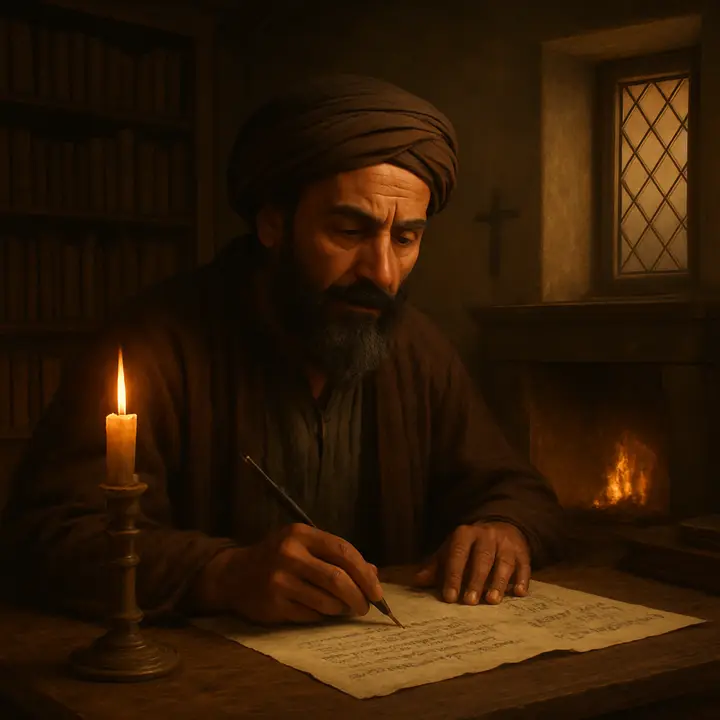
The translator (Cide Hamete Benengeli's translator) reports finding a marginal note in Hamete’s hand expressing doubt about the truth of Don Quixote’s account of the cave of Montesinos; the note neither affirms nor denies the episode and leaves judgment to the reader. The narrative then returns to the road: Don Quixote, Sancho Panza and a cousin discuss the cave-episode, Sancho’s practical gains from traveling, and possible dedications for the cousin’s books. They contemplate shelter for the night; a hermitage with a reputedly charitable hermit lies nearby, but they press on when a hurried man carrying lances and halberds urges haste toward the inn and promises “curious things.”
On the road they meet a lively youth bound for the wars who explains his poverty-driven plan to join infantry, and Don Quixote delivers an extended speech praising the military life and consolation against fear of death. Sancho privately registers skepticism about his master’s claim to have witnessed extremely improbable events but keeps his peace. Night falls and they reach the inn: Rocinante and the beasts receive good care while Don Quixote immediately inquires about the armed man, who is found in the stable tending his mule.
Key events
- Translator reports marginal note by Cide Hamete questioning the cave episode's plausibility.
- Don Quixote, Sancho and the cousin debate what was gained from travels and possible book dedications.
- A man rushes by carrying lances and halberds, saying he must reach the inn for tomorrow's uses.
- They stop at a hermitage but find only a sub-hermit and no good refreshments.
- They overtake a youthful page bound for the wars; Don Quixote gives a long speech on arms and death.
- They arrive at the inn and give best care to the beasts; Don Quixote asks after the armed man.
Analysis
This chapter performs several connective functions: it frames the Montesinos episode with metatextual doubt, then returns to the quotidian movement of the protagonists. The translator’s marginal note (attributed to Cide Hamete Benengeli) interrupts the narrative voice and explicitly invites readers to question truth, calling attention to the novel’s self-conscious storytelling and the instability of authority — a key theme in Don Quixote. The conversational exchanges between Don Quixote, Sancho and the cousin reveal character dynamics: Don Quixote’s blend of magnanimous rhetoric and literal-minded chivalric conviction contrasts with Sancho’s earthy practicality and skeptical aside. The meeting with the page and the armed man reintroduces motifs of journeying, martial aspiration, and the social realities of service, while Don Quixote’s encomium to arms underscores his values and romantic idealization of knighthood. Structurally, the chapter moves between levels of narration (translator’s commentary, direct dialogue, incidental encounters), reinforcing the novel’s layered narrative technique and its play between realism and romance. Small details — the hermitage’s lack of hospitality, the page’s patched velvet, Rocinante’s favored place in the stable — function as domestic, grounding counterpoints to the grander rhetorical claims, preserving the novel’s tension between the ridiculous and the sincere.
Important quotes
“I cannot convince or persuade myself that everything that is written in the preceding chapter could have precisely happened to the valiant Don Quixote; and for this reason, that all the adventures that have occurred up to the present have been possible and probable;”
Cide Hamete Benengeli (via translator)A marginal note expresses doubt about the veracity of the Montesinos adventure and invites the reader to judge.
“You are right," said Don Quixote; "but I should like to know, if by God’s favour they grant you a licence to print those books of yours—which I doubt—to whom do you mean to dedicate them?”
Don QuixoteDon Quixote questions the cousin about his plans for publication and dedication, revealing social concerns about patronage.
“"If I found any in water," said Sancho, "there are wells along the road where I could have had enough of it."”
Sancho PanzaSancho jokes when the sub-hermit offers cheap water, showing his earthy practicality and comic voice.
Characters in Chapter 24
- Cide Hamete Benengeli
- Don Quixote
- Sancho Panza
- the cousin
- Durandarte
- Charlemagne
- the hermit
- sub-hermit
- a man carrying lances and halberds
- the page (youth)
- The Innkeeper
- Rocinante
All chapter summaries ›Characters ›
Read Don Quixote illustrated
Every scene in these notes comes from the Book2Life reader, where the full public-domain text is illustrated as you read, with character portraits and narration. Free in your browser and on iPhone.
