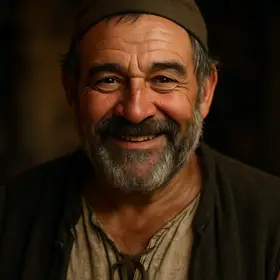
The Innkeeper in Don Quixote
Minor character
Proprietor of the roadside inn who amuses himself by indulging and managing Don Quixote’s delusions.
Who is The Innkeeper?
The innkeeper runs the modest inn that Don Quixote repeatedly mistakes for a castle. Practical, quick-witted, and amused rather than cruel, he alternates between indulging the knight-errant’s fantasies and performing small interventions to avert harm or chaos. He stages the mock knighting that launches Don Quixote’s career, provides food, lodging, and remedies, and mediates disputes among guests. When Don Quixote and Sancho return after beatings or bizarre episodes, the innkeeper supplies bandaging, a garret bed, and household props that later feed schemes to control or rescue the pair. He also houses the company—curate, barber, Dorotea, Cardenio, and others—who debate books and arrange ruses. Though chiefly amused, he sometimes asserts himself when the bill, broken property, or violence threatens his business, showing a mixture of hospitality, commerce, and social common sense throughout the episodes set at his establishment.
In the book: The innkeeper is the proprietor of the roadside inn that Don Quixote mistakes for a castle. Quick-witted and amused by the knight-errant’s delusions, he plays along, orchestrating a mock knighting that helps launch Don Quixote more fully into his adventures. As a grounded foil to Quixote’s fantasies, he highlights the gap between idealized chivalry and everyday reality.
Personality
- practical
- He provides stockfish and coarse bread and arranges beds and remedies for Don Quixote and Sancho after their beating (Chapters 2, 16, 17).
- wryly amused
- He plays along with Don Quixote’s request to be dubbed, mockingly using his account-book as a ritual before giving the accolade (Chapter 3).
- tactful
- He hastens the mock-knighting to stop patrons from stoning Don Quixote and defuses violent episodes by intervening (Chapter 3; Chapter 16).
- commercially minded
- He insists on payment for lodging and wine and becomes furious when Don Quixote and Sancho refuse to pay, treating the matter as a business dispute (Chapter 17; Chapter 46).
Character arc
The innkeeper’s behavior remains largely steady across his appearances: he is consistently a pragmatic, amused host who accommodates Don Quixote’s fantasies while protecting his household and interests. Early, he indulges the knight’s illusion by treating the inn as a castle and orchestrates the comic knighting that sends Don Quixote off on his quest (Chapter 3). In subsequent returns he continues that mixture of indulgence and control—he provides care after fights, supplies props and clothing later borrowed for the curate’s schemes, and joins conversations that examine the influence of chivalric books (Chapters 16, 24, 32). When incidents threaten order or payment, he asserts himself, demanding recompense or becoming angry at being tricked, yet he rarely escalates to vindictiveness; instead he negotiates settlements and participates in reconciliations (Chapters 17, 44, 46). By the last inn episodes he functions as a stabilizing local presence: hospitable and bemused, willing to aid dramatic plans but alert to the costs such hospitality incurs.
The Innkeeper in pictures


Relationships
- Don Quixote Host and amused foil who indulges and orchestrates the knight’s mock knighting and tends him in later returns.
- Sancho Panza Interacts as a pragmatic customer and occasional antagonist over unpaid bills and lost panniers, sharing domestic scenes and disputes.
- Maritornes House servant whose comings and goings contribute to the inn’s chaos; the innkeeper oversees her and household discipline.
- The curate Collaborates indirectly when the curate and barber borrow household items and stage plans at the inn to manage Don Quixote.
- The Barber Supplies and returns props with the innkeeper’s household items and negotiates claims (e.g., the basin/helmet episode) in the inn’s setting.
- Dorotea Acts as a guest whose presence the innkeeper accommodates while the assembled company debates and heals quarrels.
Quotes by The Innkeeper
“I cannot understand how that can be, for in truth to my mind there is no better reading in the world, and I have here two or three of them, with other writings that are the very life, not only of myself but of plenty more;”
Chapter 32The innkeeper defends books of chivalry as beloved entertainment for his workers and customers.
“We want my friend’s housekeeper and niece here now.”
Chapter 32The barber jokes about needing female accomplices to act out parts from their stratagems, highlighting the theatricality of their plot.
“Well then, attend to me everyone, for the novel begins thus.”
Chapter 32After finding a manuscript titled “Novel of the Ill-advised Curiosity,” the curate prepares to read it aloud to the assembled company, initiating a story-within-the-story.
“Let your tears cease to flow, Señor Judge, and the wish of your heart be gratified as fully as you could desire, for you have before you your worthy brother and your good sister-in-law.”
Chapter 42The curate orchestrates the unveiling of the captain and Zoraida to the judge, bringing the subplot to its emotional resolution.
Why The Innkeeper matters
The innkeeper embodies the novel’s grounding voice: he contrasts everyday pragmatism with chivalric fantasy, showing how ordinary people accommodate or profit from extraordinary tales. Through his indulgence, mock ritual, and insistence on bills, the innkeeper highlights the book’s central tensions between illusion and reality, hospitality and commerce, and generosity and self-interest. His repeated, steady presence at key scenes permits communal debate about books, madness, and social order, making the inn a recurring microcosm where Cervantes stages both comedy and critical reflection on the effects of romance literature.
Chapters with The Innkeeper
More Don Quixote characters
 Don QuixoteProtagonist
 Sancho PanzaMajor character
 Dulcinea del TobosoMinor character
- RRocinanteMajor character
 The DukeMajor character
- DDappleMinor character
 The BarberMajor character
 Cide Hamete BenengeliNarrator
All chapter summaries ›Characters ›
Read Don Quixote illustrated
Every scene in these notes comes from the Book2Life reader, where the full public-domain text is illustrated as you read, with character portraits and narration. Free in your browser and on iPhone.
