Don Quixote Chapter 27 Summary
Master Pedro and the Braying Troop
Don Quixote confronts a feuding militia whose banner ridicules a town; Sancho is struck after braying and they flee amid stones and gunfire.
Summary
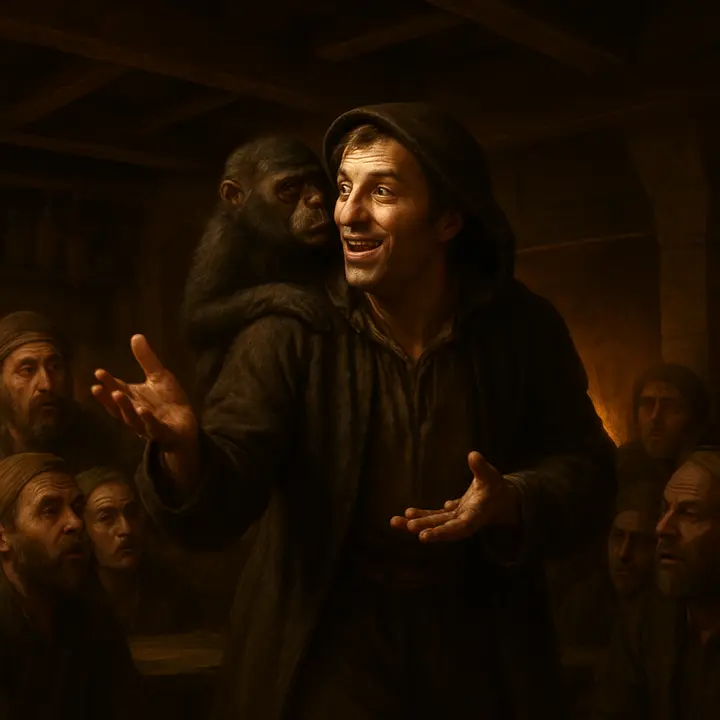
Cide Hamete (the chronicler) opens by explaining who Master Pedro and his ape are: Ginés de Pasamonte, the galley-slave Don Quixote once freed, has reinvented himself as a showman—Master Pedro—who travels with a divining ape he purchased from released Christians. Pedro learns local gossip before each performance and makes the ape appear to ‘divine’ past and present events, charging fees and building a lucrative reputation by flattering audiences or answering vaguely enough to fit many situations.
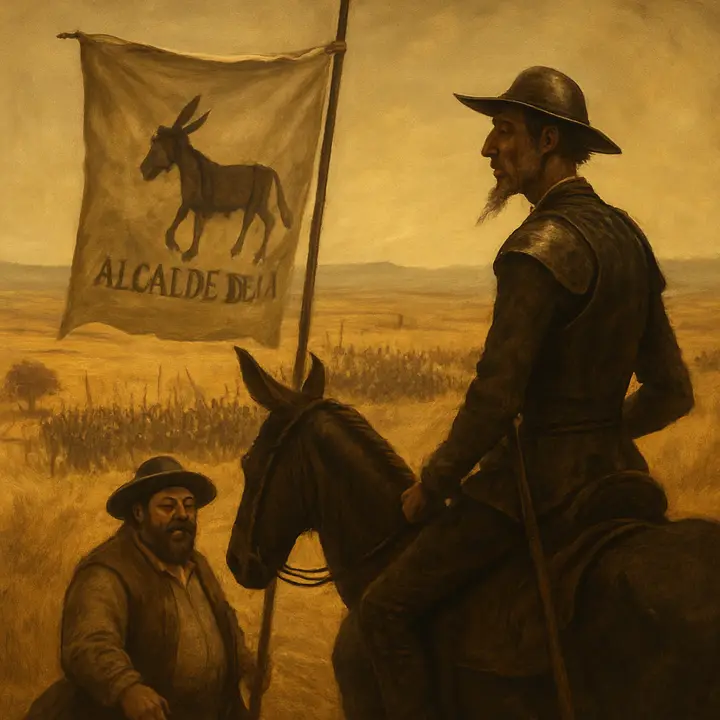
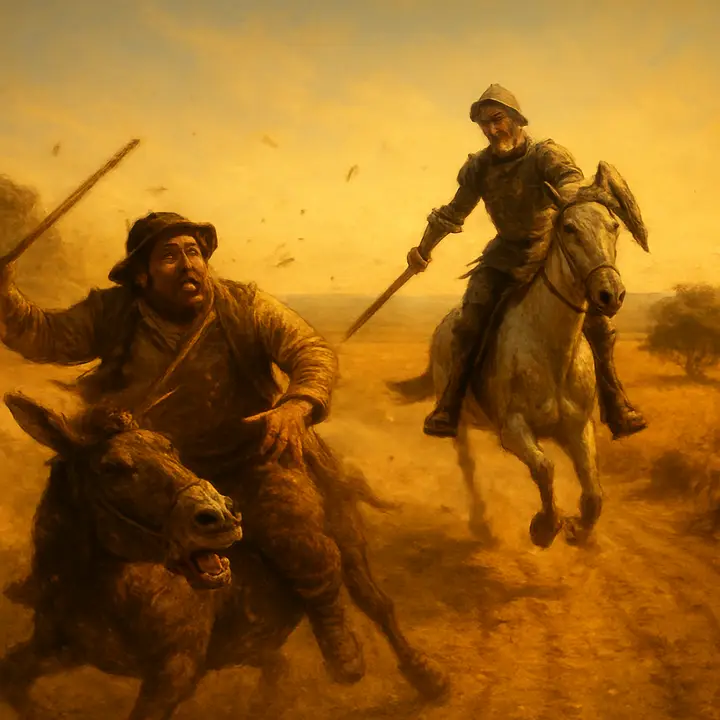
After this account, the narrative returns to Don Quixote and Sancho as they travel toward the Ebro and plan to visit Saragossa. On the third day they hear martial noises and find a large armed band bearing a banner showing a braying ass with the lines: "They did not bray in vain, Our alcaldes twain." Don Quixote interprets the device and rides among them to mediate; he delivers a long speech arguing that a whole community cannot legitimately take arms over a single insult and outlines four just causes for war (faith, life, honour/property, and service to king). Sancho, proud of his master’s learned tone, then brays loudly to demonstrate. A man near him, thinking Sancho mocks them, strikes him down with a staff. Don Quixote tries to defend Sancho but is separated and pelted with stones, crossbows, and muskets; he beats a retreat on Rocinante while Sancho, stunned, is helped onto Dapple and follows. The troop holds the field and returns to their town triumphant when no opposing force appears.
Key events
- Cide Hamete explains Master Pedro is Ginés de Pasamonte with a divining ape
- Description of Pedro's method: learning local gossip and making the ape 'divine'
- Don Quixote and Sancho travel toward the Ebro and hear military sounds
- They encounter a troop with a banner mocking a town by showing a braying ass
- Don Quixote delivers a reasoned speech against taking up arms for insults
- Sancho brays, is struck down, and Don Quixote is pelted, then flees with Sancho following
Chapter 27 in pictures
Analysis
This chapter mixes explanatory backstory with immediate action to do two things: it fills a gap in the narrative (who Master Pedro is) and it stages a characteristic episode that highlights Don Quixote’s principles clashing with social reality. The digression about Ginés de Pasamonte shows Cervantes’ interest in petty criminal reinvention and theatrical deception—Pedro’s ape is a small-scale fraud that mirrors larger social performances and the novel’s recurring theme of appearance versus reality. The martial encounter tests Don Quixote’s chivalric ethics: he advances as mediator, not to fight for honor over a joke, and articulates a quasi-legal, Christian framework for just causes—faith, life, honour, service to king—revealing both his moral earnestness and his anachronistic learning. Sancho’s impulsive bray and violent consequence underline the comic gap between ideal discourse and vulgar provocation: words and gestures have unpredictable social effects.
Narratively, the chapter shifts between narratorial commentary and immediate scene, continuing Cervantes’ layered storytelling (Cide Hamete’s oath, translator’s aside). The banner’s image (the braying ass) functions as a satirical emblem—the community’s shame made visible—and anticipates how symbols and public reputation drive local conflicts. The failure of Don Quixote’s mediation and the ugly turn to stones and blows also foreshadow that chivalric rhetoric cannot reliably control crowd violence, a recurrent structural tension in the novel between idealism and brute reality.
Important quotes
““I swear as a Catholic Christian;””
Cide Hamete BenengeliThe chronicler begins the chapter with an oath, framing his account of Master Pedro and the ape as truthful.
“They did not bray in vain, Our alcaldes twain.”
Narrator (inscription on the standard)The banner’s couplet openly mocks a town and prompts Don Quixote to intervene as mediator.
““The devil take me,” said Sancho to himself at this, “but this master of mine is a theologian; or, if not, faith, he’s as like one as one egg is like another.””
Sancho PanzaSancho reacts to Don Quixote’s long, learned speech, admiring his master’s learned tone while preparing to imitate him by braying.
Characters in Chapter 27
- Cide Hamete Benengeli
- Ginés de Pasamonte
- Master Pedro
- the ape
- Don Quixote
- Sancho Panza
- Rocinante
- Dapple
- Brunello
- Sacripante
- Don Diego Ordoñez de Lara
- Vellido Dolfos
- King Marsilio
All chapter summaries ›Characters ›
Read Don Quixote illustrated
Every scene in these notes comes from the Book2Life reader, where the full public-domain text is illustrated as you read, with character portraits and narration. Free in your browser and on iPhone.
