Don Quixote Chapter 35 Summary
Dulcinea's Required Penance
A mock-enchanter demands Sancho accept 3,300 lashes to restore Dulcinea, and after bargaining he reluctantly agrees to the penance.
Summary
In a staged, theatrical procession arranged by the duke and duchess, Don Quixote, Sancho Panza, and their hosts encounter an elaborate triumphal car bearing a veiled nymph and a gruesome figure who reveals himself as Merlin. The car, drawn by six grey mules and attended by white-robed penitents, halts before the party; the veiled nymph and Merlin remove their coverings to display, respectively, a dazzling beauty and a fleshless image of Death. Merlin explains that he has come to propose the remedy for Dulcinea del Toboso’s enchantment: for her to be restored to her original noble form, Sancho must willingly endure three thousand three hundred lashes, or allow them to be inflicted by another and at a time of his choosing.
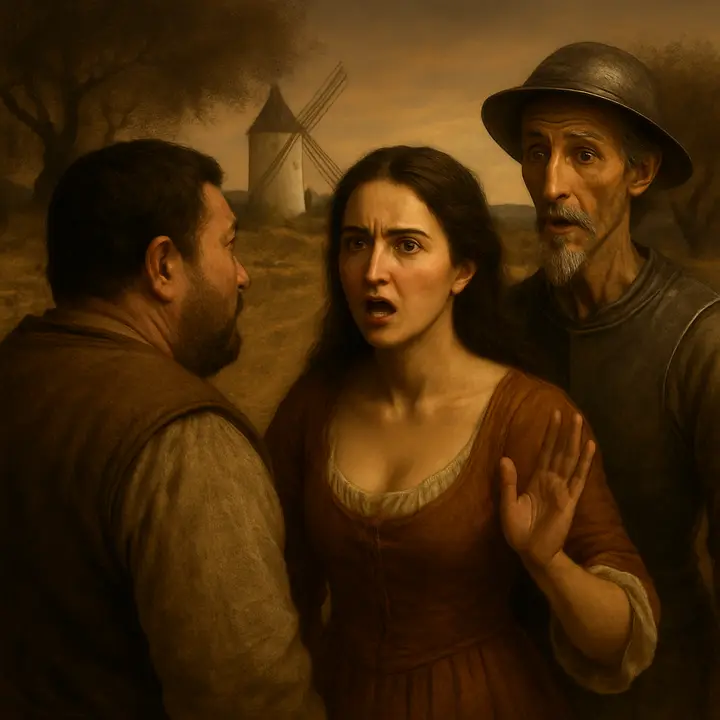
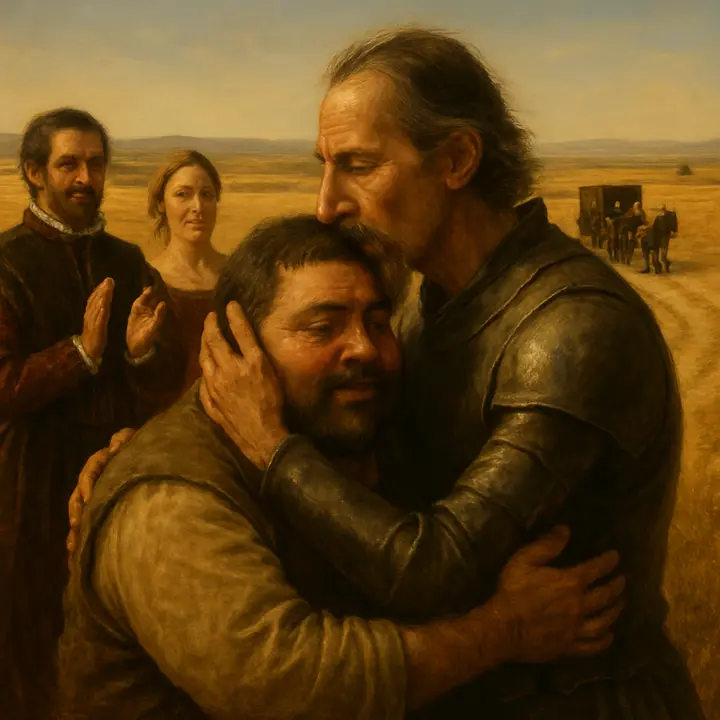
Sancho reacts with outrage and comic indignation, refusing to submit to such corporal penance and complaining that he is no one’s whipping-post. Don Quixote threatens to force the issue by binding Sancho and doubling the lashes, but Merlin insists the act must be voluntary to have magical effect. The silver-veiled nymph (actually the staged Dulcinea) addresses Sancho directly with operatic appeals, calling on his compassion and invoking Don Quixote’s desperate condition—his soul figuratively lodged in his throat—to press for compliance. The duke and duchess urge Sancho to show gratitude and magnanimity, to accept the lashes and thereby secure the governorship and Dulcinea’s release. After bargaining for conditions (no blood, counting of stripes, choice of timing), Sancho capitulates and agrees to the penance. Music and celebratory salvoes follow; Don Quixote embraces Sancho, and the mock pageant departs as dawn breaks, the aristocratic hosts pleased at how successfully their prank has been executed and resolved to continue their amusement.
Key events
- Triumphal car appears with veiled nymph and a skeletal figure who identifies himself as Merlin
- Merlin declares Dulcinea’s disenchantment requires Sancho to receive 3,300 lashes willingly
- Sancho adamantly refuses, protests comic grievances and bargaining points
- The nymph/Dulcinea addresses Sancho directly, pleading and shaming him into submission
- Duke and duchess pressure Sancho to accept; Merlin offers terms and assurances
- Sancho agrees on conditions (no drawing blood, counting, timing), music and celebration follow
Chapter 35 in pictures
Analysis
This chapter functions as a staged moral and comic test that reinforces several of the novel’s central tensions: the collision between idealism and farce, the exploitation of chivalric devotion for aristocratic entertainment, and Sancho’s perpetual negotiation between self-interest and loyalty. The mock-enchantment device reframes Dulcinea’s fate as something manipulated by theatrical contrivance rather than true magic, highlighting the novel’s questions about perception, authorship, and the power of performance. Merlin’s rigid requirement that the penance be voluntary emphasizes the interplay of free will and spectacle—Sancho’s consent transforms a cruel joke into an ostensibly redemptive act, complicating the ethical line between charity and humiliation.
Narratively, the scene is theatrical: music, costumes, and scripted speeches foreground the Dukes’ control and the artificiality of the episode, while the intimate exchange between Sancho and the faux-Dulcinea exposes character. Sancho’s comic rhetoric—his proverbs, bargaining clauses, and earthy refusal—contrasts with Don Quixote’s solemn, melodramatic devotion, sharpening their complementary roles. Symbolically, the skeletal Merlin and the veiled nymph (beauty revealed) evoke death and restoration motifs; the lashes function as both a ludicrous bodily test and a ritual of potential rebirth. The chapter also foreshadows further manipulations of the pair by the nobles, and continues Cervantes’s technique of dramatizing how stories are staged, narrated, and believed within social hierarchies.
Important quotes
“To thee, great hero who all praise transcends, La Mancha’s lustre and Iberia’s star, Don Quixote, wise as brave, to thee I say— For peerless Dulcinea del Toboso Her pristine form and beauty to regain, ’Tis needful that thy esquire Sancho shall, On his own sturdy buttocks bared to heaven, Three thousand and three hundred lashes lay, And that they smart and sting and hurt him well.”
MerlinMerlin announces the astonishing condition for Dulcinea’s disenchantment: Sancho must willingly receive 3,300 lashes, setting the chapter’s central conflict.
““By all that’s good,” exclaimed Sancho at this, “I’ll just as soon give myself three stabs with a dagger as three, not to say three thousand, lashes. The devil take such a way of disenchanting! I don’t see what my backside has got to do with enchantments.”
Sancho PanzaSancho’s outraged, comic refusal establishes his earthy pragmatism and provides much of the chapter’s humor and moral stubbornness.
““There will be no need to let you know of any over,” said Merlin, “because, when you reach the full number, the lady Dulcinea will at once, and that very instant, be disenchanted, and will come in her gratitude to seek out the worthy Sancho, and thank him, and even reward him for the good work.”
MerlinMerlin reassures Sancho by promising precise magical accounting and immediate reward upon completion, facilitating Sancho’s reluctant consent.
Characters in Chapter 35
- Merlin
- Dulcinea del Toboso
- Sancho Panza
- Don Quixote
- The Duke
- The Duchess
- Montesinos
All chapter summaries ›Characters ›
Read Don Quixote illustrated
Every scene in these notes comes from the Book2Life reader, where the full public-domain text is illustrated as you read, with character portraits and narration. Free in your browser and on iPhone.
