Don Quixote Chapter 34 Summary
The staged enchantment
The duke and duchess stage an elaborate nocturnal spectacle—a mock procession of enchanters and demons—to convince Don Quixote that Dulcinea can be disenchanted.
Summary
The duke and duchess, amused by Don Quixote and Sancho and bent on further practical jokes, use Don Quixote’s own account of Montesinos’ cave as the basis for a new trick. They outfit Don Quixote and Sancho for a grand hunt and lead them into a wooded pass between two mountains where a staged boar-hunt is carried out with great ceremony. Sancho foolishly tries to escape the boar by climbing an oak, falls and becomes suspended by a broken bough, and is rescued by Don Quixote; the party strips the slain boar and retires to richly furnished tents where they dine and converse about hunting, governance, and proverbs.
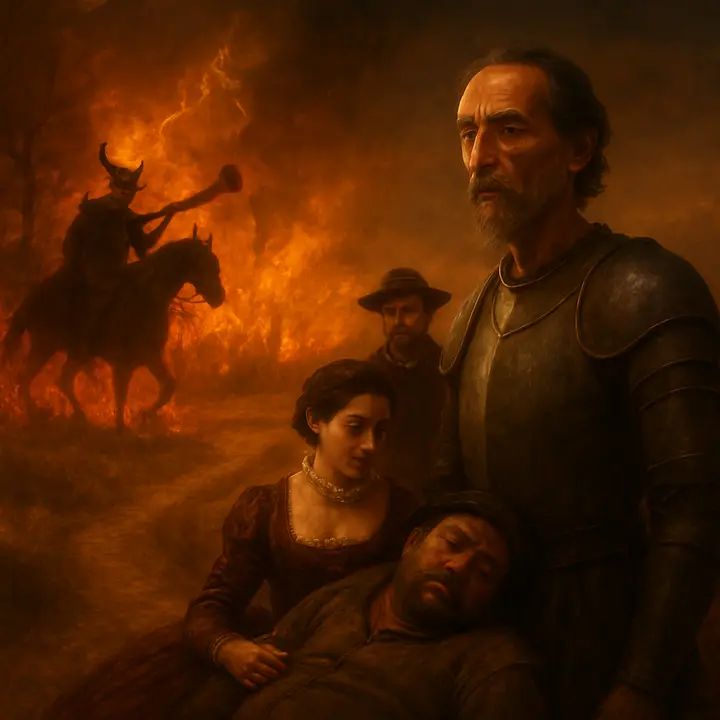
As evening falls a contrived phenomenon begins: lights, smoke, and an orchestrated cacophony of horns, drums, and military sounds. A postillion disguised as a demon announces that a procession of enchanters is bringing Dulcinea del Toboso, under enchantment, to show Don Quixote the means of her disenchantment. Sancho and Don Quixote are shaken—Sancho by the apparent supernatural corroboration of Dulcinea’s enchantment, Don Quixote by doubts about what he experienced in the cave of Montesinos. The spectacle continues with carts bearing mock sages and enchanters—Lirgandeo, Alquife, and the menacing Archelaus—each proclaimed aloud as it passes, followed by music and further uncanny effects that deepen the ruse and prepare the ground for the next staged event.
Key events
- The duke and duchess plan a large-scale prank based on Don Quixote’s cave tale.
- A ceremonial hunt is organized; Sancho falls from an oak and is rescued.
- The party feasts in sumptuous tents and debates hunting and governance.
- At twilight, staged lights and military noises begin across the wood.
- A demon-postillion proclaims Dulcinea’s enchanted arrival to be shown to Don Quixote.
- Carts bearing mock sages and enchanters (Lirgandeo, Alquife, Archelaus) pass by.
Analysis
This chapter functions as a pivot from private comic intimacy to a theatrical, collective deception: the aristocratic hosts marshal resources—costumes, music, lights, actors—to manufacture an apparent supernatural event for their amusement and to test Don Quixote’s fidelity to chivalric verities. The episode advances key themes: reality versus appearance (the aristocrats’ spectacle deliberately blurs that line), the social use of fiction (nobility as directors of narrative for entertainment), and the vulnerability of belief (Sancho’s superstition and Don Quixote’s wavering certainty after Montesinos). Structurally it elongates the novel’s play between staged and authentic adventures: here an “adventure” is explicitly produced by human agency rather than fate or enchantment, setting up moral and epistemic questions about authorship and authority. Symbolically, the procession of sages and enchanters resembles a mock trial of Don Quixote’s convictions; the noisy, multisensory trickery (lights, horns, creaking wheels) underscores how spectacle can overwhelm reason. Narratively Cervantes layers perspectives—reportage by the narrator, performed voices within the game, and the characters’ interior reactions—so the reader sees both the artifice and its effects; the chapter thereby foregrounds the novel’s sustained interest in storytelling as social practice and in how class and power shape who gets to shape belief.
Important quotes
“I am the devil; I am in search of Don Quixote of La Mancha; those who are coming this way are six troops of enchanters, who are bringing on a triumphal car the peerless Dulcinea del Toboso; she comes under enchantment, together with the gallant Frenchman Montesinos, to give instructions to Don Quixote as to how, she the said lady, may be disenchanted.”
postillion (disguised as a demon)Announces the staged procession and explicitly names the ruse’s purpose: to show Don Quixote Dulcinea under enchantment.
“I am the sage Lirgandeo”
Lirgandeo (from the cart)One of the mock sages presented during the nocturnal procession, signaling the theatrical nature of the spectacle.
“I am the enchanter Archelaus, the mortal enemy of Amadis of Gaul and all his kindred,”
Archelaus (from the cart)A deliberately menacing title meant to heighten the illusion of supernatural and chivalric stakes.
Characters in Chapter 34
- Don Quixote
- Sancho Panza
- The Duke
- The Duchess
- Dapple
- Cide Hamete Benengeli
- Montesinos
- Dulcinea del Toboso
- Lirgandeo
- Alquife
- Archelaus
- a postillion (disguised as a demon)
- the huntsmen
All chapter summaries ›Characters ›
Read Don Quixote illustrated
Every scene in these notes comes from the Book2Life reader, where the full public-domain text is illustrated as you read, with character portraits and narration. Free in your browser and on iPhone.
