Don Quixote Chapter 43 Summary
The Muleteer’s Story and the Prank
A young woman reveals the musician she loves is a noble in disguise, while Don Quixote is tricked and left hanging by the wrist at the inn.
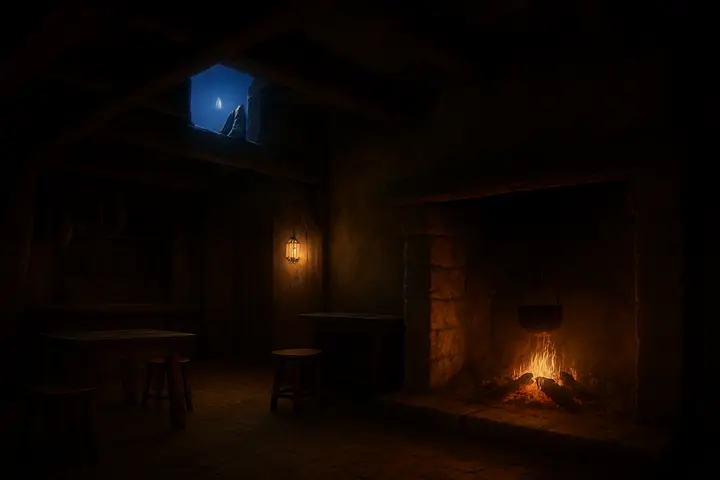
Summary
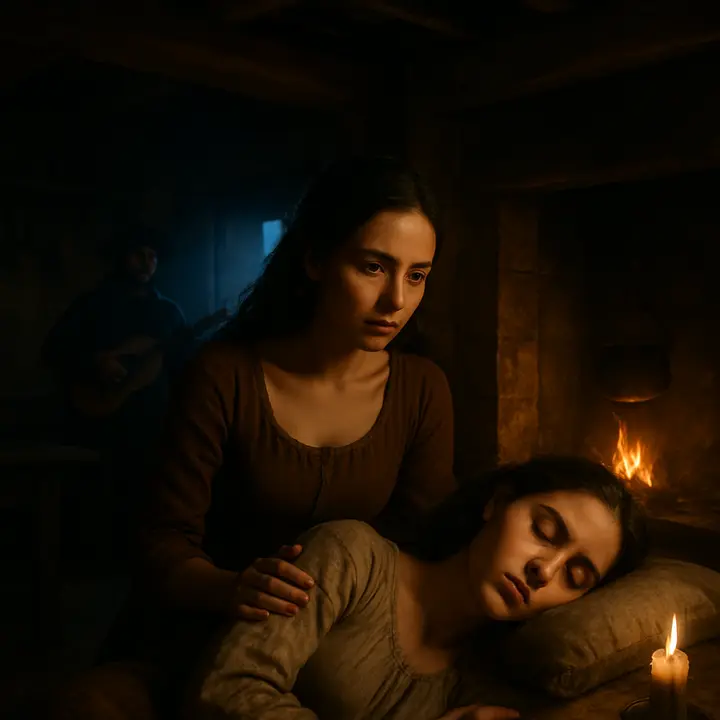
At the inn where Don Quixote and his company are staying, a singer rouses Clara from sleep; she reveals to Dorotea (Dorothea) that the moving voice belongs to a young man she loves — the son of a gentleman of Aragon who disguises himself as a muleteer to watch her. Clara explains their furtive signals, her fear of discovery by their parents, and her torment at seeing him disguised and following her in hardship. Dorotea comforts her and promises to try to arrange a favorable outcome by daylight, while Clara frets about the social gap between them and her youth.
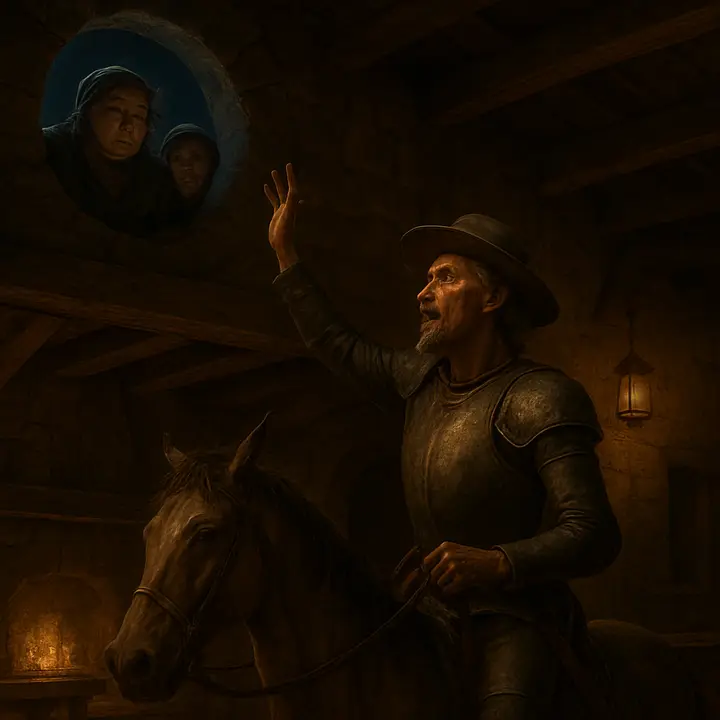
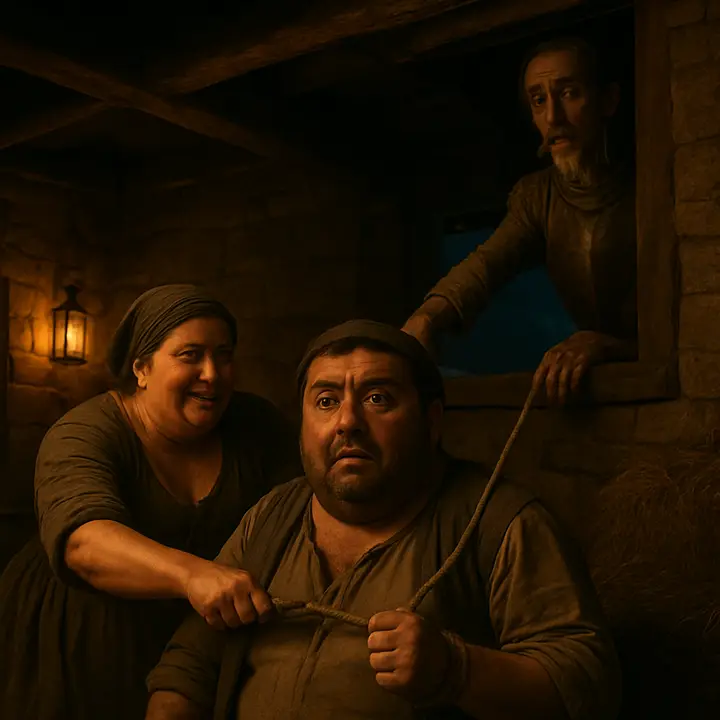
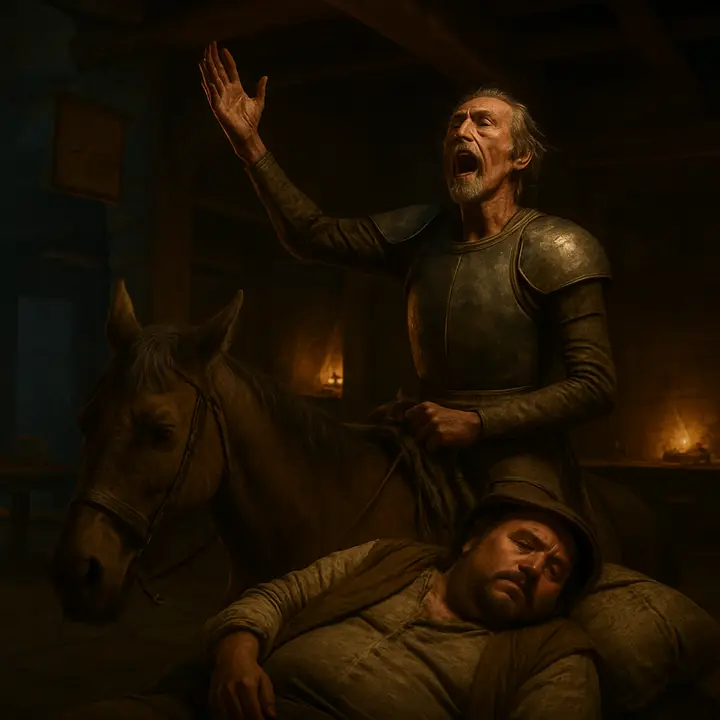
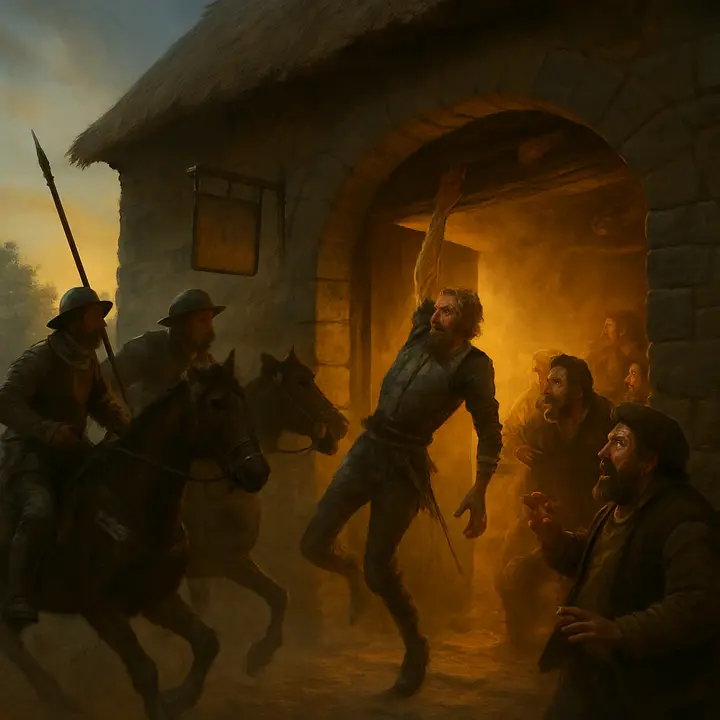
Meanwhile, two local girls (the landlady’s daughter and Maritornes) spy on Don Quixote as he stands sentinel outside the inn, making a florid speech to his imagined lady, Dulcinea del Toboso. They amuse themselves by luring him to a hole in the wall, feigning a lovelorn damsel; Maritornes slips a halter over his wrist and ties him fast to the bolt of the straw-loft, leaving him suspended by one arm through the hole. Don Quixote interprets his predicament as enchantment and invokes all manner of imaginary aid. At dawn four armed travellers arrive and knock; Don Quixote pompously refuses them entry to his supposed castle. A horse’s movement finally dislodges Don Quixote’s balance and he nearly falls, painfully suspended just above the ground and certain his enchantment will persist.
Key events
- The singer’s song wakes Clara; she is distraught and whispers her tale to Dorotea.
- Clara reveals the musician is a nobleman who disguises himself as a muleteer to follow her.
- Dorotea promises to help at daylight; Clara worries about class and her age.
- Two women spy on Don Quixote and trick him by pretending to be a lovelorn lady.
- Maritornes ties Don Quixote’s wrist to the straw-loft bolt, leaving him suspended.
- Dawn brings four armed travellers to the inn; Don Quixote challenges them, still tied and believing himself enchanted.
Chapter 43 in pictures
Analysis
This chapter pairs a tender, realistic episode of youthful, forbidden affection with broad comic satire aimed at Don Quixote’s idealism. Clara’s confession anchors the chapter in human feeling: her account of signals, shame, and hope presents love as patient, secretive, and constrained by social rank — a grounded emotional counterpoint to the knight’s rococo language about Dulcinea. Dorotea’s sympathetic, practical response highlights her role as a prudent mediator between romantic impulse and social reality.
The second strand — the prank on Don Quixote — continues Cervantes’s investigation of appearance versus reality and the novel’s sustained parody of chivalric delusion. Don Quixote’s theatrical address to a supposed lady and his immediate interpretation of the prank as enchantment show how his inner myth-making shapes and distorts ordinary events, providing comedy but also revealing his vulnerability. The chapter uses juxtaposition (sincere love vs. mock romance), dramatic irony (readers see the trick while Don Quixote does not), and a confined inn setting to examine themes of identity, social performance, and the gap between language and matter. The rope-and-hole gag foreshadows further humiliation and underlines the novel’s recurrent technique of testing the knight’s ideals against mundane consequences.
Important quotes
“This singer, dear señora, is the son of a gentleman of Aragon, lord of two villages, who lives opposite my father’s house at Madrid; and though my father had curtains to the windows of his house in winter, and lattice-work in summer, in some way—I know not how—this gentleman, who was pursuing his studies, saw me, whether in church or elsewhere, I cannot tell, and, in fact, fell in love with me, an”
Doña ClaraClara explains to Dorotea how the singer is actually a nobleman in disguise and how she secretly loves him.
“Oh my lady Dulcinea del Toboso, perfection of all beauty, summit and crown of discretion, treasure house of grace, depositary of virtue, and finally, ideal of all that is good, honourable, and delectable in this world!”
Don QuixoteDon Quixote declaims a grandiose, chivalric address to his imagined lady while the two women listen and plan their prank.
“she passed it over his wrist and coming down from the hole tied the other end very firmly to the bolt of the door of the straw-loft.”
NarratorNarrator describes Maritornes fastening the halter to Don Quixote’s wrist, which leaves him suspended and establishes the chapter’s comic climax.
Characters in Chapter 43
- Dorotea
- Doña Clara
- Maritornes
- Don Quixote
- Sancho Panza
- Dulcinea del Toboso
- Rocinante
- the landlady’s daughter
- the host / Innkeeper
- four travellers
- Lirgandeo
- Alquife
- Urganda
- Luscinda
All chapter summaries ›Characters ›
Read Don Quixote illustrated
Every scene in these notes comes from the Book2Life reader, where the full public-domain text is illustrated as you read, with character portraits and narration. Free in your browser and on iPhone.
