
Flask in Moby-Dick
Major character
The Pequod’s third mate: short, practical, combative, and focused on the hunt rather than metaphysical concerns.
Who is Flask?
Flask is the Pequod’s third mate, a compact, sturdy officer from Tisbury who treats the voyage and its whales as practical rivals to be bested. He wants straightforward success in whaling—securing whales, earning pay, and enforcing shipboard discipline—rather than philosophical speculation or challenges to command. Across the chapters where he appears, Flask pairs with the towering harpooneer Daggoo, leads and mans a boat in multiple lowerings and chases, helps secure carcasses, and carries out deck duties with brisk competence. He provides comic and blunt counterpoint to Stubb’s ironic levity and Starbuck’s moral seriousness, often reducing grand symbols (like Ahab’s doubloon) to monetary value and viewing omens with skeptical, earthy pragmatism. In action scenes he shows steadiness and courage: he helps right boats, manages men during storms and crowds of whales, and survives capsizes and close calls. Flask’s presence embodies the everyday whaleman’s ethic—duty, efficiency, and hard-headedness—grounding the Pequod’s more extreme passions in routine seafaring labor.
In the book: Flask is the Pequod’s third mate, a tough, no‑nonsense officer who leads his whaleboat with practical courage and little patience for metaphysics. Paired with the towering harpooneer Daggoo, he provides a grounded counterpoint to the more contemplative Starbuck and jovial Stubb. His role underscores the novel’s spectrum of temperaments at sea—valuing duty, efficiency, and the simple calculus of the hunt—while helping drive several key chases and the daily discipline aboard ship.
Personality
- Practical
- In the doubloon scene Flask immediately reduces the coin to its monetary worth and imagines what it will buy.
- Combative
- Introduced as short, stout, and combative toward whales, Flask treats them like personal rivals to be destroyed (Chapter 27).
- Steadfast
- He leads and steadies his boat through dangerous chases, including the capsizing after the Jungfrau encounter (Chapter 81).
- Unspectacular courage
- During the Great Armada chase and other lowers Flask performs his duties without melodrama, rowing and fighting as required (Chapter 87).
- Skeptical
- He presses Stubb about contradictions in Ahab’s danger and treats omens in a blunt, practical way while on the forecastle bulwarks (Chapter 121).
Character arc
Flask’s character remains largely constant from his early introductions through the Pequod’s final chases. He first appears as a compact, aggressive mate who relishes the hunt and views the voyage in practical, even jocular terms (Chapter 27). Throughout the voyage he repeatedly performs the hands-on work of whaling—lowering boats, managing crews, securing whales’ carcasses, and helping pull men and gear through capsizes and storms (Chapters 48, 73, 81, 87, 119). He functions as an operational anchor: when other officers debate Ahab’s obsessions, Flask focuses on immediate tasks and the tangible outcomes of the chase (Chapter 99). Even amid extraordinary events—the typhoon with its spectral lights, eerie sounds, and Ahab’s needle ritual—Flask’s responses are workmanlike rather than theological (Chapters 119, 124). He neither converts to Ahab’s monomania nor openly opposes it; instead he persists in fulfilling his mate’s duties until the final collective pursuit, where his steady competence continues alongside Stubb and Starbuck. In short, Flask refuses transcendence and remains the ship’s pragmatic executor to the end.
Relationships
- Daggoo Daggoo is Flask’s harpooneer and physical counterpoint—his towering presence emphasizes Flask’s compact, combative manner (Chapter 27).
- Stubb Stubb is Flask’s frequent companion in banter and boat-work; they exchange jokes and practical counsel while lowering and securing whales (Chapters 31, 73, 121).
- Starbuck Starbuck stands as the moral and procedural superior whose prudence contrasts with Flask’s blunt efficiency; Flask defers to Starbuck’s authority in operations (Chapter 34).
- Ahab Ahab’s monomania frames Flask’s duties: Flask resists metaphysical speculation and continues practical labor under Ahab’s dominating quest (Chapters 36, 124).
- Queequeg Queequeg appears alongside Flask in communal scenes and hunts; they share the deck’s practical choreography during chases and dinner (Chapters 34, 73).
- Tashtego Tashtego, harpooneer to Stubb, operates alongside Flask’s boat during multi-boat pursuits, entwining their efforts in captures (Chapters 81, 134).
Quotes by Flask
“The great live squid, which, they say, few whale-ships ever beheld, and returned to their ports to tell of it.”
Chapter 59Flask identifies the phenomenon and signals its rarity, setting up Melville's shift into sailors' lore and natural speculation.
““Do you suppose Fedallah wants to kidnap Captain Ahab?””
Chapter 73Flask voices the sailors' superstitious fears about Fedallah’s mysterious relationship with Ahab during their banter while towing the whale.
Why Flask matters
Flask represents the ordinary whaleman’s ethos—practical, unromantic, and task-focused—serving as a foil to Ahab’s metaphysical rage and Starbuck’s moral qualms. He underlines one of the novel’s central tensions: different responses to danger and obsession at sea. Where Ahab seeks meaning through vengeance and Starbuck confronts conscience, Flask reduces experience to work, profit, and blunt fact. This grounding voice shows how the Pequod’s voyage is sustained by routine competence even as higher passions escalate, and his stubborn practicality highlights the novel’s exploration of temperament, duty, and the limits of human interpretation in the face of unknowable forces.
Chapters with Flask
More Moby-Dick characters
 Ahab
Ahab Ishmael
 Stubb
Stubb Queequeg
 Starbuck
 Tashtego
 Moby Dick
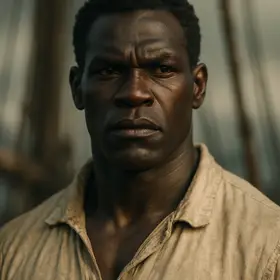 Daggoo
All chapter summaries ›Characters ›
Read Moby-Dick illustrated
Every scene in these notes comes from the Book2Life reader, where the full public-domain text is illustrated as you read, with character portraits and narration. Free in your browser and on iPhone.
