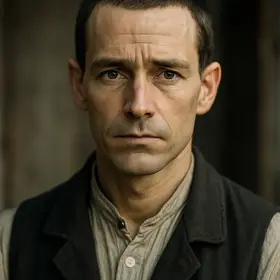
Starbuck in Moby-Dick
Major character
The Pequod’s cautious, conscientious first mate who serves as the ship’s moral and practical counterweight to Ahab’s obsession.
Who is Starbuck?
Starbuck is the Pequod’s chief mate: a compact, hardy Nantucketer of Quaker descent and an experienced whaleman who prizes prudence, duty, and the lives of his men. He commands one of the boats with Queequeg as his harpooneer and runs ordinary whaling business—cutting in, lowering, and bringing whales alongside—while also serving as the ship’s chief moral voice. Throughout the voyage he repeatedly objects to Captain Ahab’s monomania on both practical and ethical grounds: he protests Ahab’s vow of vengeance on the quarter-deck, argues to save cargo when the hold leaks, and privately struggles with Ahab’s corruption of the crew. Starbuck oscillates between obedience—keeping the ship’s routine and following orders—and inward resistance, even contemplating but ultimately refusing to shoot Ahab to protect the men. He orders Queequeg’s coffin converted into a life-buoy and continues to manage deck duties through storms and chases, trying wherever possible to limit reckless danger while fulfilling his responsibilities.
In the book: Starbuck is the Pequod’s first mate—competent, conscientious, and deeply principled—who serves as the ship’s moral ballast. A seasoned whaleman and cautious leader, he values duty, faith, and the crew’s safety, providing a sober counterpoint to more reckless impulses aboard and shaping the novel’s central tensions through his quiet resolve.
Personality
- Conscientious
- He insists the leaking casks be tended and urges hoisting the Burtons to save the cargo (Ch. 109).
- Principled
- On the quarter-deck he objects that Ahab’s quest for vengeance is mad and blasphemous (Ch. 36).
- Cautious
- He prefers men who know fear and forbids lowering after sundown or needless risks in the boats (Ch. 26).
- Devoted family man
- Memories of his young Cape wife and child temper his daring and inform his reluctance to reckless peril (Ch. 26).
- Morally torn
- He lifts and tests a musket at Ahab’s bolted door, tempted to act but ultimately cannot bring himself to shoot (Ch. 123).
Character arc
Starbuck first appears as a steady, experienced chief mate who values the practical work of whaling and the lives of his crew. Early on he fulfills ordinary duties—checking readiness with the owners, taking his place at the cabin-table, and leading a boat with Queequeg—while also being positioned as the rational foil to Ahab’s secrecy and mania. As Ahab reveals his vendetta, Starbuck increasingly feels overmanned and morally alarmed: he objects publicly on the quarter-deck and privately agonizes over Ahab’s influence on the crew (Chs. 36, 38). He acts to preserve ordinary goods and lives—ordering the Burtons hoisted (Ch. 109), directing that Queequeg’s coffin be repurposed as a life-buoy (Chs. 126–127), and managing crucial deck work during storms (Ch. 119). His conflict crescendos when he tests the musket with the intent to kill Ahab and save the men but refuses to fire (Ch. 123). In the chase sequences he remains dutiful, obeying orders and commanding his boat, but his moral resistance does not gain forceful effect; he ends the narrative as the faithful, anguished counterforce to Ahab’s self-destruction, having neither overthrown the captain nor abandoned his post.
Relationships
- Ahab Starbuck is Ahab’s chief mate who respects rank but increasingly opposes Ahab on moral and practical grounds, culminating in private temptation to kill him (Chs. 36, 109, 123).
- Queequeg Queequeg serves as Starbuck’s harpooneer and companion in many boat operations, notably in the swamping incident when Queequeg holds the lantern (Chs. 48, 72).
- Peleg Peleg, one of the owners, coordinates departure with Starbuck aboard and pressures the ship’s readiness at embarkation (Ch. 22).
- Bildad Bildad, the other owner, works alongside Peleg at sailing and checks with Starbuck that everything is set before the Pequod leaves (Ch. 22).
- Stubb Stubb is the second mate whose levity and fatalism contrast Starbuck’s sobriety; they cooperate in deck work though they interpret events differently (Chs. 27, 34, 119).
- Queequeg's coffin Not a person but a practical object: Starbuck orders the coffin converted into a life-buoy, showing his concern for ship safety (Chs. 126–127).
Quotes by Starbuck
“My soul is more than matched; she’s overmanned; and by a madman!”
Chapter 38Starbuck opens by describing how completely Ahab has overwhelmed his reason and will.
“look, how he lords it over all below!”
Chapter 38Starbuck condemns Ahab's commanding dominance of the ship and crew.
“The white whale is their demigorgon.”
Chapter 38Starbuck characterizes the crew's worshipful, almost religious devotion to the whale as a dark force guiding them.
“Almost rather had I seen Moby Dick and fought him, than to have seen thee, thou white ghost!”
Chapter 59Starbuck expresses visceral dread: an anonymous, grotesque creature scares him more than a known enemy.
“Thou hast outraged, not insulted me, sir; but for that I ask thee not to beware of Starbuck; thou wouldst but laugh; but let Ahab beware of Ahab; beware of thyself, old man.”
Chapter 109Starbuck, controlling his anger as he leaves the cabin, warns Ahab that his greatest danger is himself.
“Loveliness unfathomable, as ever lover saw in his young bride’s eye!—Tell me not of thy teeth-tiered sharks, and thy kidnapping cannibal ways.”
Chapter 114Starbuck’s reverent speech, choosing faith and fancy over harsh facts as he gazes into the sea.
Why Starbuck matters
Starbuck embodies the novel’s moral, practical, and human counterpoint to Ahab’s metaphysical rage. He represents reason, religious conscience, and the obligations of ordinary labor—valuing family, duty, and measured courage—thus foregrounding the ethical costs of monomania. Through his repeated objections, anguished restraint, and final failure to check Ahab, the book dramatizes how principled humanity is overwhelmed by charismatic obsession and how institutional rank can both bind and betray moral action. Starbuck therefore crystallizes themes of duty versus fanaticism, the limits of individual resistance, and the tragic consequences when practical morality yields to destructive passion.
Chapters with Starbuck
- Chapter 21
- Chapter 22
- Chapter 26
- Chapter 27
- Chapter 34
- Chapter 36
- Chapter 38
- Chapter 39
- Chapter 40
- Chapter 41
- Chapter 46
- Chapter 48
- Chapter 49
- Chapter 51
- Chapter 59
- Chapter 61
- Chapter 64
- Chapter 67
- Chapter 71
- Chapter 72
- Chapter 81
- Chapter 87
- Chapter 99
- Chapter 108
- Chapter 109
- Chapter 110
- Chapter 114
- Chapter 118
- Chapter 119
- Chapter 123
- Chapter 124
- Chapter 126
- Chapter 127
- Chapter 130
- Chapter 132
- Chapter 133
- Chapter 134
- Chapter 135
More Moby-Dick characters
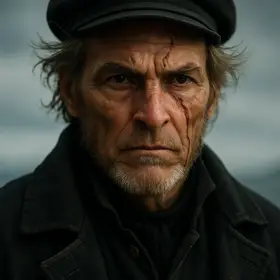 Ahab
Ahab Ishmael
 Stubb
Stubb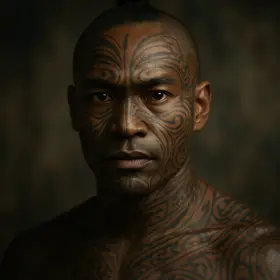 Queequeg
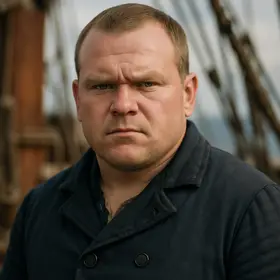 Flask
Flask Tashtego
 Moby Dick
 Daggoo
All chapter summaries ›Characters ›
Read Moby-Dick illustrated
Every scene in these notes comes from the Book2Life reader, where the full public-domain text is illustrated as you read, with character portraits and narration. Free in your browser and on iPhone.
