Pride and Prejudice Chapter 2 Summary

Mr. Bennet's Visit Revealed

Mr. Bennet quietly reveals he has already visited Mr. Bingley, provoking his family's excitement and lively domestic banter.
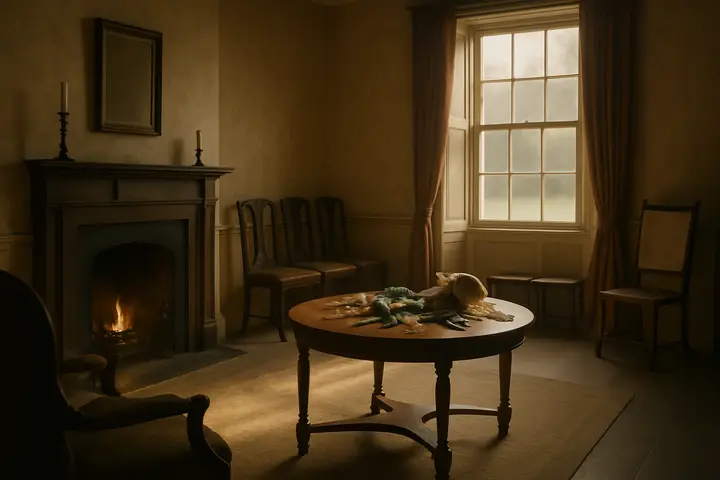
A modest Georgian sitting room washed in soft morning light: faded floral wallpaper, a well-polished fireplace, and a small round table strewn with ribbons, hat trimmings and a half‑finished bonnet. Tall sash windows look out to the lanes, while a row of high‑backed chairs and a needlework frame along the wall evoke steady domestic rhythm without a soul in sight.

Summary

The chapter opens in the Bennet family home where Mr. Bennet surprises his wife and daughters by announcing that he has already paid a call on the new neighbor, Mr. Bingley. Mrs. Bennet and the girls react with a mix of disbelief, delight, and immediate scheming, while Mr. Bennet maintains a teasing, ironic composure. Elizabeth (called Lizzy) exchanges witty remarks with her father; Mrs. Bennet responds with agitated anxiety about social introductions and future prospects.

The conversation moves quickly through domestic details—who will introduce Mr. Bingley at the upcoming assembly, the reliability of Mrs. Long to perform introductions, and the girls’ hopes for dances and attention at the next ball. Mr. Bennet mockingly praises Mary for learned seriousness, jibes at Kitty’s coughing, and deflects his wife’s fretting by insisting that the forms of introduction matter and that he can handle the social maneuvering if she will not. When Mrs. Bennet’s passions and gratitude finally overflow, Mr. Bennet leaves the room, leaving the women to celebrate and plan how to secure Mr. Bingley’s attention for their daughters.

The chapter ends on the light, domestic bustle characteristic of the Bennet household: Mrs. Bennet’s triumph in persuading her husband, the girls’ immediate plotting about dances and dinners, and Lydia’s confident, girlish boast about her height and dancing prospects. The short scene establishes new social possibility—the arrival of Mr. Bingley—and foregrounds the family dynamics, with Mr. Bennet’s teasing authority, Mrs. Bennet’s matrimonial anxieties, and the daughters’ varied temperaments all on display.

Key events

  1. Mr. Bennet reveals he has already visited Mr. Bingley
  2. Mrs. Bennet and daughters react with surprise and joy
  3. Discussion about who will introduce Mr. Bingley at the assembly
  4. Mr. Bennet teases his family and praises Mary's reading ironically
  5. Mrs. Bennet shifts from scolding to gratitude and planning
  6. Family speculates about Mr. Bingley dancing with the daughters

Chapter 2 in pictures
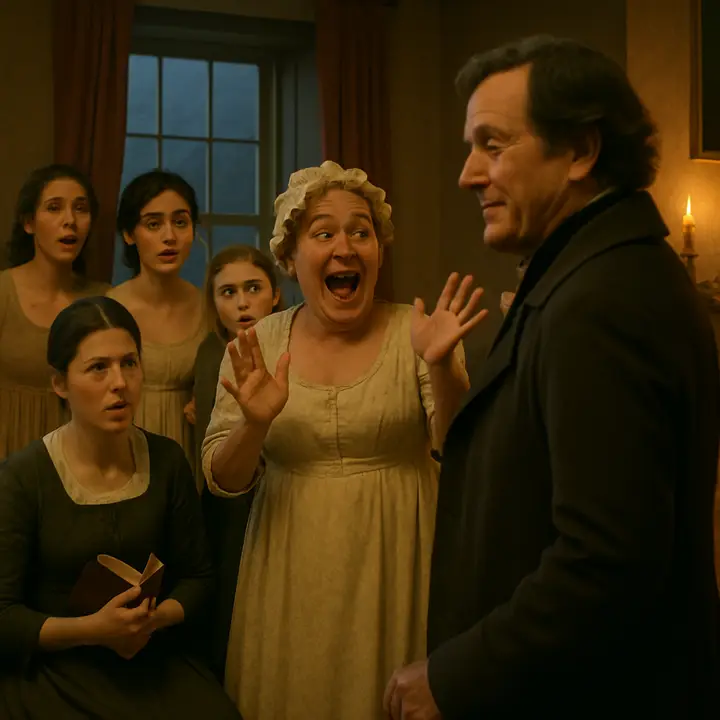
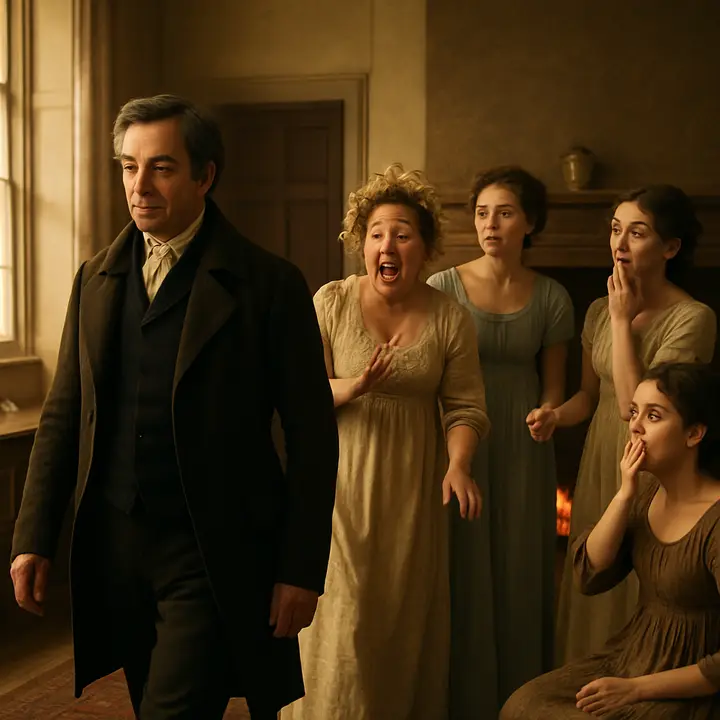
Mr. Bennet, composed and slightly amused, delivers the surprise that he has already called on Mr. Bingley while the family crowd around him in shock; Mrs. Bennet throws up her hands in rapture, Elizabeth and Jane exchange startled glances, Mary looks flustered with her book, and Kitty and Lydia gape. Mr. Bennet turns away to leave the room with a faint smile, relishing the tumult he has caused.
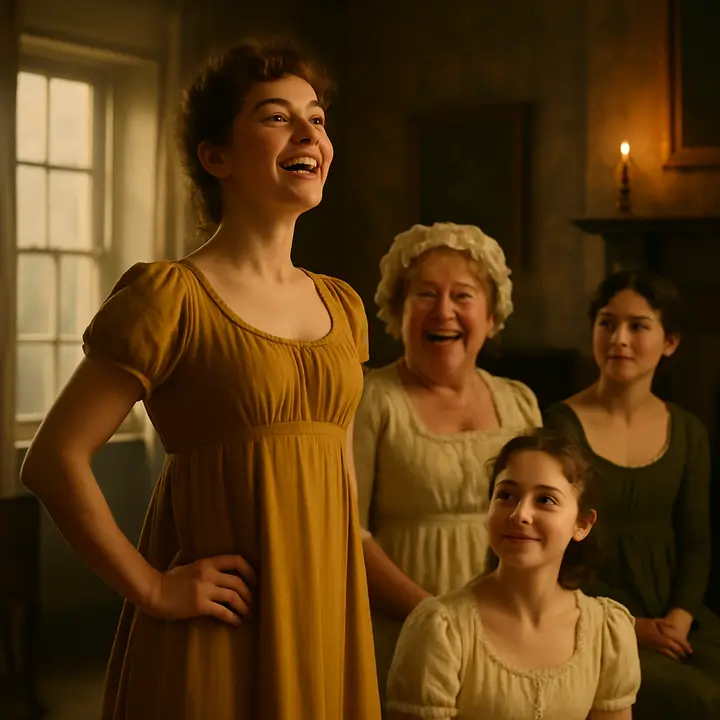
Lydia stands defiantly, chest thrust forward and chin up, proclaiming that she is the tallest while the family listens — Mrs. Bennet beams with encouragement, Kitty looks smugly pleased, and Elizabeth allows an amused half-smile. The moment is playful and petty, capturing Lydia's youthful vanity amid the cozy chaos of Longbourn.
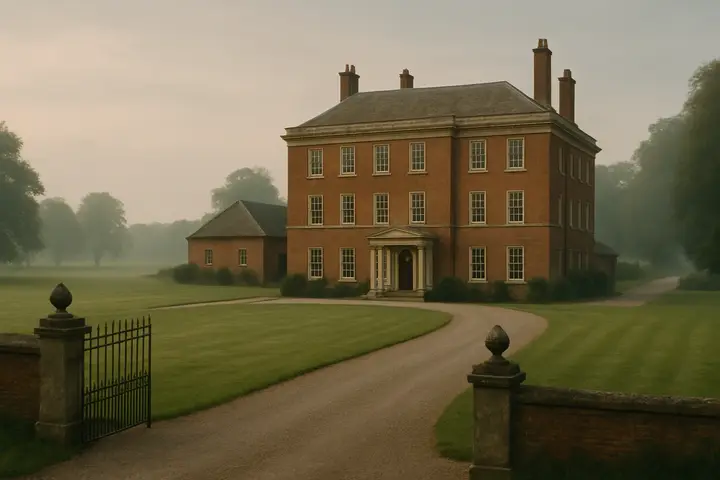
A newly‑occupied red‑brick country house set neatly within parkland: a gravel forecourt curving to a symmetrical façade, clipped lawns stretching to belts of distant trees, and a wrought‑iron gate marking the entrance. The estate reads as freshly arranged for a new tenant—clean windows, a tidy stable block to one side, and a carriage drive disappearing into misty lanes.
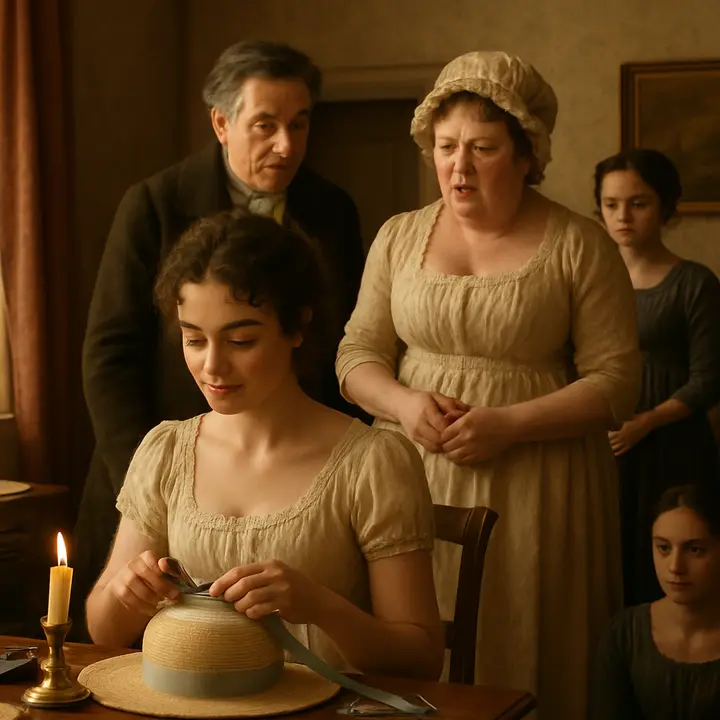
Elizabeth sits at a small dressing table, bent over a straw hat and trimming ribbons with calm concentration as her father suddenly leans in with a teasing remark about Mr. Bingley. Mrs. Bennet stands behind them, arms tight with resentment and impatient speech, while Kitty fumbles a cough in the background and Mary watches primly, unsettled. The domestic clutter of a Bennet drawing-room—keepsakes, sheet music, and a half-lit lamp—frames the intimate family sparring.
Mr. Bennet turns from the group with a dry, amused smile—having already paid a visit to Mr. Bingley—while the women erupt: Mrs. Bennet thrown into ecstatic rapture, daughters staring in astonishment, and Kitty emboldened by the permission to 'cough as much as she chuses.' The contrast between his composed retreat and the household's noisy jubilation fills the room with comic energy and exasperated affection.

Analysis

This brief chapter functions as a compact social tableau that advances the novel’s central concerns—marriage, social maneuvering, and character contrast—through domestic dialogue rather than narration. Mr. Bennet’s discreet initiative (visiting Bingley) sets the plot’s social wheels in motion while revealing his penchant for private control and public teasing. Mrs. Bennet’s excessive emotionality and obsession with advantageous marriages are foregrounded, showing her as both comic and driving force of the household’s ambitions. The daughters display distinct temperaments: Elizabeth’s wit and level-headedness, Mary’s bookish seriousness, Kitty’s fretfulness, and Lydia’s youthful impulsiveness.

Narratively, Austen uses brisk, ironic dialogue to reveal personality and social priorities without authorial intrusion; the narrator’s voice is present but lets characters expose themselves. The chapter also establishes the importance of introductions, assemblies, and neighborhood connections as mechanisms of courtship and social mobility. Mr. Bennet’s mock-respect for etiquette—insisting introductions matter—both satirizes and affirms the social code the family must navigate. Small actions and remarks (the coughing, the teasing, Lydia’s boast) function as character-signals that foreshadow how each daughter will engage with the new social opportunities Mr. Bingley’s arrival creates.

Important quotes

“I hope Mr. Bingley will like it, Lizzy.”

Mr. BennetMr. Bennet teases Elizabeth while revealing he has already visited Mr. Bingley, immediately setting a playful tone.

“A fortnight’s acquaintance is certainly very little. One cannot know what a man really is by the end of a fortnight.”

Mr. BennetHe mockingly comments on the social convention of quick judgments and introductions, undercutting his wife's eagerness.

“Now, Kitty, you may cough as much as you choose,”

Mr. BennetAfter Mrs. Bennet's excitement, Mr. Bennet dismisses her anxieties and leaves the room, showing his amused detachment.

Characters in Chapter 2

Read Pride and Prejudice illustrated

Every scene in these notes comes from the Book2Life reader, where the full public-domain text is illustrated as you read, with character portraits and narration. Free in your browser and on iPhone.

Read Pride and Prejudice free

Download Book2Life on the App Store