A Room with a View Chapter 1 Summary

Arrival at the Bertolini

Lucy and Charlotte Bartlett arrive at Pension Bertolini in Florence, clash over rooms, meet Mr. Beebe and the Emersons, and move into new rooms.
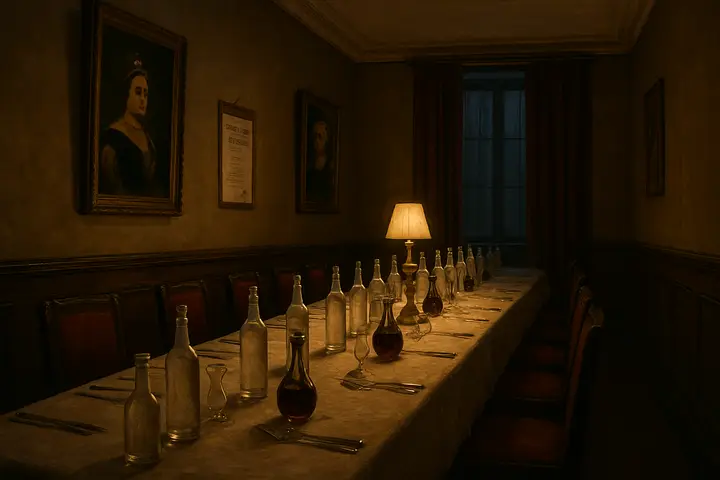
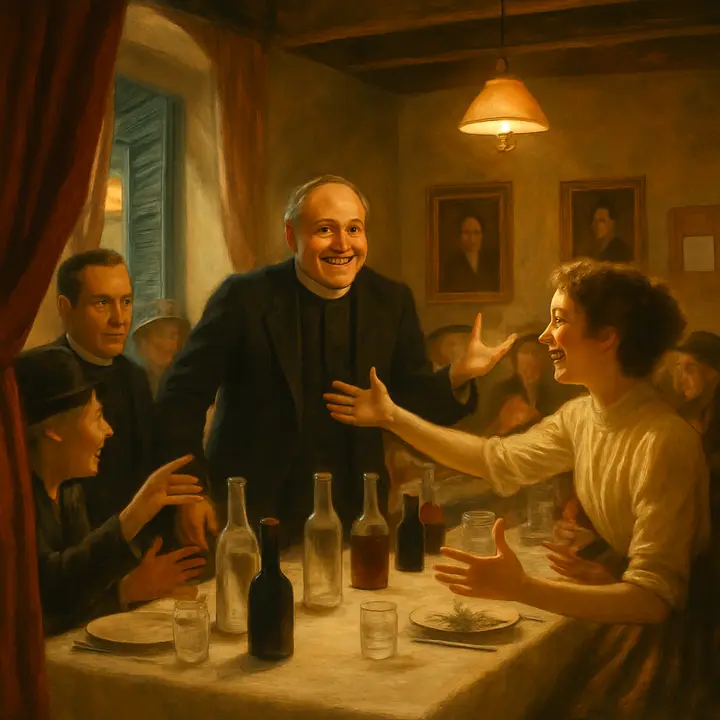
A narrow, dimly lit dining room dominated by a long polished table set with rows of white water bottles and dark red wine; heavy-framed portraits and a printed notice for the English church hang on the plaster walls. Drawn curtains and close, formal furnishings give the space a compact, London-like air of propriety and restraint.

Summary

Lucy Honeychurch and her cousin Miss Bartlett (Charlotte) arrive at the Pension Bertolini in Florence after a tiring journey. They are disappointed to find north-facing rooms looking into a courtyard instead of the south rooms with a view over the Arno promised by the Signora. Miss Bartlett complains openly, and the cousins become involved in a tense table conversation when an outspoken old Englishman, Mr. Emerson, and his son George offer to swap rooms so Lucy can have the front view. Miss Bartlett is affronted by the bluntness and crude manner of the Emersons and rejects the offer.

The mood shifts when Mr. Beebe, a friendly clergyman they remember from Tunbridge Wells, arrives and quickly befriends them. The pension erupts into hospitable advice and gossip about Florence; a sharp, opinionated woman urges travel to Prato. Mr. Beebe later intervenes in the room quarrel: he encourages Mr. Emerson to renew the offer, and when Emerson himself is indisposed, George brings the proposal. Miss Bartlett, after misgivings, decides that Lucy should accept the Emersons' kindness and asks Mr. Beebe to convey their gratitude. She insists on appearing to accept only on Lucy's behalf and chooses to occupy the larger room herself to avoid placing Lucy under obligation to the younger man. The evening ends with Lucy unsettled by the complexities of social obligation and Miss Bartlett discovering a sheet with a large question mark pinned in Lucy's room, which she saves for young Mr. Emerson rather than destroy.

Key events

  1. Arrival at Pension Bertolini; disappointment over north rooms without a view
  2. Mr. Emerson and his son George offer to swap rooms so Lucy can have a view
  3. Miss Bartlett rejects the offer as ill-bred; social awkwardness at the table
  4. Mr. Beebe arrives, recognizes the cousins, offers civil advice and intervenes
  5. Mr. Beebe persuades Emerson to renew the offer; Miss Bartlett accepts on Lucy's behalf
  6. Miss Bartlett takes the larger room herself; they move and prepare for Florence
  7. Miss Bartlett finds and preserves a puzzling sheet with a large question mark in Lucy's room

Chapter 1 in pictures
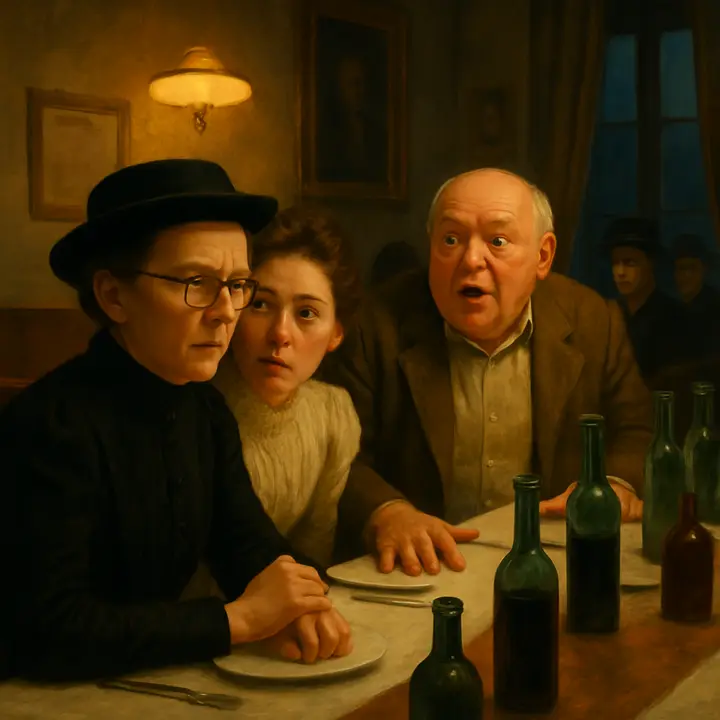
At the Pension Bertolini dining table the prim chaperon and the tired young tourist argue over rooms while rows of white water- and red wine-bottles and heavy portraits loom behind them. Suddenly a heavy-built, fair-shaven old man with large, childish eyes bangs the table and insists on swapping rooms, shattering the petty decorum. The contrast between the snug English tableau and the rude intrusion should feel startling and comic-awkward.
The curtains part and a stout, kindly clergyman steps in — Mr. Beebe — bringing a sudden rush of cheerful advice about excursions as the dining-room erupts into helpful chatter. Lucy's whole face brightens; another guest eager to recommend Prato leans forward, voices and gestures overlapping in a lively, slightly chaotic swirl. The energy shifts from peevishness to bustling relief and convivial noise.
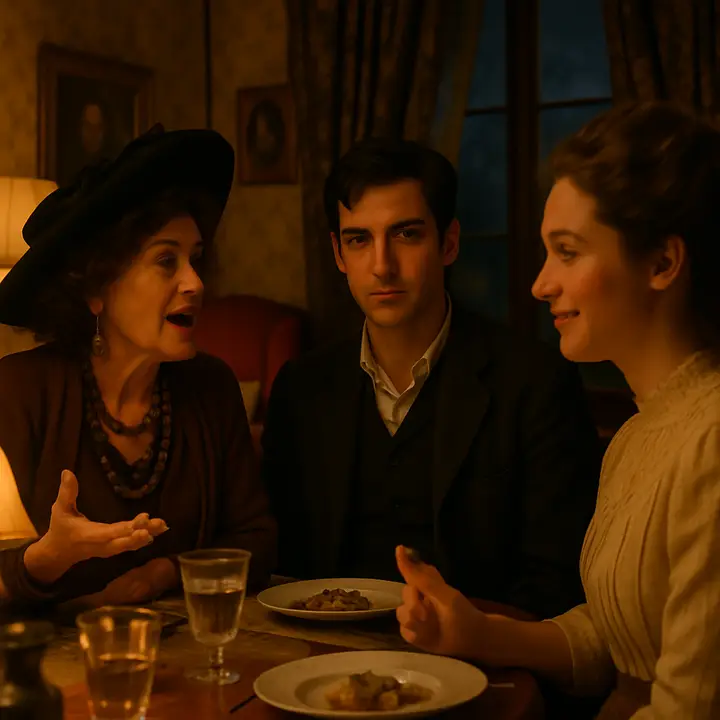
In the drawing-room an extrovert, stylish woman extols the 'sweetly squalid' corners of Italy while George Emerson casts a quick, almost secretive glance at her and then drops moodily to his plate. Lucy, newly pleased but shy, gives a nervous bow and receives from George a small, knowing eyebrow-and-smile that seems to bridge some private distance. The scene hums with subtle social electricity and unspoken intrigue.
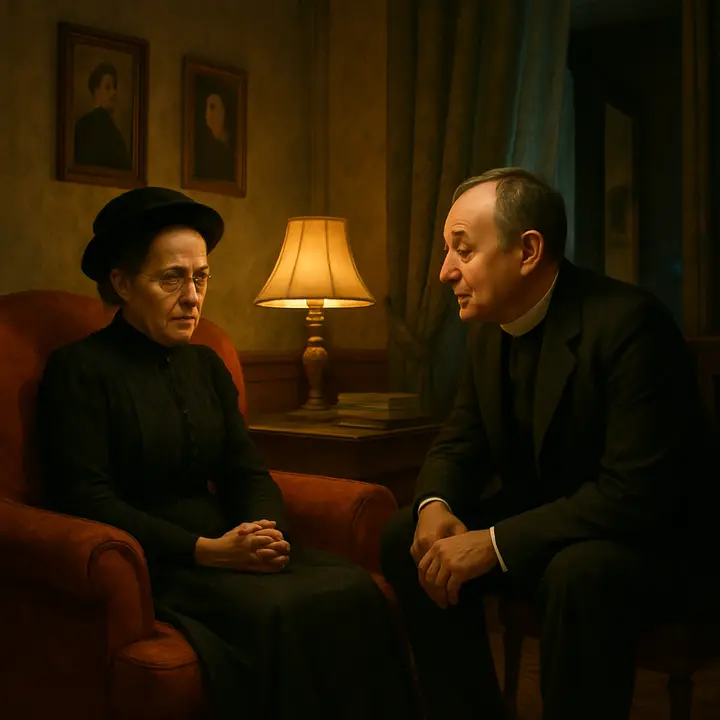
Miss Bartlett sits in a tomato-coloured arm-chair, rocking and fretting as she implores Mr. Beebe about the brusque old man; Beebe listens calmly, defending the stranger as blunt but not dangerous. Their exchange is a study in propriety wrestling with honest bluntness; Beebe finally rises and withdraws toward the smoking-room, leaving her torn between courtesy and suspicion.
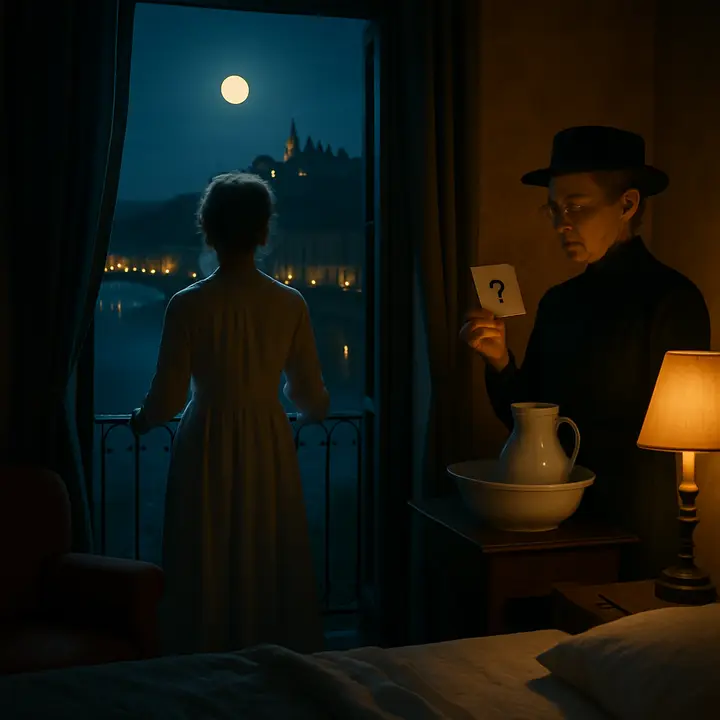
Late at night Lucy, sleepless, throws open her Arno-facing window and drinks in the silvered sweep of the Arno, San Miniato's cypresses and the moonlit Apennines — a wash of Florentine light and calm. Nearby, Miss Bartlett in her own room discovers and unpins a small paper bearing a huge question-mark above the washstand and holds it with a puzzled, protective air, an uneasy counterpoint to Lucy's rapture. The composition should place serene external beauty against a small private omen.

Analysis

This opening chapter establishes the novel’s social landscape: manners, class anxieties, and differing temperaments. The contrast between Miss Bartlett’s conscientious, prudent worldliness and Lucy’s innocent openness appears immediately in their reactions to the Emersons’ blunt kindness. Forster uses the micro-conflict over rooms as a way to reveal deeper values—Charlotte’s fear of impropriety, Lucy’s unease with being the center of obligation, and the Emersons’ refusal of conventional tact. Mr. Beebe functions as a conciliatory moral presence, mediating between competing social codes and endorsing directness over suspicion. The drawing-room scene also introduces the novel’s frequent use of public social spaces—a pension dining-room, a drawing-room—where private judgments and public performances collide.

Narratively, Forster employs free indirect discourse and an observant, slightly ironic narrator to let readers see both Lucy’s inner confusion and the social choreography around her. The chapter foreshadows tensions between authenticity and decorum: the Emersons’ candidness is at once disturbing and appealing. The enigmatic question-mark note pinned in the room acts as a small symbolic motif—suggesting inquiry, disturbance, or unresolved questions that will follow Lucy. The variety of voices at the pension (gossipy old ladies, the brusque Emersons, the helpful clergyman) sets up the social cross-currents that will shape Lucy’s experiences in Florence.

Important quotes

“The Signora had no business to do it,” said Miss Bartlett, “no business at all.”

Miss BartlettMiss Bartlett complains loudly about being given north rooms without a view, establishing her peevish, propriety-focused tone.

“You see, we don’t like to take—” began Lucy. Her cousin again repressed her.”

NarratorThis line shows Lucy’s gentle instinct to be polite and Charlotte’s controlling protective impulse during the Emersons’ offer.

“What does it mean?”

Miss BartlettMiss Bartlett reacts to the sheet with a large question-mark pinned over the washstand, treating it as ominous and preserving it for young Mr. Emerson.

Characters in Chapter 1

Read A Room with a View illustrated

Every scene in these notes comes from the Book2Life reader, where the full public-domain text is illustrated as you read, with character portraits and narration. Free in your browser and on iPhone.

Read A Room with a View free

Download Book2Life on the App Store