Adventures of Huckleberry Finn CHAPTER THE LAST Summary
Epilogue and Farewell
Huck recounts Tom's theatrical plans after Jim's release, Jim's delight at being free, and Huck's decision to 'light out' rather than be civilized.
Summary
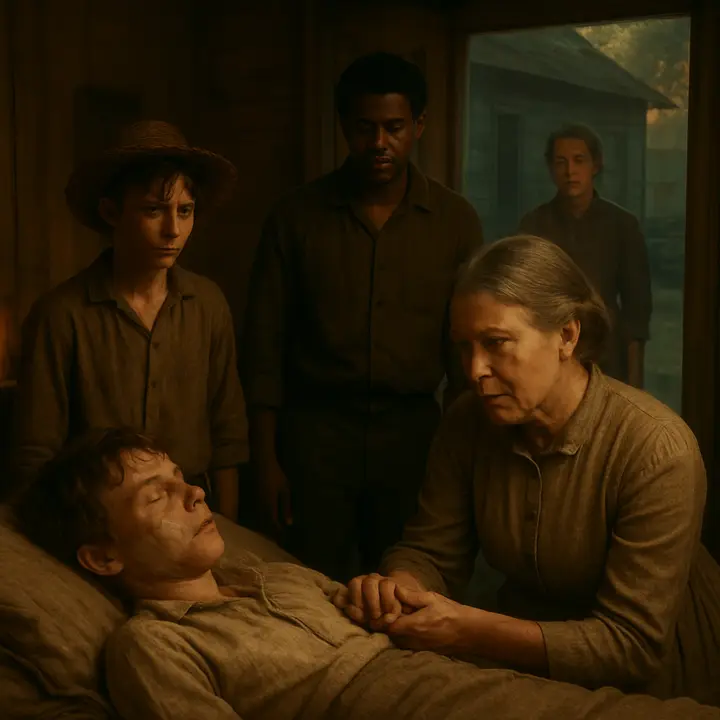
Huck first questions Tom about what Tom intended to do if the elaborate evasion had succeeded and Jim had already been free; Tom describes a romantic, theatrical plan to parade Jim back home with a brass band and make him a hero. Huck says he prefers the simpler outcome: Jim is soon unchained, cared for, and feted by Aunt Polly and others for his help in nursing Tom. The men give Jim money—Tom gives him forty dollars for bearing imprisonment with patience—and Jim bursts into a joyous, superstitious account of signs that prove he is destined to be rich again.
Tom, now recovered and playfully sporting a bullet on a watch-guard, suggests another boyish expedition — sliding away to the Indian Territory to hunt adventures. Huck agrees but worries about money; Tom reassures him that Huck's six thousand dollars is still safe with Judge Thatcher. Jim solemnly affirms that Huck's father won't be returning. Huck closes the book with a rueful, self-aware remark about the difficulty of writing a book, and then announces his intention to keep running: Aunt Sally plans to civilize and adopt him, and Huck knows from experience he cannot stand being tamed, so he must "light out for the Territory" before the rest of the family can finish reforming him.
Key events
- Huck asks Tom what his plan was if the escape had gone perfectly.
- Tom imagines a dramatic homecoming for Jim with a torchlight procession.
- Jim is celebrated, given money, and joyfully proclaims signs of future riches.
- Tom recovers and proposes another adventure; Huck worries about funds.
- Tom assures Huck his money is still with Judge Thatcher; Jim says Pap won't return.
- Huck decides to flee civilization again rather than be 'sivilized' by Aunt Sally.
CHAPTER THE LAST in pictures

Analysis
This final chapter functions as a short epilogue that ties up emotional threads while preserving the novel's central conflicts. It undercuts Tom's romanticism — his theatrical plan for Jim is comic and extravagant — by contrasting it with the simple, humane outcome: Jim is freed, cared for, and rewarded. That juxtaposition emphasizes Twain's recurring critique of sentimental and theatrical notions of heroism and justice. Huck's voice remains morally observant and ironically detached; he admires Tom's imagination yet consistently prefers actions that are practical and humane, reinforcing his growth from a passive, superstitious boy into someone with independent moral judgment.
Symbolically, the raft's journey ends offstage: the river as a space of freedom yields to domestic reabsorption, but Huck's final decision to "light out" preserves the novel's theme of resistance to social control. The narrator's direct address about the trouble of making a book breaks the fourth wall and foregrounds narrative artifice, reminding readers that Huck's account is shaped by his voice and perspective. The chapter closes with an open ending — freedom for Jim and the continuing restlessness of Huck — leaving the novel's moral questions alive rather than conclusively resolved.
Important quotes
“what he had planned in his head from the start, if we got Jim out all safe, was for us to run him down the river on the raft, and have adventures plumb to the mouth of the river, and then tell him about his being free, and take him back up home on a steamboat, in style, and pay him for his lost time, and write word ahead and get out all the niggers around, and have them waltz him into town with a ”
Tom SawyerTom describes his theatrical, romantic plan for celebrating Jim's freedom, revealing his love of adventure and showmanship.
“Dah, now, Huck, what I tell you?—what I tell you up dah on Jackson islan’? I tole you I got a hairy breas’, en what’s de sign un it; en I tole you I ben rich wunst, en gwineter to be rich agin; en it’s come true; en heah she is!”
JimJim joyfully interprets recent events as confirmation of the good signs he had read earlier, showing his superstition and happiness at being valued.
“I been there before. THE END. YOURS TRULY, HUCK FINN.”
NarratorHuck signs off the narrative with a final declaration of resistance to being 'sivilized,' closing the book in his irreverent voice.
Characters in CHAPTER THE LAST
All chapter summaries ›Characters ›
Read Adventures of Huckleberry Finn illustrated
Every scene in these notes comes from the Book2Life reader, where the full public-domain text is illustrated as you read, with character portraits and narration. Free in your browser and on iPhone.
Read Adventures of Huckleberry Finn free
