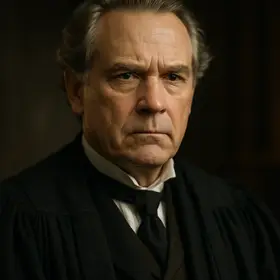
Judge Thatcher in Adventures of Huckleberry Finn
Minor character
Upright town magistrate who safeguards Huck’s money and stands as a steady legal authority amid family chaos.
Who is Judge Thatcher?
Judge Thatcher is the prudent, respectable magistrate of St. Petersburg who takes formal charge of the gold Huck and Tom find, investing it and paying Huck the interest. He functions as a legal and moral safeguard for Huck: when Pap returns and tries to seize Huck’s wealth, Thatcher structures a legal transaction to keep the money out of Pap’s hands and loans Huck small sums to prevent immediate abuses. Though not centrally involved in the novel’s odyssey down the river, Thatcher appears repeatedly as the embodiment of orderly civic authority—someone who prefers law, paperwork, and prudence to violence or spectacle. He also participates in the town’s searches and official responses to Huck’s reported death, and his careful management of Huck’s funds gives Huck a recurring sense of security that contrasts with Pap’s brutality and the river’s dangers. Thatcher remains secondary to the main action but his interventions materially affect Huck’s choices and safety throughout the narrated events.
In the book: Judge Thatcher is the upright town magistrate who safeguards Huck’s newfound wealth by managing it responsibly and acting as a legal protector when Huck’s abusive father tries to seize the money. He represents the orderly, “civilized” authority of St. Petersburg and serves as a steady, ethical counterweight to the chaos surrounding Huck, though he remains a secondary figure.
Personality
- responsible
- He formally takes Huck’s money, frames the transaction as a sale 'for a consideration,' and invests it so Huck receives regular interest (Ch. 1, Ch. 4).
- law-minded
- He uses legal forms and guardianship procedures to protect the boys’ funds and interacts with the new judge about Huck’s custody (Ch. 4–6).
- steady
- When Pap’s drunkenness and violence erupt, Thatcher remains a calm, procedural presence who seeks lawful remedies rather than dramatic confrontation (Ch. 5–6).
- protective
- He gives Huck money and takes guardianship-like actions to keep Huck’s assets from Pap’s grasp after Pap’s return (Ch. 4–6).
Character arc
Judge Thatcher’s role is consistent rather than transformational: he appears early as the sensible town magistrate who invests Huck’s treasure and continues to act as custodian and legal protector through the crises caused by Pap’s return. When Huck first needs a safe place for the money, Thatcher formalizes the arrangement and furnishes Huck with a legalistic method of avoiding direct ownership. As Pap reappears and becomes violent, Thatcher’s steady, lawful responses—seeking judicial remedies and supporting the Widow Douglas’s attempts to 'sivilize' Huck—contrast with the chaos of Pap’s behavior and the eventual drift downriver. Thatcher does not undergo a moral reversal or personal growth within the chapters in which he appears; instead he consistently represents the town’s civil order. By the novel’s end he remains the repository of Huck’s funds, a continuing safeguard mentioned when Tom reassures Huck about his money. Thatcher’s arc is therefore one of sustained institutional presence rather than change: he persists as an anchor of legality and propriety around which much of Huck’s uneasy domestic life revolves.
Judge Thatcher in pictures


Relationships
- Huckleberry Finn He acts as custodian and legal protector of Huck’s money, framing the transaction so Huck does not hold the cash directly.
- Pap Finn He opposes Pap’s attempts to seize Huck’s funds and is embarrassed when Pap’s temperance pledge and reformation fail.
- Widow Douglas He collaborates implicitly with the Widow’s efforts to civilize Huck by supporting legal measures to secure Huck’s welfare and assets.
- Tom Sawyer He manages the joint boys’ hoard (Huck’s and Tom’s) and maintains the investment that preserves their wealth while the boys pursue adventures.
- Jim He is part of the town apparatus searching for Huck’s supposed body and a background figure in the social order that Jim and Huck elude when they flee.
Quotes by Judge Thatcher
“There; you see it says ‘for a consideration.’ That means I have bought it of you and paid you for it. Here’s a dollar for you. Now you sign it.”
Chapter 4The judge reframes Huck’s gift as a legal sale, formalizing control of Huck’s money to protect him from owning it himself.
Why Judge Thatcher matters
Judge Thatcher symbolizes the steady rule of law and conventional civility that Twain sets against the novel’s themes of freedom, morality, and hypocrisy. His careful handling of Huck’s money stresses the value of legal structures and prudence in a community where personal violence and superstition often reign. At the same time, Thatcher’s orderly presence highlights the limits of 'civilization' for Huck: while Thatcher protects Huck materially, the boy still feels constrained by social expectations and ultimately rejects full domestication. Thatcher therefore reinforces the tension between institutional authority and individual liberty that runs through Huck’s decisions and the book’s moral inquiry.
Chapters with Judge Thatcher
More Adventures of Huckleberry Finn characters
 Huckleberry FinnProtagonist
 JimMajor character
 Tom SawyerMajor character
 The DukeMajor character
 Pap FinnAntagonist
 The KingAntagonist
 Aunt SallyMajor character
 Miss WatsonMajor character
All chapter summaries ›Characters ›
Read Adventures of Huckleberry Finn illustrated
Every scene in these notes comes from the Book2Life reader, where the full public-domain text is illustrated as you read, with character portraits and narration. Free in your browser and on iPhone.
Read Adventures of Huckleberry Finn free
