Don Quixote Chapter 30 Summary
The Huntress and the Duke's Welcome
Don Quixote and Sancho encounter a hunting party, gain the favour of a duchess and duke, and are invited to a nearby castle.
Summary
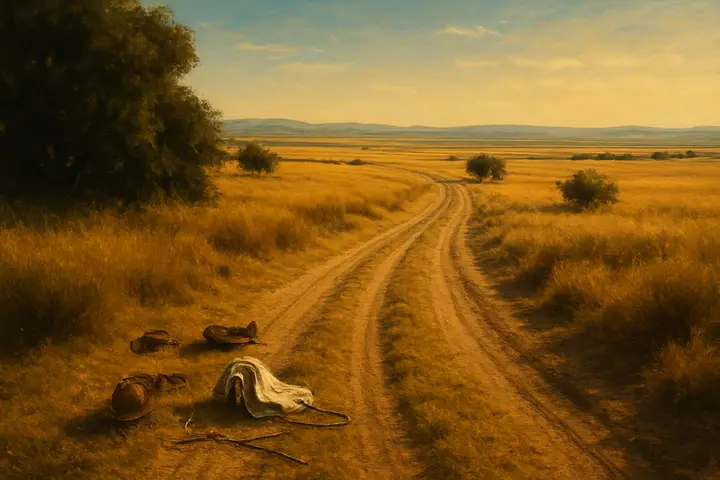
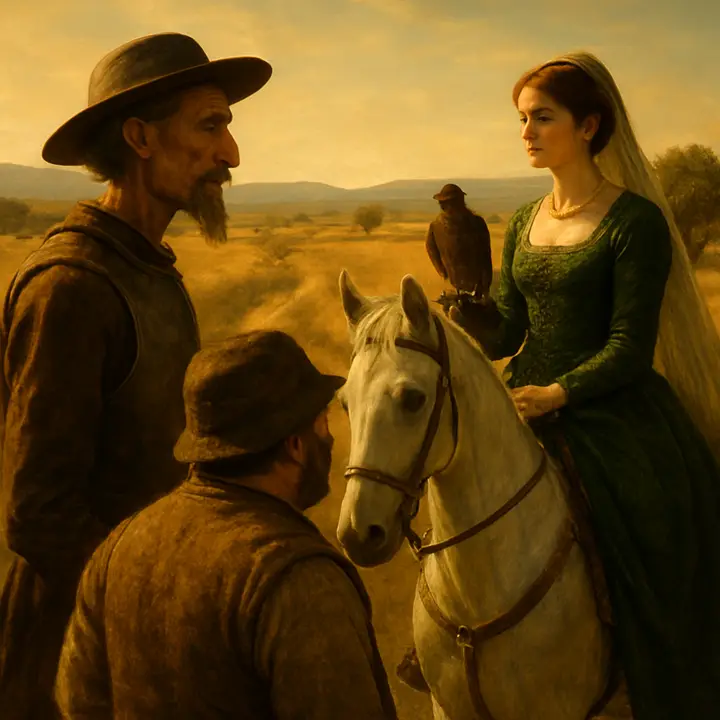
Don Quixote and his squire Sancho Panza leave a river and ride on in gloomy spirits, Sancho chiefly upset about money and his hopes for advancement. As they emerge from a wood at sunset they spot a hawking party on a green meadow; among the hunters Don Quixote notices a richly dressed lady on a white palfrey carrying a hawk and assumes she is a great lady and the mistress of the party. He sends Sancho to deliver a ceremonious message asking permission to serve her.
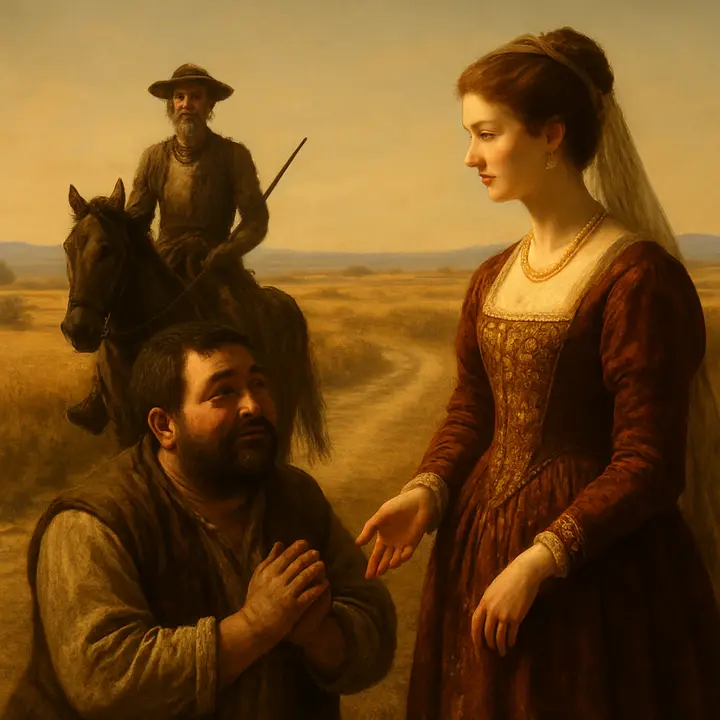
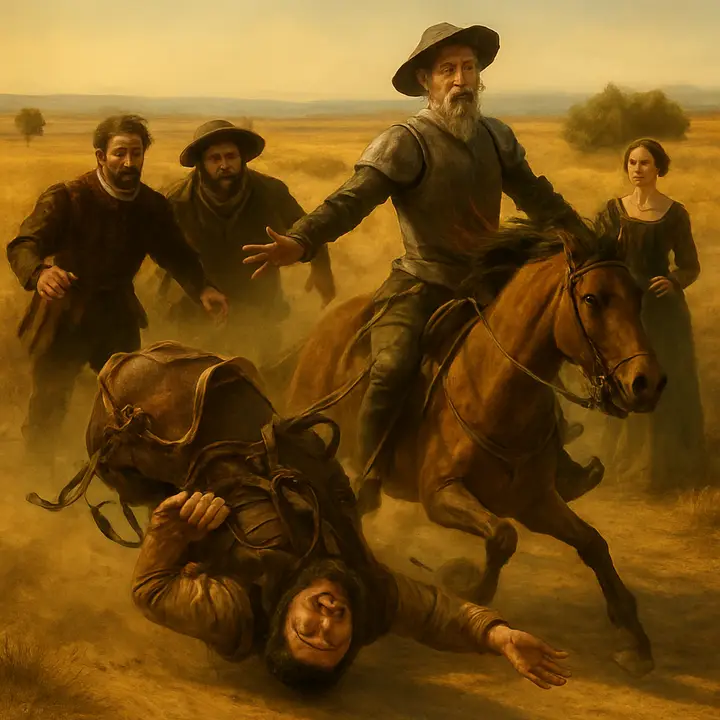
Sancho kneels and conveys the knight’s formal offer, and the lady—later identified as a duchess of unknown title—answers courteously, welcoming Don Quixote and offering the services of herself and the duke, her husband. Sancho brags about having a place in the printed history of Don Quixote and delights in the duchess’s praise; he then clumsily becomes entangled while helping his master dismount and causes both himself and Don Quixote to fall. The duke and his huntsmen help them up, and the hospitable couple, having read the First Part of Don Quixote’s history and aware of his madness, decide to humour him by treating him as a knight-errant. They invite him to a nearby castle and promise the honours due a great knight; Sancho is likewise received with amused approval for his wit, and they set out for the duke’s castle with the duchess particularly enjoying Sancho’s company.
Key events
- Don Quixote and Sancho leave the river in low spirits.
- They discover a hawking party and Don Quixote orders Sancho to make a formal salute.
- Sancho delivers the message to a richly dressed duchess, who welcomes them.
- Clumsy dismounting causes Sancho and Don Quixote to fall; the duke helps them up.
- The duke and duchess, having read Don Quixote’s history, decide to humour him.
- They invite Don Quixote and Sancho to a nearby castle; the party rides off together.
Chapter 30 in pictures
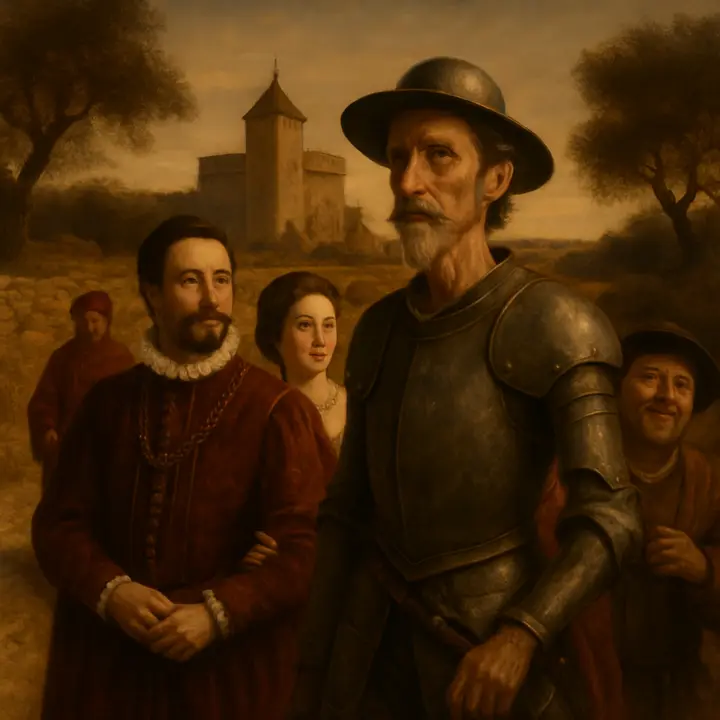
Analysis
This chapter advances the novel’s interplay between reality and fiction by placing Don Quixote’s chivalric assumptions against a social setting that both recognizes and plays along with his delusions. The duke and duchess function as cultivated readers of Don Quixote’s printed fame; their decision to entertain and stage-manage him introduces a recurring structural device: aristocratic guests who manipulate the knight’s fantasies for their own amusement. The scene deepens character contrast—Don Quixote’s solemn devotion to knightly ceremony meets Sancho’s earthy practicality and comic opportunism. Sancho’s pride in being named in the “history” and his rustic flattery of the duchess highlight his material concerns and social ingenuities, while the duke and duchess’s courteous reception signals a temporary inversion of power: the mad knight attains status because others choose to confer it.
Narratively, the chapter shifts action from chance encounter to intentional hospitality, setting up a contained environment (the duke’s castle) where further episodes can be orchestrated. The fall from the saddle works both as comic slapstick and as a small humiliation that allows benefactors to exercise noblesse oblige. The hawking lady in green can be read as a symbol of aristocratic spectacle—beauty staged for observation—anticipating how Don Quixote’s reputation will be used as entertainment. The narrator’s restrained tone preserves irony: we are told what happens plainly while being invited to see the gap between appearance and reality.
Important quotes
“Run Sancho, my son, and say to that lady on the palfrey with the hawk that I, the Knight of the Lions, kiss the hands of her exalted beauty, and if her excellence will grant me leave I will go and kiss them in person and place myself at her service for aught that may be in my power and her highness may command; and mind, Sancho, how thou speakest, and take care not to thrust in any of thy proverbs”
Don QuixoteDon Quixote instructs Sancho to deliver a formal message to the lady of the hawking party, revealing his ceremonial view of knighthood.
“Tell me, brother squire," asked the duchess (whose title, however, is not known), "this master of yours, is he not one of whom there is a history extant in print, called ‘The Ingenious Gentleman, Don Quixote of La Mancha,’ who has for the lady of his heart a certain Dulcinea del Toboso?”
The DuchessThe duchess shows she knows of Don Quixote’s printed fame, which frames how she and the duke choose to receive him.
“That which has happened me in meeting you, mighty prince," replied Don Quixote, "cannot be unfortunate, even if my fall had not stopped short of the depths of the bottomless pit, for the glory of having seen you would have lifted me up and delivered me from it.”
Don QuixoteDon Quixote responds to the duke’s sympathy by transforming his fall into a noble act of devotion, demonstrating his chivalric self-fashioning.
Characters in Chapter 30
All chapter summaries ›Characters ›
Read Don Quixote illustrated
Every scene in these notes comes from the Book2Life reader, where the full public-domain text is illustrated as you read, with character portraits and narration. Free in your browser and on iPhone.
