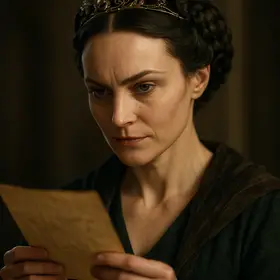
Lady Macbeth in Macbeth
Major character
Macbeth’s ambitious, steely wife who plots Duncan’s murder and later unravels from guilt into sleepwalking madness.
Who is Lady Macbeth?
Lady Macbeth is introduced reading her husband’s letter about the witches’ prophecy and immediately resolves to turn fate into action. She wants power and status for Macbeth and herself, and she seizes control of the plan to make Macbeth king: she counsels, taunts, and engineers the practical details of Duncan’s murder, acting as the decisive force that overcomes Macbeth’s doubts. As events unfold she plays the consummate hostess to mask their crime, orchestrates the cover-up immediately after the murder, and tries to steady Macbeth when his conscience and fear begin to surface. After Banquo’s murder and Macbeth’s increasing descent into paranoia, she attempts to sustain public normality at court but is gradually shut out of Macbeth’s secretive new violent decisions. By the end, Lady Macbeth is overcome by remorse and psychological collapse, manifesting in sleepwalking and obsessive hand-washing that reveal a conscience she previously sought to suppress. Her arc moves from ruthless instigator to tragic, guilt-ridden invalid whose condition doctors cannot cure.
In the book: We meet her as she reads her husband’s letter about the strange prophecy and immediately starts plotting how to turn it into reality. She’s poised, razor-smart, and speaks to Macbeth with a mix of affection and iron, pushing him to be bold while she plays the perfect, calculating hostess.
Personality
- Calculating
- Upon reading Macbeth’s letter she immediately devises the plan to drug Duncan’s chamberlains and frame them for the murder.
- Ruthless
- She declares she would dash out her own child’s brains to keep a vow, using extreme imagery to steel Macbeth to act.
- Commanding
- When Macbeth balks after the murder she scolds him, takes the daggers herself, and returns to place them on the sleeping guards.
- Composed (public)
- She greets King Duncan with flawless hospitality and feigned duty, convincing guests of their innocence in the morning after the murder.
- Guilt-haunted
- In her sleepwalking she obsessively rubs her hands and laments a ‘damned spot’ of blood, revealing deep remorse.
Character arc
Lady Macbeth begins as the dominant, driving force behind the plot to secure the throne: she reads the witches’ prophecy and immediately plots action, coaches Macbeth into murdering Duncan, and manages the immediate cover-up, performing stoic hospitality to deceive Duncan and the visiting nobles. After the regicide she remains composed in public, but privately she must manage Macbeth’s rising instability and guilt. As Macbeth moves into further violence without fully confiding in her—most notably planning Banquo’s murder while keeping her deliberately uninformed—her influence and control begin to wane. Over time the pressure of the crimes and Macbeth’s growing isolation break through her earlier hardness; she ceases to be the manipulative agent and becomes inwardly tormented. By Act 5 she no longer directs events but is observed as a sleepwalker repeating acts of washing and speaking fragmented confessions. The doctor and gentlewoman conclude her condition is beyond medical help, and the play reports her death as an apparent suicide, marking a tragic reversal from instigator to broken, guilt-ridden figure whose mind cannot bear the consequences she helped unleash.
Relationships
- Macbeth Her husband and co-conspirator whom she manipulates, pressures, and later attempts to steady as his guilt and paranoia grow.
- Duncan The grateful king she publicly welcomes with practiced hospitality, while privately plotting his murder to advance her husband.
- Banquo A political rival whose lineage threatens Macbeth’s hold on the throne; his murder and its partial failure increase tension between Lady Macbeth and Macbeth’s secretive actions.
- Doctor An observer called to witness her sleepwalking; he diagnoses her condition as moral or spiritual and says it lies beyond his medical cure.
- Waiting-Gentlewoman Her attendant who watches Lady Macbeth’s sleepwalking, reports obsessive behaviors, and refuses to repeat certain private utterances to the doctor.
- Macduff Representative of the opposition whose discovery of Duncan’s body begins the unraveling; Lady Macbeth later obliquely references Macduff’s wife in her sleep-talk.
Quotes by Lady Macbeth
“All our service, In every point twice done, and then done double, Were poor and single business to contend Against those honours deep and broad wherewith Your Majesty loads our house:”
Act 1, Scene 6Lady Macbeth offers lavish, formal hospitality, demonstrating her social grace and the performance of loyalty that conceals inner motives.
“I have given suck, and know How tender ’tis to love the babe that milks me: I would, while it was smiling in my face, Have pluck’d my nipple from his boneless gums And dash’d the brains out, had I so sworn as you Have done to this.”
Act 1, Scene 7Lady Macbeth’s shocking image to prove her resolve and to shame Macbeth into keeping his vow.
“A little water clears us of this deed:”
Act 2, Scene 2Lady Macbeth minimizes the crime’s significance and proposes a practical, theatrical solution—washing away evidence to restore appearances.
“Naught’s had, all’s spent, Where our desire is got without content: ’Tis safer to be that which we destroy, Than by destruction dwell in doubtful joy.”
Act 3, Scene 2Lady Macbeth laments that achieving power has not brought peace and urges acceptance of what cannot be changed.
“Are you a man?”
Act 3, Scene 4Lady Macbeth scolds Macbeth during his public breakdown, attempting to shame him into composure and preserve the banquet’s order.
“Out, damned spot! out, I say! One; two. Why, then ’tis time to do’t. Hell is murky!”
Act 5, Scene 1Spoken during her sleepwalking as she fixates on an imagined stain of blood, revealing deep guilt.
Why Lady Macbeth matters
Lady Macbeth embodies the play’s exploration of ambition, gender roles, and conscience. She initially subverts expected female passivity by instigating regicide and shaping political action, testing notions of agency and moral responsibility. Her eventual collapse into guilt and obsessive hand-washing shows that violent transgression carries psychological and spiritual costs the characters cannot simply wash away. Through her rise and fall, the play interrogates whether power achieved through immoral means can provide peace, and how suppressed conscience ultimately asserts itself, turning outward control into inner ruin.
Chapters with Lady Macbeth
More Macbeth characters
 Macbeth
 Banquo
 Macduff
 Malcolm
 Ross
Ross Lennox
 Duncan
 Donalbain
All chapter summaries ›Characters ›
Read Macbeth illustrated
Every scene in these notes comes from the Book2Life reader, where the full public-domain text is illustrated as you read, with character portraits and narration. Free in your browser and on iPhone.
