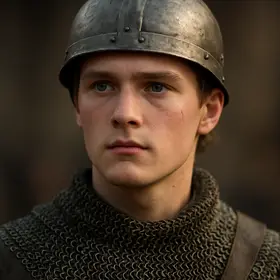
Young Siward in Macbeth
Minor character
A young English nobleman eager to prove himself in battle, fighting with Malcolm’s army against Macbeth.
Who is Young Siward?
Young Siward appears as an enthusiastic English noble fighting alongside his father in Malcolm’s campaign to unseat Macbeth. He wants to prove his bravery and earn honor on the battlefield; when Malcolm’s army advances from Birnam Wood, Young Siward takes his place among the captains and soldiers prepared to mask their numbers with boughs and press the attack on Dunsinane. In the decisive fighting around Macbeth’s stronghold he confronts Macbeth directly, demanding the tyrant’s name and charging him despite a warning. He dies in single combat, accusing Macbeth as an “abhorred tyrant,” and his death is reported afterward by the survivors as an honorable loss. His role is brief but clear: he embodies youthful courage and the personal cost of the conflict that restores Malcolm to the throne.
In the book: We meet Young Siward as an eager English nobleman serving with his father in the campaign to restore order to Scotland. He’s brave to the point of impatience, volunteering for the hardest task and pressing forward to prove himself in real battle.
Personality
- brave
- In Act 5, Scene 7 he refuses Macbeth’s warning and attacks the tyrant, immediately exchanging blows despite the danger.
- impatient
- In Act 5, Scene 4 he is among the eager captains preparing to advance as Birnam Wood approaches, ready for action rather than delay.
- loyal
- He fights with Malcolm’s army alongside his father, aligning himself with the campaign to restore rightful rule at Dunsinane.
- honorable
- After his death in Act 5, Scene 8 his loss is specifically noted as honorable by Malcolm and the other leaders entering the battlefield.
Character arc
Young Siward’s arc is short and resolutely straightforward. He first appears as part of Malcolm’s organized advance from Birnam Wood, representing the fresh, active force brought to bear against Macbeth’s isolation. From that moment he moves quickly from preparation to direct engagement: he takes part in the battle around Dunsinane and confronts Macbeth face-to-face. Rather than falter or retreat when warned by Macbeth, Young Siward charges, seeking personal valor and a clear demonstration of loyalty to the cause. His immediate death in single combat halts any further development; he does not change through experience but instead exemplifies the tragic cost of the struggle. By the final scene his fate is acknowledged by commanders as a worthy sacrifice that contributes to the narrative closure—his death helps mark the collapse of Macbeth’s rule and the transition toward Malcolm’s restoration.
Relationships
- Siward His father and fellow commander; they fight on the same side and Siward later reports his son’s honorable death.
- Malcolm The army’s leader under whom Young Siward serves in the campaign to take Dunsinane.
- Macduff A comrade in the assault against Macbeth whose later actions lead to the tyrant’s downfall, in the same campaign that claims Young Siward’s life.
- Siward (Old Siward) [listed as Siward in cast list] Parent-child bond with a commander who shares the battlefield and mourns his death.
Quotes by Young Siward
“Thou liest, abhorred tyrant. With my sword I’ll prove the lie thou speak’st.”
Act 5, Scene 7Young Siward rejects Macbeth’s claim and attacks him, demonstrating direct courage against the tyrant.
Why Young Siward matters
Young Siward symbolizes the youthful, honorable energy mobilized to overthrow tyranny; his brief, courageous stand contrasts Macbeth’s isolation and moral collapse. His death underscores the human cost of restoring order and highlights themes of sacrifice, loyalty, and the generational stake in political renewal. In the play’s resolution his fall functions as a concrete proof of Macbeth’s vulnerability and the legitimacy of Malcolm’s cause.
Chapters with Young Siward
More Macbeth characters
 Macbeth
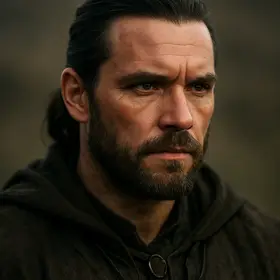 Banquo
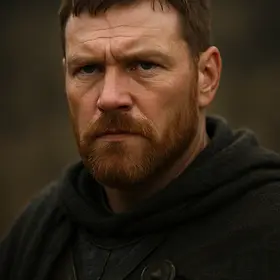 Macduff
 Malcolm
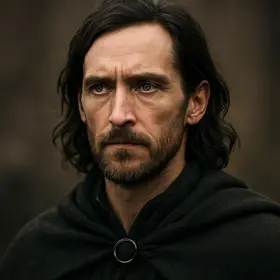 Ross
Ross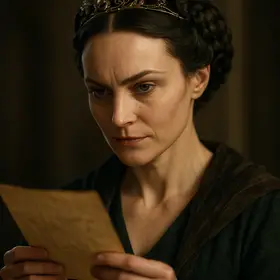 Lady Macbeth
 Lennox
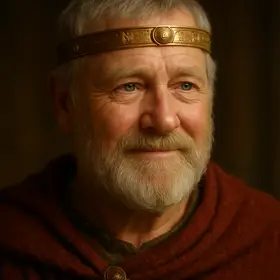 Duncan
All chapter summaries ›Characters ›
Read Macbeth illustrated
Every scene in these notes comes from the Book2Life reader, where the full public-domain text is illustrated as you read, with character portraits and narration. Free in your browser and on iPhone.
